CySEC decided to impose a fine of €400.000 on CIF Goldenburg Group Ltd.
Abstract:The Cyprus Securities and Exchange Commission (CySEC) has recently taken decisive action against CIF Goldenburg Group Ltd (LEI 2138009UJX646ZT32817), a financial services firm, for serious violations of the Investment Services and Activities and Regulated Markets Law of 2017 and the Regulation (EU) 1286/2014 on key information documents for packaged retail and insurance-based investment products (PRIIPs).
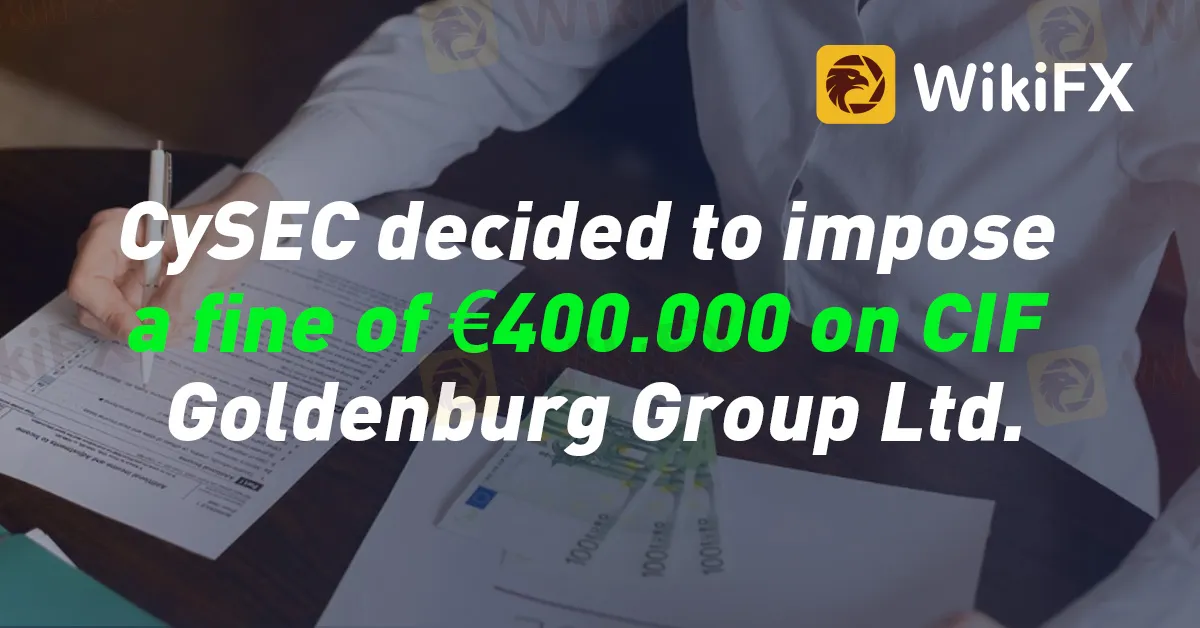

The Cyprus Securities and Exchange Commission (CySEC) has recently taken decisive action against CIF Goldenburg Group Ltd (LEI 2138009UJX646ZT32817), a financial services firm, for serious violations of the Investment Services and Activities and Regulated Markets Law of 2017 and the Regulation (EU) 1286/2014 on key information documents for packaged retail and insurance-based investment products (PRIIPs). At its meeting on May 8th, 2023, the CySEC board decided to impose an administrative fine of €400,000 on the company, holding it accountable for multiple instances of non-compliance and misconduct.
The Violations and Fines
Failure to Ensure Client Interests Amid Conflicts of Interest (€25,000 fine)
During the period of November 1, 2019, to February 28, 2021, CIF Goldenburg Group Ltd failed to comply with the authorization conditions outlined in section 17(3)(a) of the Law. The company neglected to establish and implement effective organizational and administrative arrangements to mitigate conflicts of interest properly. This failure jeopardized the interests of its clients, making the firm liable for a fine of €25,000.
Inadequate Conflict of Interest Management (€25,000 fine)
Between November 1, 2019, and February 28, 2021, the company did not adopt adequate measures to identify, avoid, and manage conflicts of interest between its employees and its customers based in Slovenia. A marketing agent acting on behalf of the company in Slovenia was involved in this conflict, leading to a fine of €25,000.
Breach of Professional Conduct and Client Interest Obligations (€100,000 fine)
From February to November 2020, CIF Goldenburg Group Ltd failed to act fairly, honestly, and professionally while providing investment services to its clients. The actions and practices of the company's employees and those of the marketing agent in Slovenia led to a violation of section 25(1) of the Law. As a result, the company incurred a fine of €100,000.
Misleading Information Provided to Customers (€100,000 fine)
Between February and November 2020, the information addressed to the company's customers residing in Slovenia was found to be inaccurate, unclear, and misleading. This breach of section 25(3) of the Law, as specified in section 44(2) of the Delegated Regulation (EU) 2017/565, resulted in a fine of €100,000.
Incompetent Investment Advice (€50,000 fine)
From February to November 2020, CIF Goldenburg Group Ltd failed to ensure that its employees providing investment advice possessed the necessary knowledge and competence to fulfill their obligations. This violation of section 26(1) of the Law, as specified in the Directive on the Certification of Persons and the Certification Registers, incurred a fine of €50,000.
Failure to Notify the Supervisory Authority (€50,000 fine)
From April 2018 to October 25, 2022, the company neglected to inform the Supervisory Authority of Slovenia (SMA) about the key information documents (KIDs) before posting them on its website, as required by the Slovenian national law. For this breach of section 5(2) of the Regulation (EU) 1286/2014, the company was fined €50,000.
Incomplete Key Information Documents (€50,000 fine)
The company also violated section 8(3) of Regulation (EU) 1286/2014 by failing to include all the prescribed information in the key information documents (KIDs). As a result, the CySEC imposed a fine of €50,000.
Conclusion
The CySEC's decision to impose a substantial fine of €400,000 on CIF Goldenburg Group Ltd sends a clear message about the importance of adhering to regulatory standards and protecting the interests of investors. By taking this robust action, CySEC aims to maintain the integrity of the financial services industry and safeguard investors from potential misconduct. It serves as a warning to all financial entities that non-compliance and inadequate client protection will not be tolerated, and stringent measures will be taken to ensure compliance with the law and regulations.


Read more
PURPLE TRADING Review: Do Withdrawal Delays, Wide Spreads & Customer-Service Complaints Hold Weight?
PURPLE TRADING, a Seychelles-based forex brokerage entity, is constantly criticized by numerous traders on review platforms such as WikiFX. While withdrawal delays or denials are reportedly a common issue here, there are also complaints about wide spreads and poor customer services. This PURPLE TRADING review examines user-reported allegations against the trading enterprise. Additionally, the article takes a close look at the broker’s regulatory status.
Exness Review for Indian Traders 2026: The RBI Question Comes Before Leverage and Spreads
Exness review for Indian traders in 2026. This guide explains what the RBI Alert List says, what it does not say, why a global license is not Indian authorization, and how to verify permitted forex routes before funding an account.
HSB Investasi Review 2026: Is “Instant Withdrawal” Really Under One Minute?
HSB Investasi review 2026: check the Instant Withdrawal claim, the IDR 14 million per-proposal limit, the three-request daily cap, transfer costs, transaction statuses, and what Bappebti data does—and does not—tell traders.

Branded Trading Platform in 2026: When Does Your Brand Become a Real Operating Advantage?
A branded trading platform can look like the fastest route to a modern branded trading environment, but a fast launch is not the same as a controlled launch. This 2026 broker guide explains what the custom trading platform is, where a provider broker solution can sit in a wider operating stack, and how to evaluate the difference between a white label, a server license, and a connected CRM or Client Office setup. It also unpacks proprietary platform costs beyond the monthly headline, including implementation, integration, support, data, governance, migration, and exit assumptions. Use the practical questions, workflow tests, comparison table, and launch checklist to assess a platform provider without mistaking a feature demo for evidence that your brokerage can run the service safely at scale.
WikiFX Broker
Latest News
Traze Review: What Traders Should Know Before Depositing
 WikiFX
Match-Trade Gives AI Direct Access to Broker Trading APIs
WikiFXWhy Sovereign Debt Can Sink a Currency: The Credit Risk Channel
WikiFXUS July CPI Could Take a Fed Rate Hike Off the Table
WikiFXEMAR MARKETS Review 2026: Severe Withdrawal Complaints and Risk Signals
WikiFXBYBIT Review: What Traders Should Know Before Depositing
WikiFXPocket Broker Review: What Traders Should Know Before Depositing
WikiFXIC Markets Global Review for South Asian Traders: A Global License Isn't the Same as Local Permit
WikiFXTrader's Way Review: Trades Vanished Overnight , And There's No Regulator to Call
WikiFXLockwood Review: AMF-Blacklisted Broker with Users Reporting Blocked Withdrawals
WikiFXRate Calc

