Defense industry stocks: key factors to consider in trading
Abstract:The defense industry, an integral part of national security, often captures attention due to its strategic importance and global implications. However, beyond geopolitical considerations, defense industry stocks have become an intriguing area for investors and traders, however you need to go into it with caution.

The defense industry, an integral part of national security, often captures attention due to its strategic importance and global implications. However, beyond geopolitical considerations, defense industry stocks have become an intriguing area for investors and traders, however you need to go into it with caution. With advancements in technology, increasing defense budgets, and evolving global threats, the sector presents a unique investment landscape.
In fact, investors and traders are turning their focus towards the defense sector as the conflict in Ukraine garners increased attention. From aerospace giants to specialized manufacturers, defense industry stocks may offer the potential for substantial returns. But they also raise questions about sustainability, ethical considerations, and the impact of geopolitical events.
In this article, we delve into the world of defense industry stocks, exploring their opportunities, challenges, and the broader implications they entail.
Top defense industry stocks to trade
1. Lockheed Martin stock
Lockheed Martin Corporation (LMT), our top pick, emerged from a merger in 1995 and now holds the position of the world's largest defense company with a market cap of nearly $113.82 billion as at August 2023. Notable shareholders include SSgA Funds Management, the Vanguard Group, and BlackRock Fund Advisors. Their offerings encompass aircraft, helicopters, and guided missiles. Traders may consider adding this stock to their watch list and be on the lookout for compelling technical entry signals.


2. Northrop Grumman Corp. stock
Northrop Grumman Corp. (NOC), headquartered in West Falls Church, Virginia, is a leading supplier of armaments in shipbuilding, aerospace, and information technology. The company's portfolio includes reconnaissance aircraft, stealth bombers, and ICBMs (fortunately not utilized in the Ukraine war). The company boasts significant institutional investors such as SSgA Funds Management, Capital Research & Management Co., and The Vanguard Group. With a market capitalization of over $65.47as at August 2023, it is also worth mentioning that Northrop Grumman consistently engages in substantial share buybacks.
3. Thales shares
Thales (TCFP), the French armaments group with a current market capitalization of €27.42 billion (August 2023), offers a diverse range of devices, systems, and services for air, sea, and ground applications. Their offerings encompass regulation and control systems, communication security systems, as well as infrastructure and data protection solutions such as cryptology and network security management. The largest shareholders of Thales include the French state and Dassault Aviation SA, each holding approximately 25% stakes, followed by employee shareholders with a little over 2% ownership.


4. General Dynamics stock
General Dynamics, based in West Falls Church, Virginia, holds a market capitalization of approximately $61.30 billion (August 2023). The company specializes in a diverse range of military aircraft, land and marine vehicles, weaponry, and ammunition. Notably, General Dynamics is involved in the development of satellite-based weapons systems. With its subsidiary, General Dynamics European Land Systems (GDELS), the company operates in Germany, Austria, Spain, and Switzerland, manufacturing armored and amphibious vehicles.


Read more
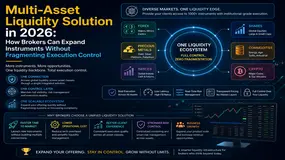
Multi-Asset Liquidity Solution in 2026: Expand Instruments Without Fragmenting Execution
A multi-asset liquidity solution can help a broker support FX, CFDs, commodities, and indices through a more unified operating model. But adding asset classes can also create fragmented symbols, pricing, routing, margin rules, records, and client messages if controls are not designed first. This 2026 guide explains how a multi asset liquidity provider, forex CFD liquidity setup, commodity liquidity provider, and indices liquidity provider fit into a broker-owned execution service. It outlines the due-diligence questions, shared-control model, cost drivers, and 90-day implementation plan that help teams expand without making the execution chain harder to explain. The aim is not to promise deeper liquidity or better trading outcomes. It is to create evidence that a broker can supervise market access, trace order events, reconcile costs, and communicate consistently to the relevant clients when conditions are difficult.

XAU/USD Hits $4,500: Washington Bought Bonds—and Gold Exploded
Gold surged above $4,500 after the US Treasury expanded its purchases of longer-dated government bonds, pushing yields and the dollar lower. But this was not debt forgiveness or Federal Reserve money printing—it was a liquidity operation that exposed a much bigger fear: America may be finding it increasingly difficult to live with market-driven interest rates.
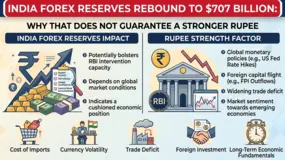
India Forex Reserves Rebound to $707 Billion: Why That Does Not Guarantee a Stronger Rupee
India forex reserves rose by $14.136 billion to $707.002 billion in the week ended 7 August 2026. This explainer separates RBI forex-reserve facts from rupee predictions, explains the role of foreign currency assets and gold, and gives forex-market readers a practical checklist before treating one headline as a trading signal.

Prime of Prime Forex in 2026: The Credit and Control Questions Brokers Must Answer Before Connecting
A Prime of Prime forex arrangement can help a broker access trading relationships, credit intermediation, technology connectivity, and liquidity aggregation that may otherwise be difficult to obtain directly. But the label does not prove direct bank access, executable depth, or a particular execution outcome. This 2026 guide explains what a forex Prime of Prime, PoP liquidity provider, prime brokerage forex service, and forex prime broker proposal can mean in practice; where the credit and order-routing chain must be documented; how to test pricing, limits, rejects, records, and resilience; and which commercial terms create hidden operating cost. Use the comparison framework, red-flag list, and 90-day launch plan to assess fit for your client mix and risk model. The objective is a controllable execution dependency with traceable evidence, not a marketing claim about institutional access.
WikiFX Broker
Latest News
KATOPRIME Review: Unregulated and Risky, With Withdrawal Complaints to Verify
 WikiFX
DFSA Warns of Scam Impersonating Firm Menhir Capital
WikiFXMiri man loses RM511,406 to fake online investment scheme
WikiFXReview 2026: EMAR MARKETS Complaints, Regulation, and Account Access Risks
WikiFXReview 2026: STMARKET Regulation, MT5 Access, and Withdrawal Complaint Signals
WikiFXDFSA warns of scam cloning authorised firm Menhir Capital
WikiFXSingapore orders Facebook, Instagram, TikTok to ban scam ads
WikiFXNAFEM turnover hits $1.41bn, highest in five weeks
WikiFXBessent says Treasury buyback operation could be more than $4 billion
WikiFXTPFx Review 2026: An A+++ Result and an Impersonation Warning - What to Check Before Funding
WikiFXRate Calc

