Bank of America gains 3% after earnings ???? Goldman Sachs loses
Abstract:Bank of America, the second largest bank in the United States, witnessed a surge of over 3% in its shares today. This notable uptick can be attributed to the bank surpassing predictions and achieving a 10% year-on-year improvement in profits.

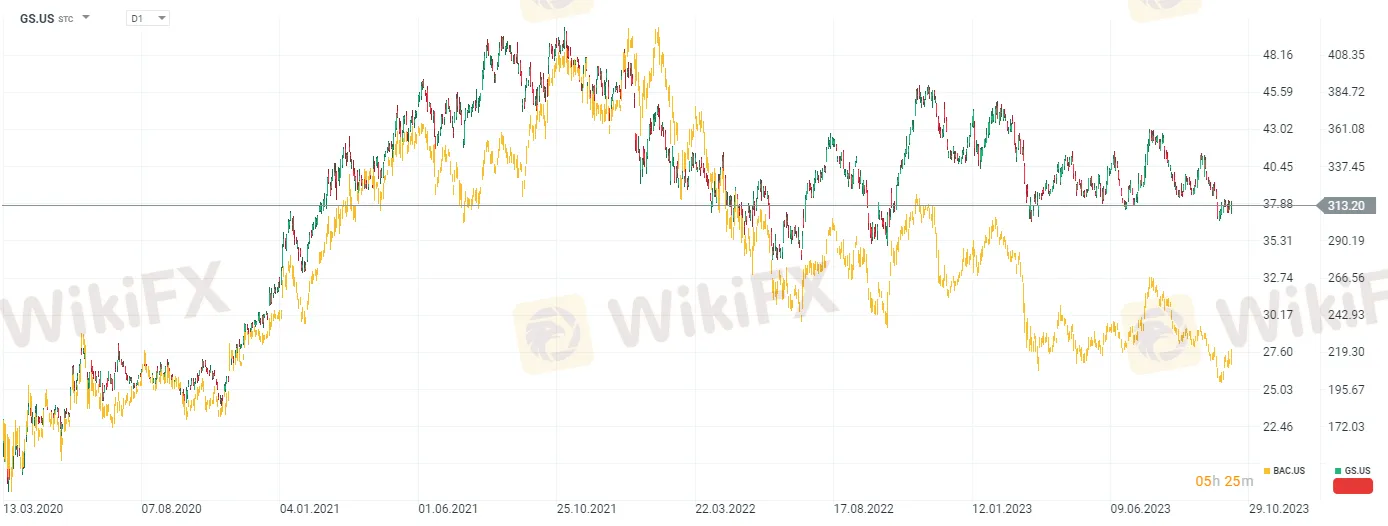
Bank of America, the second largest bank in the United States, witnessed a surge of over 3% in its shares today. This notable uptick can be attributed to the bank surpassing predictions and achieving a 10% year-on-year improvement in profits. Contrarily, Goldman Sachs experienced a decline of approximately 0.5% following the release of their earnings report. The outcomes were met with caution by Wall Street, as the net profit of Goldman Sachs witnessed a substantial 33% year-on-year decrease. Despite slightly exceeding expectations in terms of revenue, investors remained hesitant to purchase shares in the company.
Bank of America (BAC.US)
The bank earned nearly $7.8 billion, compared to $7.1 billion a year earlier. Profits were mainly provided by investment banking and higher interest rates, which improved interest income. Of course, at the same time, the bank reported higher losses on its bond portfolio, which already stands at $131.6 billion compared to $105.8 billion at the end of Q2. The bank plans to hold them to maturity, of course (it doesn't have to realize losses if it never sells the bonds, but it can't invest or borrow these funds at higher rates while it holds them). Bank President Moynihan signaled that consumer spending is weakening.
• Revenues: $25.32 billion vs. $25.14 billion forecast (3% y/y growth)
• Earnings per share (EPS) $0.9 vs. $0.83 forecasts and $0.81 in Q3 2022 10% y/y increase
• Allowance for credit losses: $931 million vs. $520 million in Q3 2022
• Total loan loss provisions: $1.23 billion vs. $1.3 billion forecasts
• Interest income: $14.4 billion vs. $14.1 billion forecasts (4% y/y increase)
• Investment and wealth management division revenue: $5.32 billion vs. $5.34 billion forecasts
• Total deposits: $1.88 trillion vs. $1.77 trillion forecasts
• CET1: 13.5% vs 13.2% forecasts
Wells Fargo analysts described BofA's quarter as 'good' - albeit weaker than JP Morgan or Citi. At the same time, the institution continues to grow despite concerns about the economy. The CEO pointed out that the number of customers grew 'across all business segments. The bank has 'made a name for itself' for its very high exposure to bond losses, which it accumulated more intensively than its competitors during the coronavirus pandemic - as a result, the loss on them weighs on it now and makes the bank more vulnerable to rising yields. According to UBS analysts, this remains the main reason for the discount in valuation against other major US banks.
Goldman Sachs (GS.US)
Goldman Sachs beat Wall Street forecasts primarily due to a stronger-than-expected bond trading result. In a commentary on the results, Goldman pointed to the growing popularity of 'fixed income' and hiptrades, which helped offset declines in foreign exchange, commodities and credit (FICC) trading. Revenues from financing fixed-income instruments reached a record $730 million. Revenues from equity and derivatives trading rose 8% year-on-year to nearly $3 billion thanks to estimates of $2.8 billion.
• Revenues: $11.82 billion vs. $11.19 billion forecast (down 1% y/y)
• Earnings per share (EPS): $5.47 vs. $5.31 per share (down 33% y/y)
• Investment banking revenue: $1.55 billion vs. $1.48 billion forecast (1% increase y/y)
Trading and consulting accounted for two-thirds of the bank's revenues last quarter, and it is still 'trading' that remains its main source of profits and revenues. In 2023, mergers, IPOs and debt issuance failed to 'harvest' in an environment of higher rates and expensive debt. The bank also pointed to write-downs on losses related to commercial real estate. The bank recorded a write-down of $506 million (GreenSky loans) and $358 million from CRE properties in Q3.
Wells Fargo analysts commented on the results as below average in the face of higher costs and net returns below target. At the same time David Solomon, Goldman CEO indicated that he has never been so optimistic about Goldman Sachs despite fotness in consumer business about which he hears from CEOs.
Tomorrow, before the US session, Morgan Stanley (MS.US) publishes its results.


Read more
Exness Review for Indian Traders 2026: The RBI Question Comes Before Leverage and Spreads
Exness review for Indian traders in 2026. This guide explains what the RBI Alert List says, what it does not say, why a global license is not Indian authorization, and how to verify permitted forex routes before funding an account.
HSB Investasi Review 2026: Is “Instant Withdrawal” Really Under One Minute?
HSB Investasi review 2026: check the Instant Withdrawal claim, the IDR 14 million per-proposal limit, the three-request daily cap, transfer costs, transaction statuses, and what Bappebti data does—and does not—tell traders.

Branded Trading Platform in 2026: When Does Your Brand Become a Real Operating Advantage?
A branded trading platform can look like the fastest route to a modern branded trading environment, but a fast launch is not the same as a controlled launch. This 2026 broker guide explains what the custom trading platform is, where a provider broker solution can sit in a wider operating stack, and how to evaluate the difference between a white label, a server license, and a connected CRM or Client Office setup. It also unpacks proprietary platform costs beyond the monthly headline, including implementation, integration, support, data, governance, migration, and exit assumptions. Use the practical questions, workflow tests, comparison table, and launch checklist to assess a platform provider without mistaking a feature demo for evidence that your brokerage can run the service safely at scale.
Market10 Review 2026: Withdrawal Delays and Missing Funds Raise Questions
Has your trading experience with Market10, a South Africa-based brokerage entity, been miserable? Did you fail to receive funds in your trading account despite approvals on the Market10 login dashboard? Did the broker constantly push you into depositing while withholding your earlier funds? In this Market10 review, we have shed light on the growing allegations against the broker. Additionally, we have provided an overview of the broker’s regulatory status.
WikiFX Broker
Latest News
iFX Brokers Review: Is Your Deposit Safe?
 WikiFX
ONE ROYAL Faces SCM Malaysia Warning , What Traders Should Verify Before Funding an Account
WikiFXASIC Crackdown Hits 5-Year High: 150 Rogue Operators Banned
WikiFXMoneycorp Review: Is This Broker’s License Really Telling the Truth?
WikiFXBYBIT Review: Unregulated Broker Warning After Withdrawal Complaints and Forex Profit Disputes
WikiFXSECP Refers Blink Capital to FIA Over Rs446.6m Alleged Fraud
WikiFXHow to Start a Forex Broker in 2026: Build the Operating Model Before You Buy the Platform
WikiFXEMAR MARKETS Review 2026: Severe Withdrawal Complaints and Risk Signals
WikiFXTrader's Way Review: Trades Vanished Overnight , And There's No Regulator to Call
WikiFXLockwood Review: AMF-Blacklisted Broker with Users Reporting Blocked Withdrawals
WikiFXRate Calc

