Daman Markets Review: Regulation, Scam Warnings & Forex Trading Insights
Abstract:Is Daman Markets a scam? Uncover Daman Markets regulation status, WikiFX score, and critical exposure cases. Get vital insights before you login or trade Forex with Daman Markets. Read our review now!
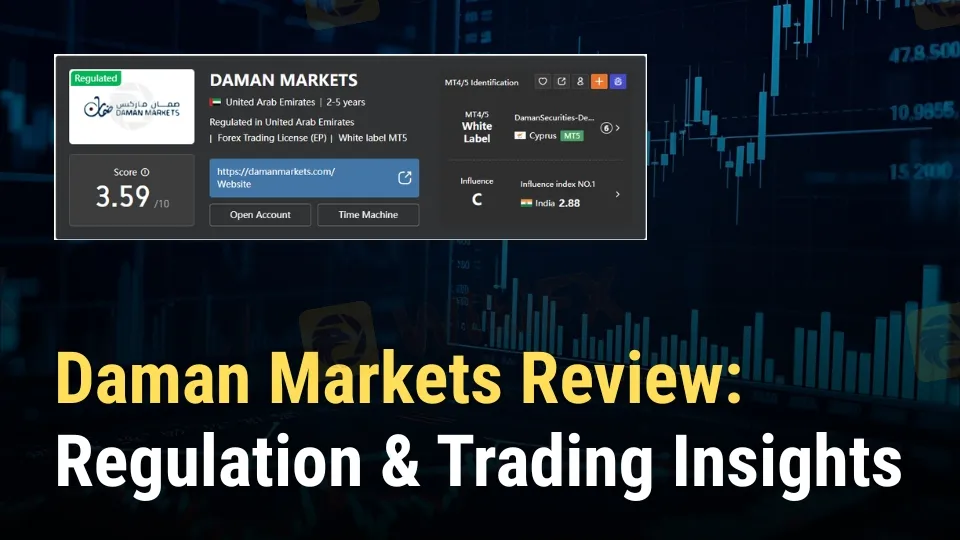
Daman Markets: Claims vs. Reality in Regulation
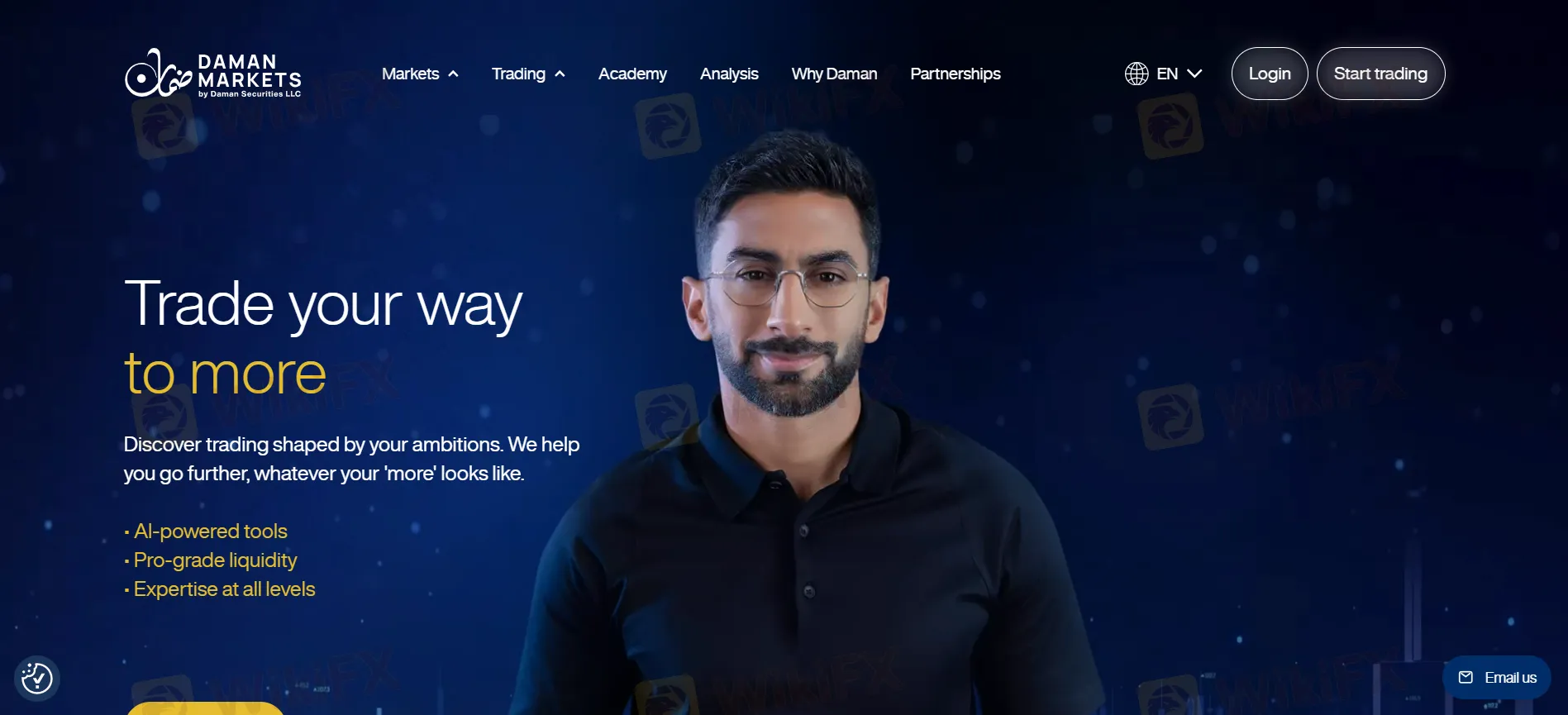
Daman Markets, operating under Daman Securities LLC, presents itself as a premier forex broker based in the United Arab Emirates (UAE). The company offers a variety of trading instruments, including Forex, commodities, indices, and cryptocurrencies, primarily through the MetaTrader 5 (MT5) platform. A key pillar of their marketing is their regulatory status; they claim to be regulated by the UAEs Securities and Commodities Authority (SCA) under license number 20200000043.
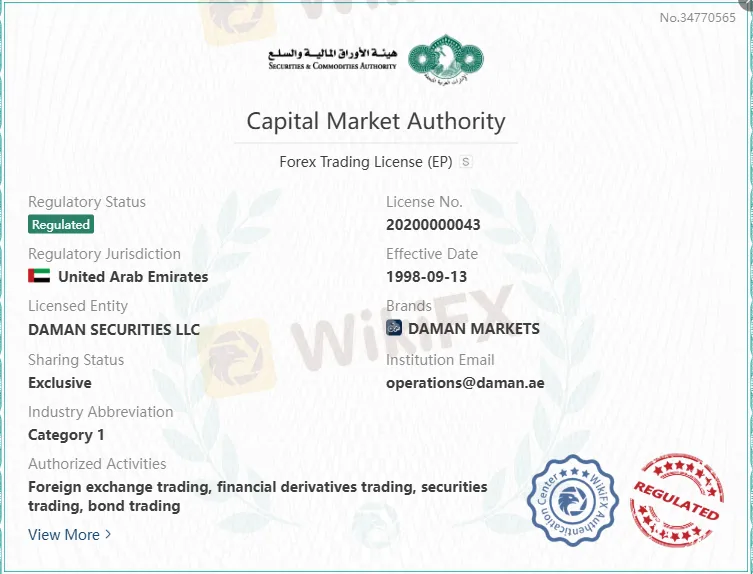
WikiFX, a prominent global forex broker regulatory inquiry platform, confirms that Daman Markets does indeed hold a CMA Regulated Forex Trading License (EP). However, this confirmation of Daman Markets regulation is immediately overshadowed by severe warnings. Despite its regulated status, WikiFX flags the broker with a “High potential risk” label and explicitly advises traders to “stay away”. This stark contrast between official regulation and independent risk assessment highlights a crucial reality in the forex industry: holding a license does not automatically guarantee a safe or reliable trading environment. The presence of negative field survey reviews further complicates the narrative, suggesting that the operational reality of broker Daman Markets may significantly diverge from its regulated facade.
WikiFX Score: A Critical Red Flag
The concerns surrounding Daman Markets are quantified by its alarmingly low WikiFX score of 3.59 out of 10. This comprehensive rating evaluates various aspects of a brokers operations, and a score this low is a definitive red flag for anyone considering to review Daman Markets or engage in Forex trading on their platform.
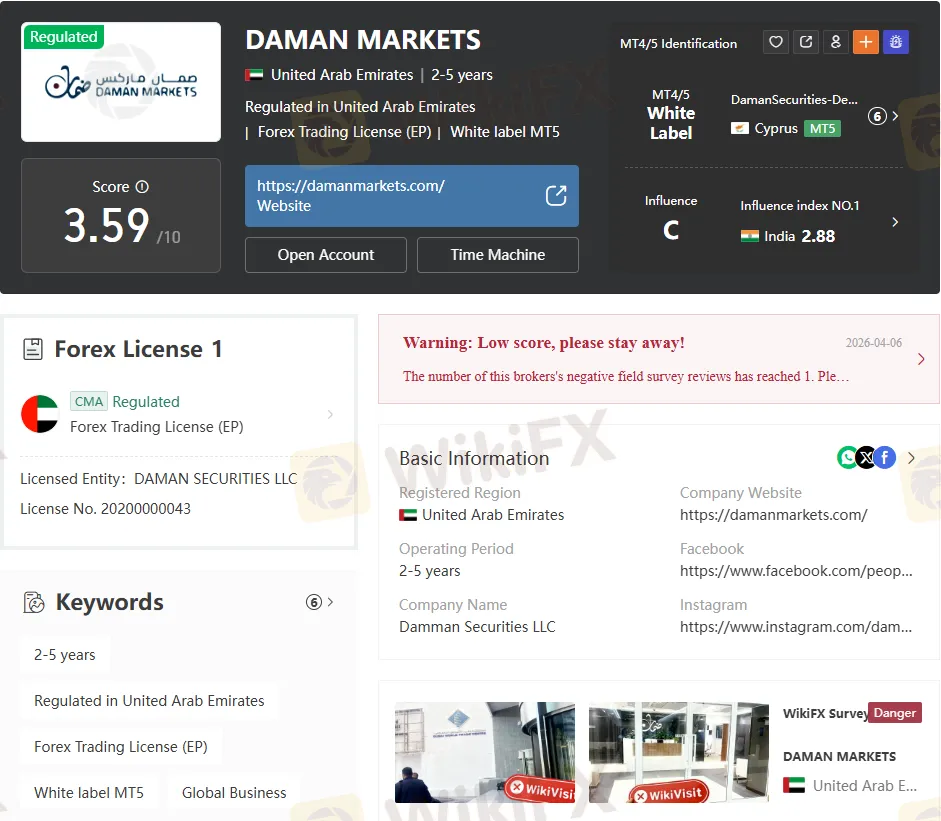
Delving deeper into the sub-indices reveals even more troubling metrics. While the Regulatory Index sits at 4.62, reflecting the existence of the SCA license, the Risk Control Index is a stark 0.00. This indicates a complete absence of effective risk management protocols, leaving traders highly vulnerable to market volatility and potential platform irregularities. The low overall score, coupled with a zero in risk control, serves as a critical warning that the foundational security measures expected of a reputable broker are severely lacking, making any decision to login Daman Markets a highly risky proposition.
Recent Exposure Cases
The theoretical risks indicated by the low WikiFX score are unfortunately substantiated by real-world user experiences. A critical exposure case reported on WikiFX in late 2025 illustrates the severe issues traders may face:
- Case 1 (October 7, 2025): A user identified as “FX5145712720,” operating from Basra, Iraq, filed a severe exposure report against Daman Markets. The user detailed a harrowing experience where, upon attempting to withdraw their funds, the broker demanded the payment of a “high tax amount”. Following this demand, the broker allegedly blocked the users account entirely. The user unequivocally labeled Daman Markets a “scam platform”.
This specific incident highlights a classic tactic often associated with fraudulent operations: creating artificial barriers to withdrawal, such as unexpected “taxes” or “fees,” followed by account termination. Furthermore, WikiFX explicitly notes that “The number of this brokers negative field survey reviews has reached 1,” reinforcing the severity and credibility of these allegations. Such reports are a dire warning for anyone considering Forex Daman Markets services.
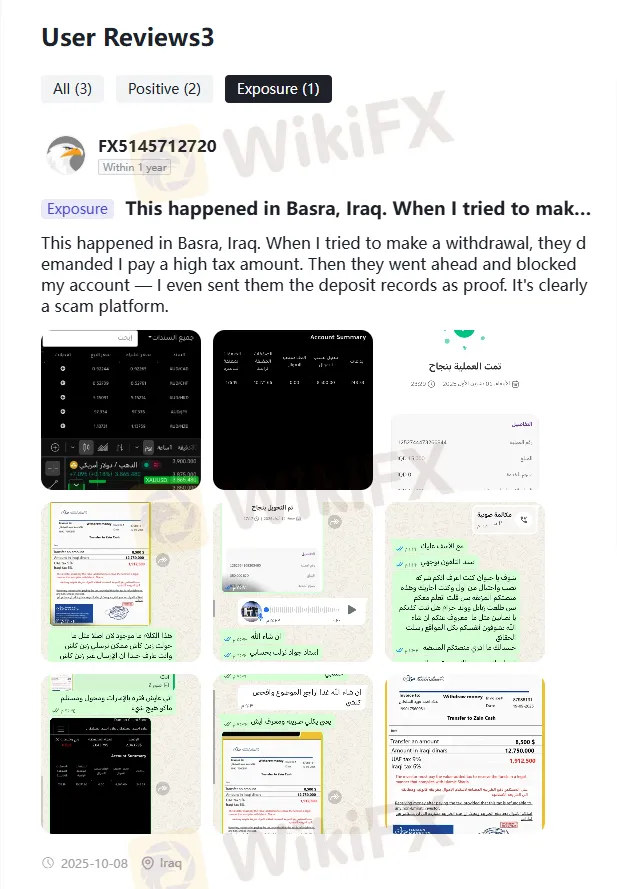
Check out here for more Exposure Cases reported.
Why WikiFX Matters: Investor Awareness
The case of Daman Markets underscores the indispensable role of independent platforms like WikiFX in the modern trading landscape. WikiFX issues a clear and unambiguous warning: “Low score, please stay away! The number of this brokers negative field survey reviews has reached. Please be aware of the risk and the potential scam!”.
This situation perfectly illustrates why traders cannot rely solely on a brokers self-proclaimed regulatory status. While regulation Daman Markets claims is technically valid, the independent assessment reveals a high-risk environment plagued by poor risk control and severe user complaints regarding fund withdrawals. Platforms like WikiFX aggregate these crucial data points—regulatory verification, risk indices, and real user exposures—providing a holistic view that is essential for conducting thorough due diligence. Relying on such comprehensive resources is the most effective way to navigate the complexities of the forex market and avoid potential pitfalls.
Conclusion: Proceed with Extreme Caution
In conclusion, a thorough Daman Markets review reveals a highly concerning profile. While the broker operates under Daman Securities LLC and holds a verifiable license from the UAEs SCA, independent analysis by WikiFX paints a vastly different picture. The critically low trust score of 3.59/10, a Risk Control Index of 0.00, and explicit warnings of “High potential risk” strongly contradict the security typically associated with regulated entities.
Furthermore, the documented exposure case from October 2025, detailing severe withdrawal issues, demands for unexpected “taxes,” and subsequent account blocking, solidifies the high-risk assessment. Prospective traders are strongly advised to exercise extreme caution. The combination of a low trust score and serious allegations of financial misconduct suggests that choosing to login Daman Markets or engage in Forex trading with this broker carries significant risk. Prioritizing brokers that demonstrate not only verifiable regulation but also high trust scores and a proven track record of reliable client service is paramount for safeguarding investments.


Read more
eToro Review 2026: Why Some Users Report Withdrawal Problems - and What the Evidence Shows
eToro, a United Kingdom-based brokerage entity, is facing serious user allegations concerning the basic facility a trader expects - Fund Withdrawal. Users worldwide are complaining about the lack of a withdrawal option, account restriction, and lack of customer support in real time. Many of their complaints appeared on credible broker review platforms such as WikiFX. In this eToro review, we have examined these complaints.
Fortex White Label in 2026: Can Your Liquidity Stack Scale Without Losing Control?
A Fortex white label can look like the fastest route to a modern branded trading environment, but a fast launch is not the same as a controlled launch. This 2026 broker guide explains what the Fortex platform is, where a Fortex broker solution can sit in a wider operating stack, and how to evaluate the difference between a white label, a server licence, and a connected CRM or Client Office setup. It also unpacks Fortex cost beyond the monthly headline, including implementation, integration, support, data, governance, migration, and exit assumptions. Use the practical questions, workflow tests, comparison table, and launch checklist to assess a Fortex provider without mistaking a feature demo for evidence that your brokerage can run the service safely at scale.
Spreadex Review: Wider Spread & Unexplained Account Closure Allegations for This 2-Decade-Old Broker
Did you incur trading losses on the Spreadex platform due to wider spreads? Have you experienced delays in trade processing by the United Kingdom-based forex broker? Has your Spreadex trading account been closed without any explanation? You are not alone! Many traders have expressed concerns on online broker review platforms. In this Spreadex review 2026, we have covered user allegations and provided a regulatory framework the broker operates under.
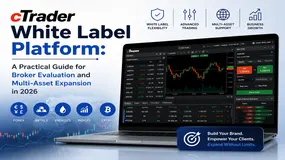
cTrader White Label Platform: A Practical Guide for Broker Evaluation and Multi-Asset Expansion in 2
A broker can launch a white-label platform quickly and still fail the first serious operating test. The failure often begins quietly: an assets expansion has been approved, the client app is branded, and a new account journey looks complete. Then a client asks why a trade-related status, funding hand-off, or account restriction looks different across channels. Support cannot see the same reference trail as operations. The product owns the screen, but no one owns the explanation. The issue is not a missing feature. It is an untested operating model. That is why a cTrader white label platform should be evaluated as a route to a multi-asset service - not as a shortcut to a more attractive terminal. The central question is whether the broker can add instruments, client channels, integrations, and service capacity without making its controls harder to operate or explain.
WikiFX Broker
Latest News
FxPro Review: Is This 1.80-Rated Broker Safe for Your Funds?
 WikiFX
Razor Markets Review: What Traders Should Know Before Depositing
WikiFXAGILE GLOBAL LIMITED Review: What Traders Should Know Before Depositing
WikiFXMASTER MIND CAPITALS Review: Withdrawal Complaints Pile Up Against This Unregulated Broker
WikiFXMangaluru Woman, 61, Loses Rs 16.2 Lakh in Facebook Scheme
WikiFXATFX Trading Volumes Drop 29% After Record Q1
WikiFXWhy a 90% Win Rate Can Still Lose You Money
WikiFXAI GOLD Review: Is Your Deposit Safe?
WikiFXFD Review: What Traders Should Know Before Depositing
WikiFXOANDA Broker: Regulated but Is It Really Safe for Traders?
WikiFXRate Calc

