Think Forex Support and Resistance Always Work? High-Impact News Can Prove You Wrong!

Abstract:Forex traders often have to come to terms with these two popular concepts - Support and Resistance. A support level refers to the point where buyers have historically come together to prevent the price from sliding further. On the other hand, the point of resistance is where sellers have historically limited upward movement. These two levels form the foundation of many trading strategies employed by traders to spot entry, exit and stop-loss points. However, many beginners begin to think that these price levels are unbreakable. Such assumptions can go horribly wrong during high-impact economic news releases such as inflation reports, employment data, monetary policy announcements by the central bank or any other major news events. These events can trigger price movements so much that even the strongest support and resistance levels can crack within seconds.
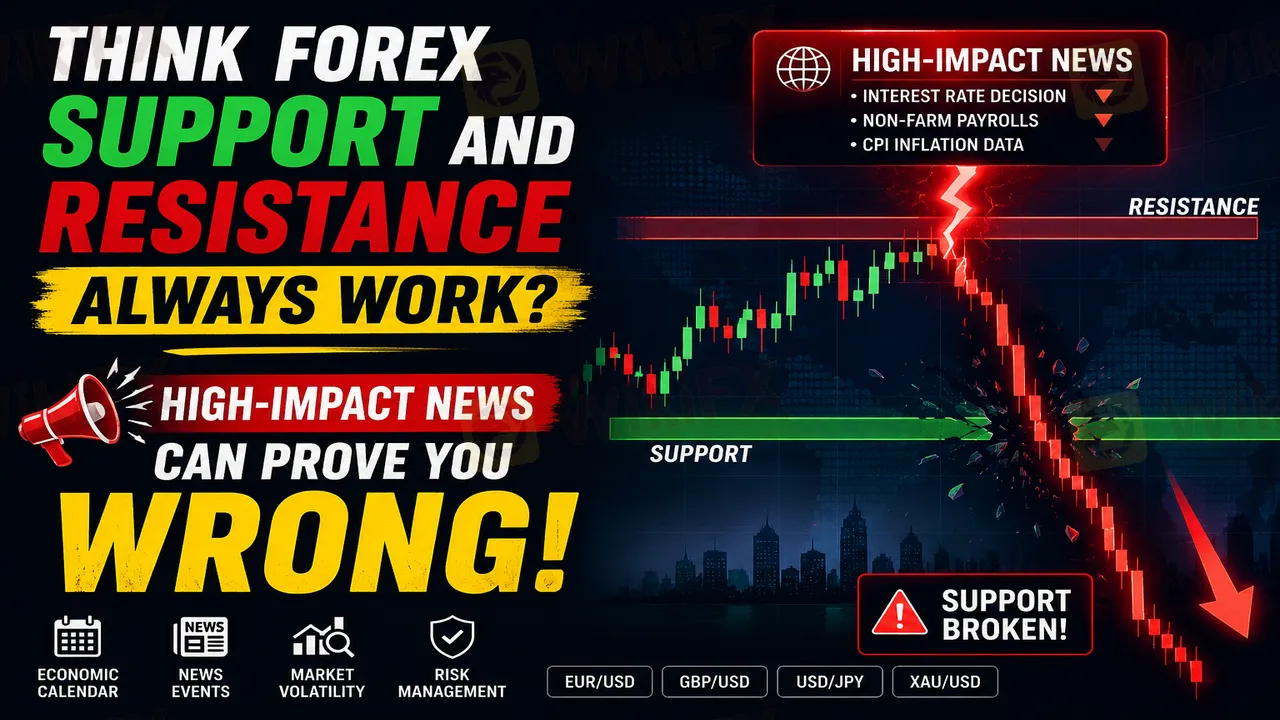
Forex traders often have to come to terms with these two popular concepts - Support and Resistance. A support level refers to the point where buyers have historically come together to prevent the price from sliding further. On the other hand, the point of resistance is where sellers have historically limited upward movement. These two levels form the foundation of many trading strategies employed by traders to spot entry, exit and stop-loss points.
However, many beginners begin to think that these price levels are unbreakable. Such assumptions can go horribly wrong during high-impact economic news releases such as inflation reports, employment data, monetary policy announcements by the central bank or any other major news events. These events can trigger price movements so much that even the strongest support and resistance levels can crack within seconds.
What Makes Support and Resistance Work Most of the Time?
Its the market psychology that makes support and resistance levels exist. Traders often remember the prices where markets reversed previously, creating several buy and sell orders around such levels. Hedge funds, retail traders and institutional traders usually monitor these levels, allowing them to reinforce under normal market conditions.
For instance, if EUR/USD constantly finds buying signals around 1.1500, traders start considering that level as strong support. At the same time, if this currency pair finds it hard to move past 1.1600 many times, it converts into a recognized resistance level. These levels usually lead to temporary reversals or price consolidation under normal market conditions, allowing traders to enter or exit trades.
The Changes Brought by High-Impact News
The fresh information emerging from high-impact news often leads to a change in market expectations. Events, such as the Consumer Price Index (CPI), Non-Farm Payrolls (NFP) and Federal Reserve interest rate decisions or any geopolitical developments, often make traders reassess the currency value almost immediately. These events prevent markets from reacting primarily to historical levels. Rather, the market starts reacting to new economic information.
Suppose the EUR/USD pair has gone beyond a strong support level for several days. If a stronger-than-expected US jobs report significantly raises confidence in the USD, aggressive selling may overwhelm buyers. The previously held support level for multiple times may break with little hesitation. During these times, fundamental developments take precedence rather than technical analysis, for the short term only.
False Signals Due to Increased Volatility
Major news releases come with a sharp rise in market volatility. They may trigger a sudden and sharp price movement within seconds. This will likely make technical signals less reliable. This often leads to false breakouts. Prices may break above resistance for a brief period and then reverse sharply as the initial order wave subsides. At the same time, support may appear broken before buyers quickly regain control. This quick back-and-forth movement usually triggers stop-loss orders on both sides of the market before a clearer direction emerges. Inexperienced traders can make emotional decisions and face unnecessary losses due to these sudden price swings.
Liquidity Can Deplete
High-impact news can lead to reduced market liquidity. Despite increased possibilities of high trading volume, many liquidity providers raise spreads or decrease available liquidity due to increased uncertainty. The likely fewer resting orders around key price levels can easily make relatively large market orders push prices through support or resistance compared to normal trading hours.
So, How Can Traders Protect Themselves During High-Impact News Scenarios?
Technical analysis is as important as fundamental analysis. However, one must understand the limitations major news events can leave you with while trading. You can reduce unnecessary risks by adopting these habits.
- Keep an eye on the economic calendar before opening new positions.
- Check whether high-impact news is for the currency pair you intend to trade.
- Wait until the initial volatility settles before seeking support or resistance for trade entries.
- Cut position sizes during news events if you want to stay in the market.
- Remember to use stop-loss orders and be prepared to face slippage (if any) in a fast-moving market.
Final Thoughts
Support and resistance are powerful tools, but they are not guarantees. During high-impact news events, fresh economic information, heightened volatility, and changing liquidity conditions can quickly overpower historical price levels. Rather than assuming these levels will always hold, traders should treat them as probability zones instead of fixed barriers.
By monitoring the economic calendar, managing position sizes, and combining technical analysis with fundamental awareness, traders can better navigate periods of elevated market volatility and avoid costly surprises when the next major news release hits the Forex market.
Download the WikiFX app for more such insightful forex updates.

Interesting Articles for You
Review 2026: I’m Unable to Receive My Profits. We Investigated This Common User Allegation.
Read more

Is TradingPRO Safe? FCA Warning, Indonesia Blocklist Evidence, and 7 Checks Before You Deposit
This Trading Pro broker review checks the FCA warning, Indonesia blocklist evidence, licence claims, and what South Asian users should verify before depositing.
MT4 White Label Cost in 2026: What Brokers Must Budget Beyond the Platform Fee
The visible fee in an MT4 white label proposal is rarely the real cost of operating it. For an existing broker, the decision is not simply whether an MT4 white label platform is “cheap” or “expensive.” The real question is whether the commercial model remains viable after integration, support, data, client migration, compliance, and exit costs are included. That is why an MT4 white label cost review should be built as a 24- to 36-month operating case. It should compare three credible choices: 1. Keep the present MT4 setup and improve its weakest controls. 2. Replace the MT4 white label provider but retain the client proposition. 3. Migrate selected clients or products to another platform while running MT4 in parallel. This guide explains how to build that case without relying on headline prices or generic vendor claims.

The Rise of Deepfake Investment Scams: ASIC Shares Key Warning Signs
Artificial Intelligence (AI) has grown remarkably recently. However, it has also amplified the scope for financial fraud. One such is the rapid use of deepfake technology involving AI-generated videos, images and audio clips imitating real people. Fraudsters are leveraging these technologies to impersonate financial advisers, celebrities, business leaders and government officials to lure victims into fake investment schemes. Understanding the emerging implications, the Australian Securities and Investments Commission (ASIC) has cautioned investors of investment avenues promoted through convincing AI-generated content. Seemingly authentic, deepfakes are designed to manipulate trust and make people transfer funds before authenticating the investment’s legitimacy.

Best White Label Trading Platform 2026
The decision to switch white label providers or migrate to a modern white label trading platform is no longer a luxury for growth-minded brokers—it's a strategic necessity for survival in 2026. The convergence of technological stagnation, regulatory evolution, and shifting client expectations has created a perfect storm.
WikiFX Broker
Latest News
Alpari Review 2026: Official Warnings and High Complaint Patterns
WikiFXM4Markets Broker Review: Regulation, Licenses and WikiScore Analysis
WikiFXTHINK MARKETS Broker Might Not Want You To See This
WikiFXFBS Review: Is Your Deposit Safe?
WikiFXPocket Broker Review: Can You Actually Withdraw Your Money?
WikiFXThe broker test: What black swans teach about real risk control
WikiFXHow to Lock In Profits and Create a Zero-Risk Trade
WikiFXIG Review: Broker Complaints Collide With Mixed Regulation Signals
WikiFXHow to Spot Your First Trial Short on H1 After a Break
WikiFXSTARTRADER Adds SK Hynix CFD Days After $26.5B US Listing
WikiFXRate Calc

