Break the Habit of Adding to Your Losing Trades

Abstract:Many beginner Forex traders trap themselves by adding to losing trades in hopes of averaging down. This article explains the psychological trap of the sunk cost fallacy and provides a simple, logical question traders can ask themselves to cut their losses before blowing up their accounts.
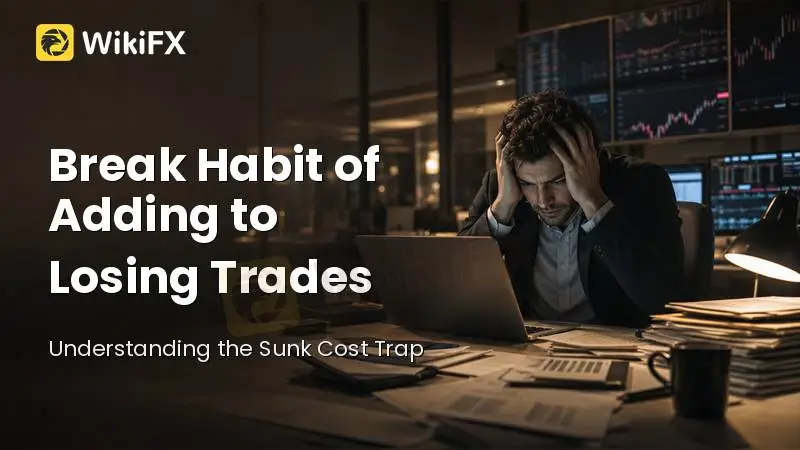
You have likely been in this exact situation. You open a buy position on a major pair like EUR/USD, fully expecting the price to rise. Instead, the market immediately moves against you. Your screen turns red, and a floating loss stares back at you.
As the price drops lower, a dangerous thought crosses your mind: if you open a second buy position right here, you can lower your average entry price. That way, the market only needs to bounce back halfway for you to break even.
This strategy is often called averaging down, and for beginner Forex traders, it is one of the fastest ways to blow up a trading account. The urge to rescue a bad trade is rarely driven by logic. It is almost always driven by a psychological trap known as the sunk cost fallacy.
Understanding the Sunk Cost Trap
In economics, a sunk cost is money, time, or effort that has already been spent and cannot be recovered. A rational person should make future decisions based solely on future odds, completely ignoring the sunk cost.
However, human beings are rarely rational when losing money. Behavioral economists have found that we suffer from “loss aversion.” This means the mental pain of losing money is much stronger than the pleasure of making the same amount. When your trade is deeply in the red, closing it means accepting the loss and making it a permanent reality. To delay that pain, you hold on to the trade.
We also suffer from commitment bias. Once you make a decision to buy, your brain wants to prove that your original analysis was right. Admitting you were wrong is uncomfortable. So, instead of accepting a small loss early, you dig your heels in. You hold the losing trade, and you might even pour more margin into it by opening a second or third position, desperately hoping a market reversal will save you.
The reality is that the Forex market does not know or care about your entry price. A bad trade does not suddenly become a good one just because you are running out of margin.
The Question That Saves Your Capital
When you are trapped in a bad trade and feel the intense urge to add another position, you need a way to snap out of your emotional state. You can do this by using a psychological trick called the reverse deduction method.
Stop looking at your floating loss for a second and ask yourself one simple question:
“If I had absolutely no open positions right now, would I confidently open a new trade at this exact price?”
Look at the chart with fresh eyes. Look at the current trend, the momentum, and your technical indicators. If you were flat—meaning your account had zero open trades—would you truly see the current price as a high-probability entry point?
Almost every time, the honest answer is no. If the chart is in a heavy downtrend, you would never randomly choose to buy into it.
If you would not enter a new trade at that price, you have absolutely no business holding your current position, and you certainly have no business adding more money to it. If the answer is no, you must cut the loss immediately.
Focus on the Next Opportunity
Walking away from a sunk cost requires discipline. It hurts to close a trade at a loss, but it is a necessary survival skill in the Forex market.
Professional traders do not hold onto terrible setups just because they have already committed money to them. They set a limit before they even enter the market, usually in the form of a strict Stop Loss. If the market hits that limit, they exit without hesitation.
Your goal is to protect your remaining capital so you can deploy it on future trades that actually make sense. The money you lose on a bad trade is gone, but the margin you save by cutting the loss early is the capital you will use to catch tomorrow's best opportunities.
Becoming a steady trader means controlling the elements you actually have power over. You cannot force a currency pair to reverse. You can, however, control your daily risk, you can control your emotions when a trade goes wrong, and you can control the safety of your funds by using tools like the WikiFX app to verify your brokers regulatory status before you deposit. Keep your focus on protecting your account, cut your losing trades when your logic tells you they are broken, and never let a sunk cost dictate your next move.


WikiFX Broker
Latest News
Axim Trade Review: Withdrawal Alarms, Weak Regulation, and a Broker Risk Traders Cannot Ignore
WikiFXTracking Institutional Footprints Before the Market Reverses
WikiFXHow Trailing Stops Protect Profits in Forex Day Trading
WikiFXYen Weighs Intervention Risks as Dollar Steadies
WikiFXHow Forex Scalping Targets Small Price Gap Movements
WikiFXFizmo Fx Markets Review 2026: Complaints, Withdrawals, and Risk Signals
WikiFXSEVEN STAR FX Review 2026: Unregulated Status, Complaints, and Key Risks
WikiFXCabana Capital Review 2026: Unregulated Warnings and Withdrawal Risks
WikiFXFortune Prime Global Review 2026: Should You Trade with This Broker?
WikiFXHong Kong SFC Requires Brokers to Strengthen Account Security Against Phishing Risks
WikiFXRate Calc

