How Malaysian Companies Get Caught by USD Exchange Rate Risk

Abstract:This article explains how Malaysian companies become exposed to USD exchange rate risk through real-world trade and borrowing scenarios, using a simple hypothetical example.

What is USD exchange rate risk?
Foreign exchange risk, or forex risk, is the chance that a companys financial result will change because the exchange rate between the ringgit and a foreign currency moves. For Malaysian businesses, the US dollar is usually the most important foreign currency because international trade is frequently priced in USD. When a company has costs, revenues, assets, or borrowings denominated in US dollars, any shift in the USD/MYR exchange rate can create an unexpected gain or loss, even if the underlying business decision was sound.
This risk is sometimes called currency exposure. A firm that never speculates on currencies can still be financially hit by exchange rate swings. A manufacturer paying for imported raw materials, a plantation company with US dollar loans, or an exporter receiving payments in USD all face exposure. In each case, the ringgit value of the dollar amount changes over time, and that change hits the bottom line.
Beginner mistake alert: Many first-time business owners think they only need to worry about the ringgit weakening. In fact, if the ringgit strengthens, an exporter who has already issued a USD invoice will receive fewer ringgit than planned. Currency risk goes both ways.
The three types of currency exposure every business owner should know
Economists usually split corporate currency risk into three buckets. For a beginner, these help you see where the risk hides.
- Transaction exposure: This arises from contractual cash flows, such as paying an import bill or collecting an export receivable that is priced in a foreign currency. The risk is between the date the contract is signed and the date cash changes hands. This is the most visible and easiest to measure.
- Translation exposure: This affects multinational groups that consolidate financial statements in ringgit when they have overseas subsidiaries. A Malaysian parent with a US subsidiary must translate the subsidiary‘s USD assets and earnings into MYR, so a weaker ringgit inflates the reported value, while a stronger ringgit reduces it. This is an accounting, not a cash, effect.
- Economic exposure: The broadest concept; it captures how long-term exchange rate movements can shift a company’s competitive position, market share, and pricing power, even if no explicit foreign-currency contract exists. For example, a local carmaker may lose domestic sales if a strong ringgit makes imported cars cheaper.
For most Malaysian SMEs, transaction exposure is the one that shows up in the bank account every month. The next section focuses on that, with a step-by-step numerical example.
A step-by-step example: when the ringgit moves against an importer
Imagine a fictional Malaysian electronics distributor, TechGear Sdn Bhd. It buys smartphone accessories from a US supplier and sells them to local retailers. The following numbers are hypothetical and for illustration only; they are not trading advice or a prediction.
- In January, TechGear orders 1,000 units at USD 200 each, generating a supplier invoice of USD 200,000. Payment terms are 60 days, due in March.
- On the order date, the spot USD/MYR rate, which is the rate at which currencies can be exchanged immediately, is assumed to be 4.30. TechGears management budgets an MYR cost of RM860,000 (that is 860,000 ringgit; calculation: 200,000 × 4.30).
- By the March settlement date, the ringgit has weakened, and the spot rate has moved to 4.50. To settle the USD 200,000 invoice, TechGear must now pay RM900,000 (that is 900,000 ringgit; calculation: 200,000 × 4.50).
- The unexpected extra cost is RM40,000, a 4.65% increase from the original budget, purely from the exchange rate move.
This is transaction exposure in its simplest form: a fixed USD commitment turns into an unpredictable MYR outflow. The same logic applies when a Malaysian exporter ships goods in January and waits for a USD payment in March: if the ringgit strengthens during that wait, the MYR receipts shrink.
A company does not have to trade in physical goods to be exposed. A property developer with a USD-denominated loan faces the same dynamic: a weakening ringgit increases the MYR cost of every interest payment and the principal repayment. A service firm with overseas clients that pay in USD also bears transaction exposure between the date the invoice is raised and the date the client settles.
What matters is the timing gap. Whenever the exchange rate is not fixed at the moment a cash-flow commitment is made, currency risk slips in.
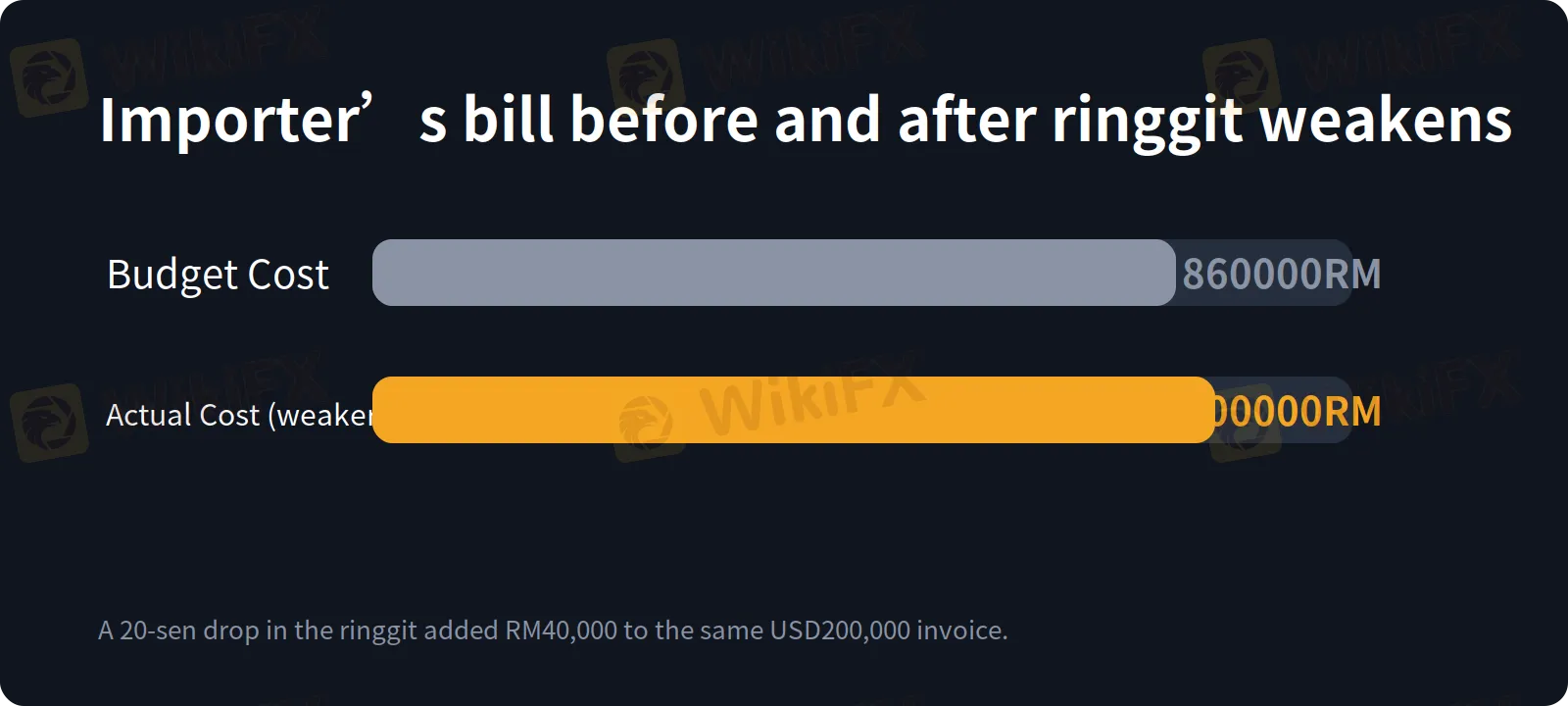
Based on the hypothetical TechGear example. Not a forecast.
Beginner traps and why “its only a few sen” can kill your margin
- Mistake 1: “Only exporters win when the ringgit falls.” Many news headlines focus on the export boost from a weaker MYR. But importers and businesses with USD debt get squeezed, and even exporters that use imported inputs suffer higher costs. Currency moves create winners and losers simultaneously; no side is insulated.
- Mistake 2: “Hedging makes the risk disappear.” Forward contracts and options can lock in an exchange rate, but they come with fees, credit requirements, and sometimes imperfect timing. Over-hedging can lock a company into an unfavourable rate when the ringgit strengthens. Risk management is about reducing uncertainty to an acceptable level, not achieving zero risk.
- Mistake 3: “The exchange rate does not change much, so my small business is safe.” Short-term fluctuations of a few sen may look small, but on a large USD amount, the ringgit impact can be significant. A 10-sen move on a USD 500,000 shipment changes the cost by RM50,000. Many small businesses do not survive two large swings in a year.
- Mistake 4: “I will worry about it when I get the invoice.” By then, it is usually too late to take meaningful action without paying a high price. Currency exposure begins the moment a commercial commitment is made, not when cash is due.
Currency risk for a Malaysian company is the ringgit-value uncertainty attached to a USD commitment. It is not a prediction that the ringgit will keep falling. It is not a problem reserved for large corporations; any business with foreign-currency inflows or outflows faces it. And it is not a trading signal: understanding how the risk arises does not tell you whether to buy or sell MYR.
The first step to managing the risk is simply to map where and when a companys MYR cash flows depend on the USD exchange rate. That awareness allows a business to separate real operational risk from currency noise.
WikiFX Broker
Latest News
iFX Brokers Review: Is Your Deposit Safe?
WikiFXONE ROYAL Faces SCM Malaysia Warning , What Traders Should Verify Before Funding an Account
WikiFXASIC Crackdown Hits 5-Year High: 150 Rogue Operators Banned
WikiFXMoneycorp Review: Is This Broker’s License Really Telling the Truth?
WikiFXBYBIT Review: Unregulated Broker Warning After Withdrawal Complaints and Forex Profit Disputes
WikiFXSECP Refers Blink Capital to FIA Over Rs446.6m Alleged Fraud
WikiFXHow to Start a Forex Broker in 2026: Build the Operating Model Before You Buy the Platform
WikiFXEMAR MARKETS Review 2026: Severe Withdrawal Complaints and Risk Signals
WikiFXTrader's Way Review: Trades Vanished Overnight , And There's No Regulator to Call
WikiFXLockwood Review: AMF-Blacklisted Broker with Users Reporting Blocked Withdrawals
WikiFXRate Calc

