Why Elections Make Currencies Swing Harder Than You Expect

Abstract:Elections and geopolitical events amplify short-term exchange rate volatility through uncertainty and thinner liquidity. This article explains the mechanism, walks through a clearly hypothetical calculation, and corrects common beginner misunderstandings without giving any trading advice.
What Elections and Geopolitical Events Do to Currency Pairs
Elections and geopolitical events are political moments that change how traders think about a country's future. A general election, a referendum, which is a direct vote by the public on a single issue, a border dispute, or a sudden trade restriction can all qualify. In the foreign exchange market, often called forex, one currency is traded for another. These events do not set the direction of a currency pair by themselves. They mainly raise the range of possible near-term outcomes.
When a currency pair moves a lot in a few hours or days, that movement is called exchange rate volatility. Volatility is not the same as a trend going up or down. It refers to how wide and fast the price swings are. For example, the euro against the US dollar, written as EURUSD, might move 1.25 percent in a day after a surprise result, even if the long-term trend has not changed.
Before an election or geopolitical shock, the market faces uncertainty. Uncertainty means that investors cannot easily estimate the probability of different outcomes. A contested election may have many possible winners, each with different policies on trade, spending, or monetary policy. Monetary policy is how a central bank manages interest rates and the supply of money in the economy.
How Uncertainty and Thin Liquidity Boost Volatility
Liquidity is how easily a currency can be bought or sold without moving its price much. During major political events, liquidity often gets thinner. Some professional participants called market makers, which are banks or firms that quote both a buy and a sell price, reduce their order sizes. Some traders step to the sidelines. This combination of high uncertainty and thin liquidity can make even ordinary orders push the price further than usual.
- Uncertainty rises: market participants assign wider probability ranges to future policy paths.
- Liquidity thins: fewer resting buy and sell orders are near the current price.
- Price impact grows: each trade can move the rate more because there are fewer counterparties, meaning fewer other parties on the opposite side of a trade.
- Volatility spikes: intraday moves, or movements within a single trading day, become larger without any long-term fundamental change.
You can see the short-term effect with a simple percentage change calculation: percent change equals (new price minus old price) divided by old price, multiplied by 100. Here is a clearly hypothetical example using a major currency pair. Suppose the euro against the US dollar is trading around 1.1555 before a surprise election result. Within the next trading day, the market reprices the euro to 1.1700. The calculation steps are:
- Identify the starting rate: 1.1555.
- Identify the rate after the event: 1.1700.
- Subtract and divide: (1.1700 - 1.1555) divided by 1.1555 equals 0.0145 divided by 1.1555.
- Multiply by 100 to get about 1.25 percent.
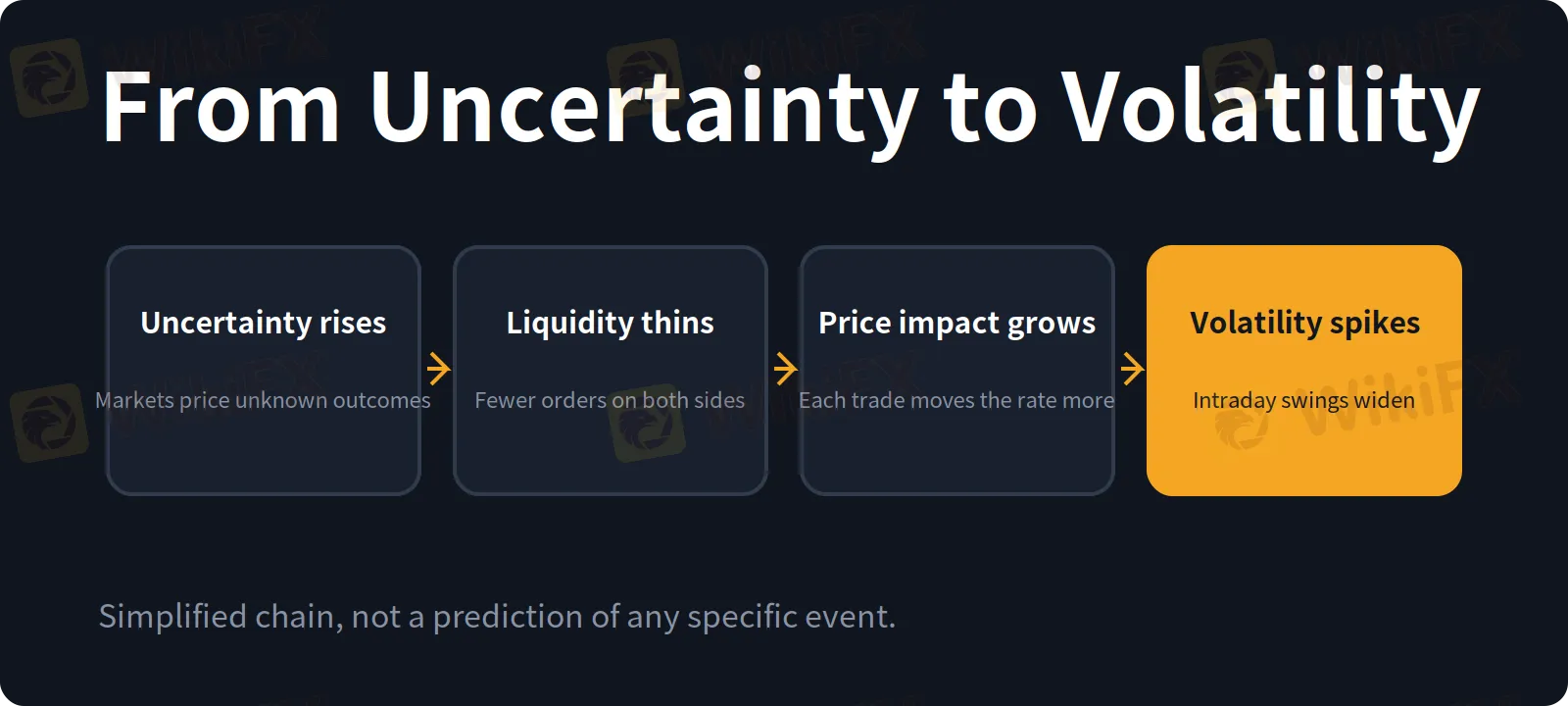
A simplified chain showing how election uncertainty can amplify short-term currency moves.
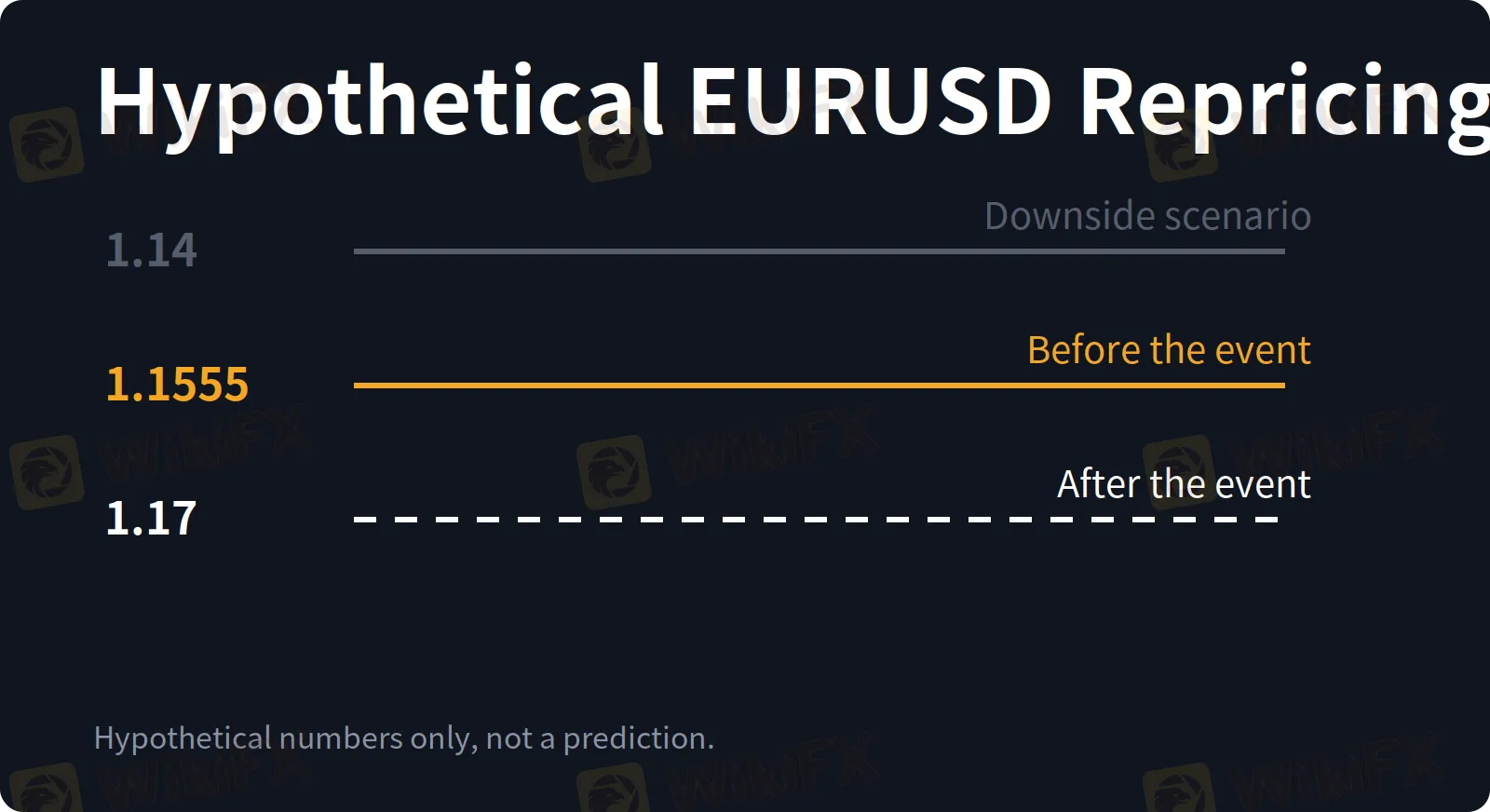
Hypothetical EURUSD levels before and after a surprise result.
Common Mistakes Beginners Make When Reading Election Moves
One common beginner misunderstanding is that an election result directly tells you which way a currency will go. In reality, the market may react positively first and then reverse within hours. The short-term volatility reflects repricing, not a guaranteed trend.
Another misunderstanding is to compare daily percentage moves across different pairs without context. A 1 percent move in a highly liquid major pair can be unusual, while the same percentage move in a less liquid emerging-market currency may be more common. African currency pairs, for example, can have wider day-to-day ranges because domestic liquidity and event risks differ.
Spreads also matter. A spread is the gap between the buy and sell price. During election volatility, spreads often widen because market makers face more risk. This means a beginner who watches only the chart may underestimate the cost of trading during the event.
Finally, past election patterns do not automatically repeat. Each event has unique candidates, rules, and external pressures. A volatile reaction one time does not mean the same volatility will appear next time. Election and geopolitical shocks amplify short-term exchange rate movement, but they do not tell you whether a currency will end higher or lower over the medium term. The main lesson is that volatility is a measure of uncertainty, not a signal of direction. Seeing a wide intraday swing may first trigger the question: is this a pricing adjustment, or is liquidity simply thin? Treating extreme short-term moves as automatic trend signals is exactly the kind of mistake this concept helps you avoid.
WikiFX Broker
Latest News
Luno Review: Users Report Blocked Withdrawals on an Unregulated 'Suspicious Clone'
WikiFXFizmo Fx Markets Review 2026: Unregulated Status and Withdrawal Complaints
WikiFXForex Liquidity Provider in 2026: Why the Tightest Spread is Not Always the Best Execution Decision
WikiFXUS July CPI Could Take a Fed Rate Hike Off the Table
WikiFXCrypto Revenue Falls in Q2 as Another Platform Moves Into CFDs
WikiFXTraze Review: What Traders Should Know Before Depositing
WikiFXTRADEVIEW MARKETS Review: Broker Complaints, Regulation Warnings, and Funds Withheld Claims
WikiFXMatch-Trade Gives AI Direct Access to Broker Trading APIs
WikiFXWhy Sovereign Debt Can Sink a Currency: The Credit Risk Channel
WikiFXBX Trade Review: Is a $1 Minimum Deposit Worth the No-Regulation Risk?
WikiFXRate Calc

