Grand Markets-Some important Details about This Broker
Abstract:Grand Markets is a regulated global online trading platform that offers CFD trading services for multiple asset classes, including forex, cryptocurrencies, commodities, and stock indices. The platform supports MetaTrader 4 (MT4) on both desktop and mobile devices, making it suitable for traders seeking low-cost and multi-functional platforms, particularly for high-frequency forex trading and novice traders getting started.
| Review Summary | Grand Markets Review Summary |
| Year Founded | 2015 |
| Registered Country/Region | Australia |
| Regulation | ASIC (Australia), FSC, AOFA (Offshore regulation) |
| Market Instruments | Forex, indices, gold, crude oil, cryptocurrencies, and commodities |
| Account Types | ECN / Standard Account / Cent Account |
| Demo Account | Available |
| Leverage | Up to 1:1000 |
| Spreads | ECN: EUR/USD from 0.1, Gold from 10; Standard: EUR/USD from 1.7, Gold from 28 |
| Trading Platforms | MT4 / MT5 / Grand Markets App |
| Minimum Deposit | $10 |
| Customer Support | 24/7 support, live chat, contact form |
| Regional Restrictions | United States, New Zealand, Iran, North Korea (DPRK), Brazil, United Kingdom, Russia, Belarus |
Grand Markets Information
Grand Markets is a regulated global online trading platform that offers CFD trading across multiple asset classes, including forex, stock indices, cryptocurrencies, and commodities. The platform supports MetaTrader 4 (MT4), MetaTrader 5 (MT5), and the Grand Markets App on both desktop and mobile devices. It is suitable for traders seeking a low-cost and versatile trading platform, particularly for high-frequency forex trading and beginners getting started.
Pros and Cons
| Pros | Cons |
| Regulated by ASIC | |
| MT4 available | Regional restrictions |
| Demo accounts available | Offshore regulation risks |
| 24/7 multilingual customer support | |
| Low minimum deposit |
Is Grand Markets Legit?
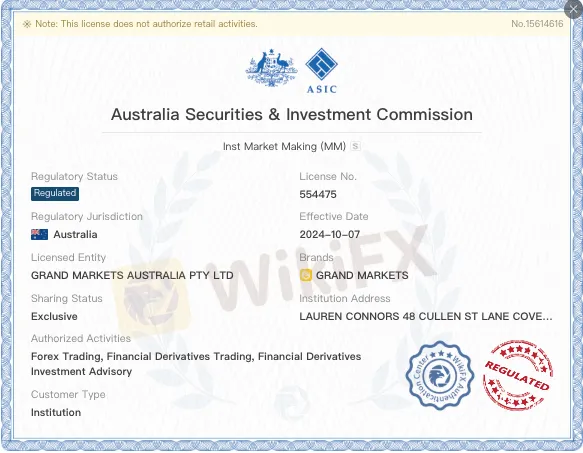
This broker is regulated by the Australian Securities and Investments Commission (ASIC), the Financial Services Commission of Mauritius (FSC), and the Anjouan Offshore Financial Authority (AOFA) of the Comoros.

What Can I Trade on Grand Markets?
The platform offers over 50 CFD trading instruments, including forex (more than 50 currency pairs), commodities, cryptocurrencies, and stock indices.
| Tradable Instruments | Supported |
| Forex | ✔ |
| Commodities | ✔ |
| Stock indices | ✔ |
| Cryptocurrencies | ✔ |
| Options | ❌ |
| ETFs | ❌ |
| Bonds | ❌ |
| Mutual Funds | ❌ |
Account Type & Fees
| Account Type | Standard | ECN | Cent |
| Minimum Deposit | $10 | ||
| Average Spread | 1.7 pips | From 0.0 pips | 1.6 pips |
| Commission | 0 | Up to $7 per lot | 0 |
The Standard account offers an average spread of 1.6 pips on major currency pairs (such as EUR/USD), while the ECN account provides spreads as low as 0 pips. Only the ECN account charges a commission of up to $7 per lot. Most instruments (such as major currency pairs and cryptocurrencies) are swap-free, with no overnight interest charged.
Leverage
The platform offers a maximum leverage of 1:1000, applicable to all account types. However, exotic currency pairs (such as USDCNH) use fixed margin requirements, which are not affected by leverage adjustments.
Trading Platform
| Trading Platform | Supported | Available Devices | Suitable For |
|---|---|---|---|
| MT4 | ✔ | Desktop & Mobile | Beginners |
| MT5 | ✔ | / | Experienced Traders |
| Grand Markets App | ✔ | Mobile Devices | Beginners / Experienced Traders |
Deposit and Withdrawal
Deposits support both global and local payment methods (such as USDT, credit cards, and bank transfers), with funds credited to accounts instantly (platform processing time is usually within minutes).
For withdrawals, funds typically arrive in your bank account within 1–3 business days (depending on the region and bank). Withdrawals require one-time password (OTP) verification and follow PCI DSS compliance standards with segregated client fund protection. No handling fees are charged, and refunds are supported via the original payment method.

Read more

Succedo Markets Review 2026: The First Withdrawal Worked—What Happened Next?
Most traders who have opened accounts with Succedo Markets, a Saint Lucia-based brokerage entity, have reported withdrawal request denials after a pleasant first experience. Traders globally, including those from India, have made these complaints. Meanwhile, some traders have reportedly taken legal recourse to recover their stuck funds. The critical nature of these complaints made us share this in-depth Succedo Markets review. This review does not only examine user allegations but also shed light on its regulatory framework.
Tattvam Review 2026: Investigating Complaints Concerning Trade Executions
Did you encounter trade-related concerns with Tattvam, a Mauritius-based brokerage entity? Several users have reportedly accused the broker of cancelling profitable trades, allegedly citing scalping as the reason. At the same time, traders have reportedly expressed concerns over the lack of understanding among the broker officials about critical trading aspects such as copy trading. In this Tattvam review, we have carefully examined user-reported allegations. Additionally, we have given a regulatory overview of the broker.

suxxessfx Review 2026: Funds Worth $5K-$42K Reportedly Lost. Check Our Investigation!
suxxessfx, a Seychelles-based brokerage entity, grabbed massive ire from traders on broker review platforms such as WikiFX, a globally recognized forex broker regulation inquiry app. Exposure reports have revealed fund losses worth over $5K-$42K on the broker’s trading platform. This suxxessfx review examines serious user allegations and its regulatory status. Read on!
Pakistan Remittances Hit $3.63 Billion: Why USD/PKR Traders Should Look Past One Strong Number
Pakistan remittances reached $3.631 billion in July 2026, up 13% year on year and 4.5% from June, according to the latest State Bank of Pakistan data release. The SBP remittances update is a useful external-sector input, but it is not a currency forecast. This guide explains what the inflow can mean for the Pakistan forex market and USD PKR, and what it cannot prove about the next Pakistan rupee move.
WikiFX Broker
WikiFX Broker
Latest News
South Korean Won: BoK tightening supports KRW against US Dollar – Commerzbank
 WikiFX
Mexican Peso tumbles as Warsh embarks on inflation fight
WikiFXOEXN Broker Review: Regulated but is it Safe for Traders?
WikiFXUSDCHF: Rising Channel Continuation Toward the Target Zone
WikiFXJapanese Yen dips further despite hotter inflation, upbeat employment data
WikiFXSilver Price Forecast: False breakout and hawkish Fed sink XAG
WikiFXPoland: Growth supported by investment rebound – ING
WikiFXDow Jones Industrial Average round-trips a Fed that promised nothing
WikiFXBreaking: Nonfarm Payrolls benchmark revision to lower US employment by 79,000 through March 2026
WikiFXGBPUSD | Bearish Breakdown & Downside Continuation
WikiFXRate Calc

