WIKIFX REPORT: Can USD/ZAR Go For A Higher High?
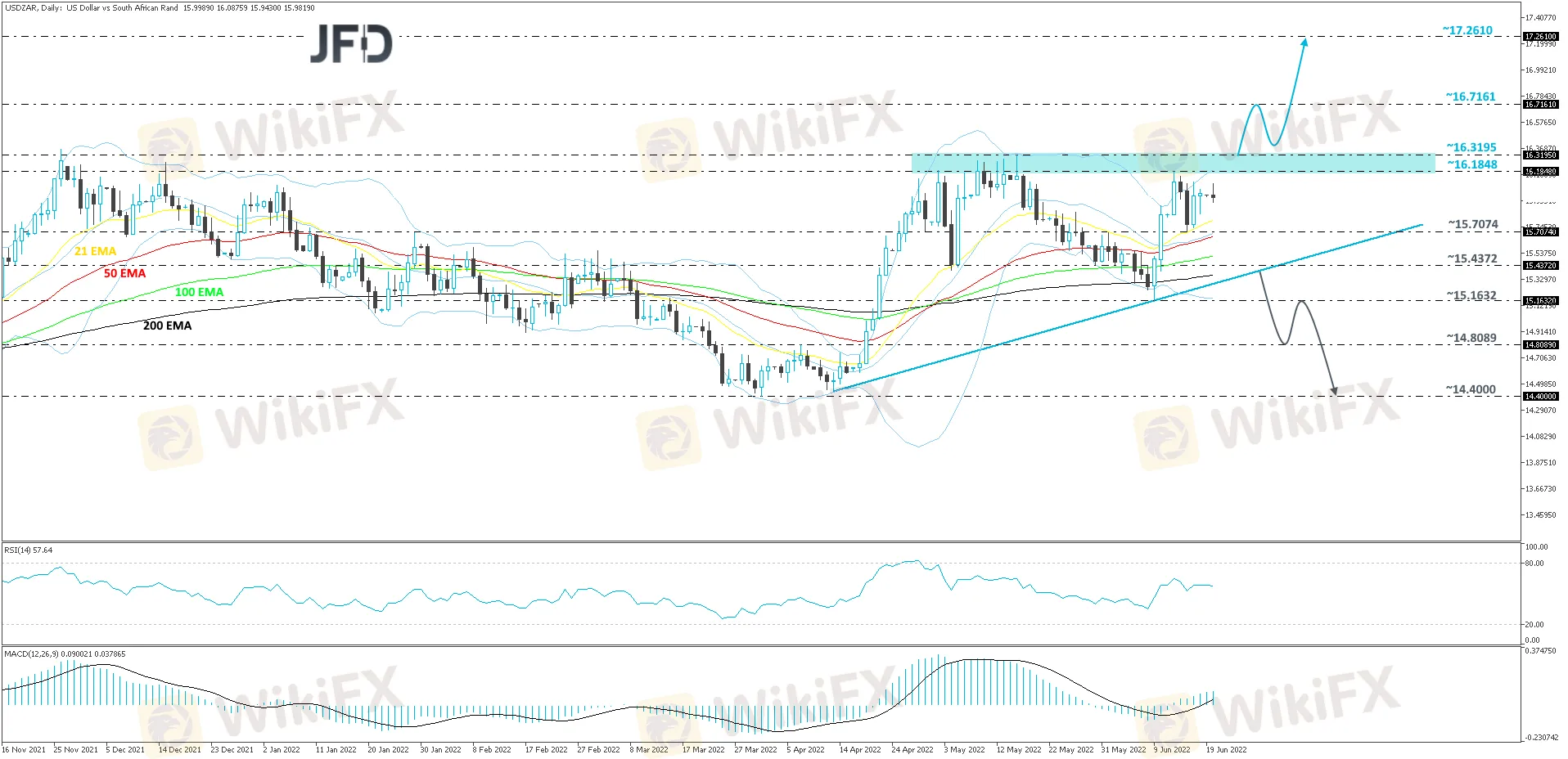
Abstract:Looking at the technical picture of USD/ZAR on our daily chart, we can see that after reversing higher at the end of March, the pair is now trading above a short-term upside support line taken from the low of April 13th. That said, the rate is currently trading below a key resistance area between the 16.1848 and 16.3195 levels, marked by the highs of June 13th and May 16th respectively. In order to aim further north, we would prefer to wait for a push above that resistance area first.
Looking at the technical picture of USD/ZAR on our daily chart, we can see that after reversing higher at the end of March, the pair is now trading above a short-term upside support line taken from the low of April 13th. That said, the rate is currently trading below a key resistance area between the 16.1848 and 16.3195 levels, marked by the highs of June 13th and May 16th respectively. In order to aim further north, we would prefer to wait for a push above that resistance area first.
Such a break will confirm a forthcoming higher high and may open the door to the 16.7161 hurdle, marked by the high of October 15th, 2020. We could see a slight hold-up around there, however, if the buyers remain strong, they might overcome that obstacle and aim for the 17.2610 zone, which is the highest point of September 2020.
The RSI is flat but continues to run above 50. The MACD is pointing higher, while running above zero and the signal line. Overall, the two oscillators show positive price momentum, which supports the upside scenario.
Alternatively, a break of the aforementioned upside line may change the direction of the current short-term trend. USD/ZAR could then drift to the current lowest point of June, at 15.1632, which was tested on the 9th of the month, a break of which might clear the way towards the 14.8089 zone. That zone marks the inside swing high of April 7th. However, if the sellers continue to apply pressure and break that zone, the next possible support area could be at 14.4000, which is the lowest point of March.

Read more
FINEX Review: A+++ Rating Does Not Remove Risks - How to Read Spread, Withdrawals & Other Aspects
FINEX review 2026 for readers comparing an Indonesia forex broker: understand what Bappebti's A+++ rating does and does not show, then check floating spreads, withdrawals, segregated accounts and the complaint route for PT Finex Bisnis Solusi Futures.
Tier 1 Liquidity Forex in 2026: What Institutional Really Means for a Broker
Choosing a tier 1 liquidity forex is not a search for the lowest displayed spread or the longest provider list. It is a broker decision about pricing integrity, depth, routing, credit, reporting, incident response, and client communication. This 2026 guide explains how an institutional liquidity provider, bank liquidity forex, or interbank liquidity provider arrangement fits into a broker’s execution chain; what to test before onboarding; why a “best tier 1 liquidity forex” claim cannot replace due diligence; and how to compare cost beyond commission. Use the execution-quality scorecard, provider questions, routing scenarios, and 90-day onboarding plan to assess whether a liquidity relationship can support your actual client mix, instruments, risk model, and jurisdiction. The goal is not to make a universal ranking. It is to build evidence that your broker can explain, supervise, reconcile, and recover its execution service when market conditions are difficult.
MIFX Review 2026: How to Read Spreads, Withdrawal Rules and the Complaint Route
MIFX review 2026: understand published commissions and spreads, the withdrawal process, Instant Withdrawal conditions, and the PT Monex Investindo Futures complaint route without turning community discussion into factual allegations.

Forex Liquidity Provider in 2026: Why the Tightest Spread is Not Always the Best Execution Decision
Choosing a forex liquidity provider is not a search for the lowest displayed spread or the longest provider list. It is a broker decision about pricing integrity, depth, routing, credit, reporting, incident response, and client communication. This 2026 guide explains how a forex LP, FX liquidity provider, or liquidity provider forex arrangement fits into a broker’s execution chain; what to test before onboarding; why a “best forex liquidity provider” claim cannot replace due diligence; and how to compare cost beyond commission. Use the execution-quality scorecard, provider questions, routing scenarios, and 90-day onboarding plan to assess whether a liquidity relationship can support your actual client mix, instruments, risk model, and jurisdiction. The goal is not to make a universal ranking. It is to build evidence that your broker can explain, supervise, reconcile, and recover its execution service when market conditions are difficult.
WikiFX Broker
Latest News
BX Trade Review: Is a $1 Minimum Deposit Worth the No-Regulation Risk?
 WikiFX
Octa Review 2026: Severe Withdrawal Complaints and High Risk Signals
WikiFXKCB Review: Is Your Deposit Safe?
WikiFXCrypto Revenue Falls in Q2 as Another Platform Moves Into CFDs
WikiFXWinvest Review: Is Your Deposit Safe?
WikiFXWhy More Commodity Revenue Doesn't Instantly Strengthen a Currency
WikiFXSingapore Nabs 270 Suspects in RM17 Million Scam Bust
WikiFXDollar and Asian FX Steady Before US CPI
WikiFXLuno Review: Users Report Blocked Withdrawals on an Unregulated 'Suspicious Clone'
WikiFXCrypto Platform YEPBIT Got Shutdown by Australian Regulators
WikiFXRate Calc

