OmegaPro Forex Scam Founder Arrested in Turkey: The Fall of Andreas Szakacs
Abstract:Turkish authorities have arrested Andreas Szakacs, the co-founder of OmegaPro, one of the world’s largest and most infamous online multi-level marketing (MLM) scams. Szakacs, who had been on the run since November 2022, was apprehended after a years-long international manhunt. His arrest marks a pivotal moment in the pursuit of justice for the millions of investors defrauded by the OmegaPro scam.
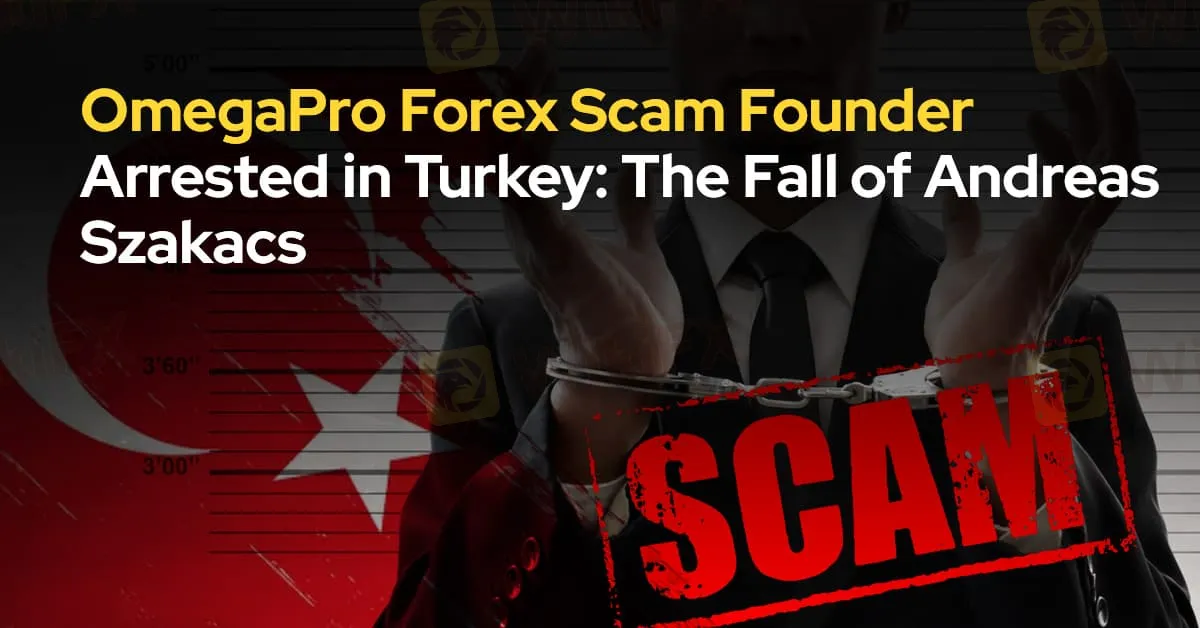
Turkish authorities have arrested Andreas Szakacs, the co-founder of OmegaPro, one of the worlds largest and most infamous online multi-level marketing (MLM) scams. Szakacs, who had been on the run since November 2022, was apprehended after a years-long international manhunt. His arrest marks a pivotal moment in the pursuit of justice for the millions of investors defrauded by the OmegaPro scam.
What Was OmegaPro?
On WikiFX, OmegaPro is considered a Ponzi scheme. WikiFX has given this broker a very low score. OmegaPro presented itself as a forex trading platform, enticing investors with the promise of astronomical returns. The company claimed that investors could achieve a 300% return on their investment within 16 months. The scheme was heavily promoted by retired football stars and self-proclaimed business gurus, lending an air of legitimacy to the operation.

Investors could join the scheme with as little as $100, while some invested as much as $50,000, lured by the potential for massive profits. However, OmegaPro was nothing more than a sophisticated Ponzi scheme. The companys supposed forex trading activities were a facade, and the promised returns were paid out using the funds of new investors.
As pressure from regulators and law enforcement intensified, OmegaPro rebranded itself as Go Global. However, this name change did little to disguise the true nature of the operation. The company continued to deceive investors, ultimately collapsing in November 2022.
The Scam Unraveled
OmegaPro was launched in 2019 and quickly expanded its reach globally. Operating out of Dubai, the company managed to defraud investors of over $100 billion in just three years. Despite its claims of legitimacy, OmegaPro began to attract the attention of regulators and law enforcement agencies around the world.
By 2020, French authorities had blacklisted two websites associated with OmegaPro for offering unauthorized forex trading services. This marked the beginning of a series of legal actions against the company. Class action criminal proceedings are currently underway in France, and other countries have since launched their own investigations.
The first arrests related to the OmegaPro scam occurred in April 2022 in the Congo. By August, regulators in Myanmar had launched their own investigations. The collapse of OmegaPro in November 2022 forced Szakacs and his co-founders, Mike Sims and Dilawar Singh, to go underground.
In March 2023, Juan Carlos Reynoso, a key executive responsible for managing OmegaPro‘s operations in Latin America, was arrested in Mexico. Reynoso, a Peruvian citizen, played a significant role in the company’s global operations.
In November 2023, an initiative called Omegapro Action Nigeria was launched in an attempt to recover funds for scammed Nigerian investors. However, just two days later, a petition was started on Change.org, calling on the Sheikh of Dubai to investigate OmegaPro and its co-founders, who were believed to have fled to Dubai following the companys collapse.
A Web of Deception: The Background of Key OmegaPro Members
The individuals behind OmegaPro were no strangers to fraudulent schemes. Andreas Szakacs, Mike Sims, and Dilawar Singh had all been involved in previous scams. For example, Paulo Tuynman, a senior executive at OmegaPro, had a history with the Omnia Project scam. Another executive, Christopher Hamilton, was linked to the notorious OneCoin crypto scam, one of the largest cryptocurrency frauds in history.
Nader Poordeljo, another associate of OmegaPro, was known for his connection to Jordan Belfort, the infamous “Wolf of Wall Street.” These associations highlight the deep-seated connections between OmegaPro and other fraudulent schemes.
Despite the arrest of Szakacs, many of the key figures behind OmegaPro remain at large. Dubai, where several of these individuals are believed to reside, has yet to take significant action against them. This lack of accountability raises concerns about the protection of investors and the potential for similar scams to emerge in the future.


Read more
WAYONE CAPITAL Review 2026: Trading Complaints on Withdrawal Denials & Platform Glitches
WAYONE CAPITAL, a Saint Lucia-based forex broker, is reportedly facing allegations from users worldwide. Most users allege that the brokerage entity does not comply with fund withdrawal norms and gives petty excuses for not releasing funds on time. Additionally, users have complained about the reflection of the wrong trading account balance while accessing the WAYONE CAPITAL login. If you have faced similar concerns with this broker, you are at the right place! This 2026 WAYONE CAPITAL review article examines user allegations and gives an update on the broker’s regulatory status.

Lost Your Capital by Clicking on a Forex Trading Link? This is the Latest Scam Trend!
Newspaper after newspaper, social media platforms after social media platforms, we often come across the term forex trading scam. It’s taking a vicious shape. Unknown profiles constantly jam your phones or social media accounts with luring messages of guaranteed and astonishing returns that you may not have heard of before. So, what many do? They click on the link and get into a dreamy, yet fake world that somehow appears much later. More so, in many cases, after the scam. The case of XPO.ru last year, where users were told to click on a link to start forex trading, led to the siphoning of as much as INR 3,100 crore, leaving affected investors and the authorities puzzling over the incident. While the XPO scam was a massive incident, there has not been a shortage of these incidents. The Internet is flooded with stories concerning forex scams of this nature. In this article, we take a close look at several such scams.
In-depth Alpari Exposure Report: Account Restriction and Withdrawal Denial Allegations
Were you restricted from opening trades on the Alpari trading platform? Did the Comoros-based forex broker prevent you from accessing withdrawals despite numerous requests? Have you faced trading losses because of the chart-related errors? These have reportedly turned into large-scale negative reviews for the broker online. This Alpari review 2026 article is aimed at providing insight into user allegations and the broker’s regulatory framework.
Zenstox Review 2026: Unexplained Profit Cancellation & Account Termination Allegations
Have you suspected Zenstox of cutting your profit amount on the trading platform? Failed to receive a proper response from the customer support team of the broker on this profit deduction? Did you face an unexplained account termination by the Seychelles-based forex brokerage firm? Broker review platforms, such as WikiFX, are flooded with negative user comments in 2026. In this Zenstox review article, we have examined these allegations. Take a close look at the same.
WikiFX Broker
Latest News
The Market's Ledger: Why Price Returns to Fill Liquidity Voids
 WikiFX
Position Sizing Math For Steady Small Account Growth
WikiFXThe May inflation numbers are due out Wednesday morning. Here's what to expect
WikiFXIndia Left Reeling as Net FDI Crashes from $28 Billion to Just $1 Billion in Two Years
WikiFXInstaForex Review: Broker Profit Deductions, Login Shock, and Regulation Red Flags
WikiFXTenX Prime Review: PAMM Blackout, Login Blocks, and Broker Regulation Questions
WikiFXUniglobe Markets Review 2026: Should You Trade with This Broker?
WikiFXOcta Review 2026: Severe Withdrawal Complaints and Regulation Warnings
WikiFXWorld Cup · Forex Predict & Win Event
WikiFXZenstox Review 2026: Unexplained Profit Cancellation & Account Termination Allegations
WikiFXRate Calc

