EUR looking to continue its bullish trend ahead of FOMC and ECB meeting
Abstract:The Euro is steady going into the European session last week and is looking to notch up a fourth straight monthly gain after making a 20-year low last September.

The Euro is steady going into the European session last week and is looking to notch up a fourth straight monthly gain after making a 20-year low last September.
While The US Dollar losing ground across the board has aided the rally thanks to perceptions that the Federal Reserve might be less aggressive in its tightening regime.
The move up for EUR/USD has also received some tailwinds from the European Central Bank (ECB) stepping up its fight against inflation. In addition, with employment data to come out of the USA softer data may support a more dovish Federal reserve.
In the previous few days and weeks, the EUR has seen some strong momentum on the back of growth data that has seen the region avoid a recession. Crucially, the GDP of the Eurozone grew by 0.1% which beat an expected 0.1% retraction for the quarter. A general weakening of the USD has also supported a bounce of the EUR as money has moved away from the safety of the greenback and into other assets.
Technical Analysis
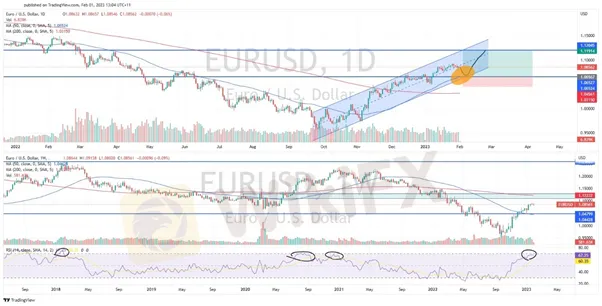
When it comes to the long-term analysis, the price has mostly ranged between 1.04 and 1.25 except when the price bottomed last year. The price is currently showing some weakness and has so far been unable to break through 1.09 and has sold down on candlesticks that are testing the 1.09 level. Therefore, it would not be surprising to see the price retrace to the previous support level at 1.06 before another move to the upside.
On the daily price chart, the price is showing a strong upward channel/trend. This channel shows how the bottom of the channel fall along an important area of market structure. This zone acts as the 50-day moving average, the recent support level and the bottom of the channel. This bolsters this region as a zone for ana entry should the price retrace. With a target of 1.12 this represents a risk reward of 2.5.
Ultimately the trend of the EUR will most likely be dictated by the movements of the Federal reserve and the ECB. However, should the macroeconomic factors permit, the EUR could very well continue its run.


Read more
Why Is My Forex Withdrawal Still Pending? 7 Broker Excuses Traders Keep Hearing
Withdrawal delays are precisely the complaint we keep receiving on WikIFX, a veteran in the forex regulation inquiry space. While some users receive withdrawal access initially and find rejections on their applications later, some fail to receive a single approval. Some delays usually result from genuine compliance requirements that brokers need to adhere to. However, in many cases, traders have accused the broker of repeated excuses as part of its alleged strategy to deny a seamless fund release. A pending withdrawal cannot be an outright indicator of fraudulent activity. Financial institutions, including forex brokerage entities, need to abide by the anti-money laundering (AML) and Know Your Customer (KYC) regulations. However, as the monitoring process stretches beyond weeks or months, traders become frustrated and raise questions over the broker’s reliability.
One Lot Size Mistake Can Cost You Thousands—Here's Where the 1% Rule Helps
Switched from one trading strategy to another but could not avert heavy losses? Wondering what went wrong despite your market analysis being spot on? It may not be a strategic issue then. It may just be that you chose the wrong lot size. Yes, a single oversized position can get your account exposed to far greater risks than you may imagine. You may be moved by the impressive profits with increasing lot sizes. But by doing so, you also invite a proportionate rise in losses. This is where you need to apply the essential 1% risk management principle. This rule helps you assess how much you can afford to lose if a trade does not go as planned.

exfor Review 2026: I’m Unable to Receive My Profits. We Investigated This Common User Allegation.
User complaints regarding profit withdrawals have become an increasingly discussed issue among some Exfor traders, including those in South Asia. Trading profits never come easy; they come by spending hours understanding the fundamental and technical factors and their impact on different markets such as forex. However, what matters is whether you are able to receive them. For exfor clients, according to their complaints, this problem is worse! While they claim profits on the dashboard, the same do not reach their trading accounts, resulting in many negative exfor reviews. In this article, we have examined user allegations concerning several issues, including this common profit withdrawal problem.

Your Backtesting Results Mean Nothing If You Ignore This One Live Trading Reality
Backtesting remains one of the primary skills forex traders learn. By implementing a trading strategy based on historical currency pair price information, traders can view their past performance. The strategy leading to consistent profits during backtesting can raise confidence and lay a structured approach to the forex market. However, the path is not as simple as it may sound. Several traders tend to meet a harsh reality when transitioning to live trading. The strategy that seemed almost flawless on historical charts suddenly fails to deliver the results it did before. The sudden difference may not necessarily be because of a poor strategy. Rather, it indicates limitations concerning backtesting and several factors that play their part in a live market where conditions change frequently. It is thus important to understand these differences so that you can set realistic expectations and work on to achieve consistent success.
WikiFX Broker
Latest News
Aligning H4, H1, and M15 Charts for Clearer Intraday Forex Trades
 WikiFX
Building a Forex Strategy: What Beginners Get Wrong About Risk and Chart Patterns
WikiFXRisk Management for Beginners: How Margin and Stop-Losses Prevent Account Blowouts
WikiFXSpotting Forex Ponzi Schemes and Confidence Scams Before You Deposit
WikiFXWhat Indian Beginners Should Check Before Choosing a Forex Broker
WikiFXFBS Review: CySEC & ASIC Licensed, Yet Scored 2.51 , What's Really Going On?
WikiFXINVESTIZO Review: Unregulated Broker Under Fire Over Withdrawals and Profit Cancellation
WikiFXBuild Trading Discipline Using a Bar-by-Bar Blind Test
WikiFXBreak the Habit of Adding to Your Losing Trades
WikiFXOcta Review: Profit Withdrawals, Account Blocks, and Broker Risk Signals
WikiFXRate Calc

