OANDA Japan to End Browser-Based MT4 and MT5 Access in May

Abstract:OANDA Japan will shut down MT4 and MT5 web terminal access at the end of May, while desktop and mobile trading remain available as the broker continues its MT4 phase-out.
OANDA Japan has announced that it will stop offering web terminal access for MT4 and MT5 at the end of May, removing browser-based login for both platforms.
The change affects only the web versions. Clients will still be able to trade through installed desktop terminals and mobile apps.
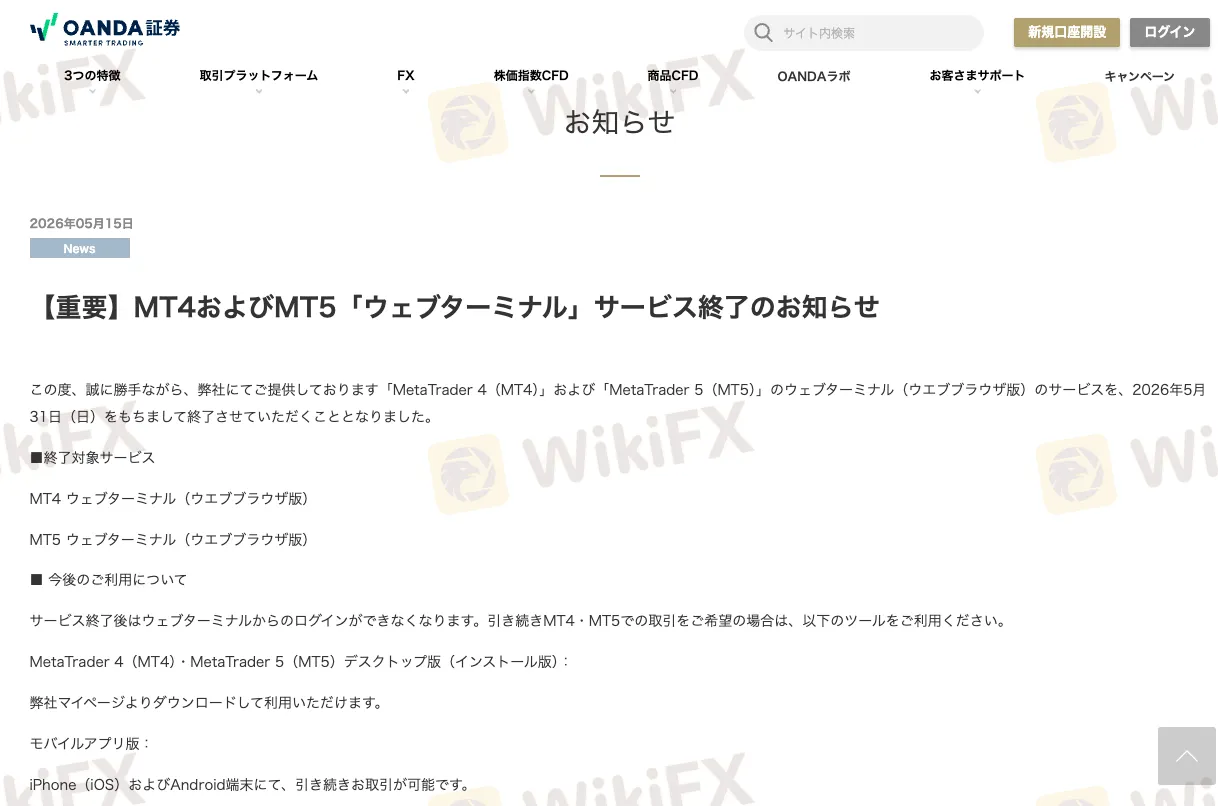
Web trading access to end first
After the deadline, users will no longer be able to sign in through a browser for either MetaTrader platform.
OANDA Japan said clients should switch to the downloadable desktop versions of MT4 or MT5, or continue using the brokers mobile apps on iPhone and Android. The broker also noted that account balances, open positions, and pending orders will stay unchanged after the web terminal service ends.
One limitation remains: chart layouts and indicator settings created in the web terminal will not move automatically to desktop or mobile. Users who relied on browser-based chart setups will need to rebuild them manually on another device.
Part of a wider MT4 shutdown plan
The web terminal closure is not an isolated move. It comes as OANDA Japan continues a broader withdrawal from MT4.
The broker had already announced earlier that it plans to end MT4 completely in November. That process has already started. New MT4 account openings have been stopped, and the next stages include restrictions on order placement before the platform is fully closed later in the year.
[Insert Image 2: OANDA Japan MT4 phase-out schedule]
In its earlier explanation, the company said MT4 no longer fits current security and maintenance requirements. It also pointed to the lack of ongoing support for the older platform as one of the reasons behind the transition.
Clients are being pushed toward MT5 and fxTrade
OANDA Japan has been directing users toward MT5 and its own fxTrade platform as alternatives.
That shift has also appeared in other changes around the MT4 environment. Earlier this year, the broker tightened trading conditions on MT4 accounts hosted on its Tokyo server, raising margin requirements and effectively reducing leverage on that setup. The move was presented as part of risk control and operational management, but it also added pressure on remaining MT4 users to migrate.
The firm has also introduced account-transfer measures for some clients with low margin maintenance, moving positions and balances to MT5 where needed.
MetaTrader support is narrowing across the industry
OANDA Japans latest step reflects a broader direction already visible among brokers still running older MetaTrader infrastructure.
Across the industry, support for older MT4 environments has been getting tighter as firms deal with security, maintenance, and system compatibility issues. In that context, ending browser access is a narrower technical step, but it fits the same larger pattern: keeping MT5 and newer systems active while gradually removing older access points.
For OANDA Japan, the immediate message is clear. Web access disappears first, but the broader MT4 exit is already in motion.
About WikiFX
WikiFX is a global broker information platform that provides broker profiles, licence records, regulatory updates, and industry developments across multiple jurisdictions. It is widely used by traders to follow broker background information and market-related changes.

Read more

Same Currency Pair, But Different Prices on Two Brokers? The Reason May Shock You!
Forex traders often wonder why the same currency pair, for instance, EUR/USD, shows 1.17450 on one broker but 1.17455 on another. This difference creates suspicion among traders, often leading to wrong calls and losses. Calm your nerves first by understanding that small price variations are normal and are a reflection of the global forex market’s operation. The forex market is decentralized with no single exchange or official price for any currency pair. That is some revelation for new forex traders. So, what’s the methodology for price determination? It is derived from an expanded network of financial institutions, banks, liquidity providers and brokers globally. So, as a forex trader, you must understand the price structure thoroughly to stay out of unnecessary chaos and continue to reap rewards.
EMAR MARKETS Review 2026: No Withdrawals Despite Millions Paid in Verification Fees
EMAR Markets, a South Africa-based forex broker, allegedly never misses the opportunity to disappoint its traders, according to their reviews. The user allegations present a disturbing picture, with users repeatedly complaining about pending EMAR MARKETS withdrawal processing in the pretext of a data review process that reportedly seems to have no end. They even accused the broker of withholding funds even after they paid the verification fee worth 2,000 to 5,000 yuan as requested. Some users complained about the not-so-meaningful updates and complete communication halt that further made the overall trading scenario precarious. In this EMAR MARKETS review, we have examined serious user allegations to provide an overview of the overall situation. To further help you assess its legitimacy, we have provided a regulatory framework of this company.

Indian Stocks Rally, but the Rupee Breaks a Six-Day Winning Streak—What's Behind the Sudden Reversal
Indian stock indices today, i.e., June 22, 2026, recorded growth, with the BSE Sensex rising 297.11 points to 77,094.07, recording a 0.38% jump. On the other hand, the NSE Nifty hit approximately 24100, largely aided by broad-based purchases across sectors, except for consumer durables and fast-moving consumer goods (FMCG). The Nifty grew by 89.80 points (0.37%+) to 24,102.90.
Telegram Banned in India? Here's What Traders Must Do Next
Yes, it’s true! The Government of India decided to ban Telegram in the country on June 16, 2026, surprising many who rely on this platform for daily trading alerts & advisories. The ban has taken effect under Section 69A of the IT Act as part of the government’s plan to stop fraud during the NEET-UG re-examination. According to reports, fraudulent rackets were selling fake question papers for amounts ranging from INR 5,000 to 50,000. But the ban, which will be effective until June 22, 2026, affects far more than students. It transcended from a messaging blockout to a sudden disengagement from the app that shaped many traders’ daily routine over time. Out of the 15 crore plus unique registered investors in India, a large chunk sought trading tips, market news, along with buy and sell signals on Telegram. It must have taken investors by surprise. But is the ban detrimental to traders, or is there something more than meets the eye?
WikiFX Broker
Latest News
Vonway Forex Review: No Regulation, Withdrawal Complaints, and a Broker Warning
WikiFXRoboMarkets Review 2026: Regulation, Complaints, and Execution Quality
WikiFXMazi Finance Review 2026: Unregulated Status, Withdrawal Complaints, and Risk Signals
WikiFXReview 2026: TRADING 212 Regulation, Clone Warning, and Withdrawal Complaint
WikiFXReview 2026: BOLD PRIME Complaints, Regulation Warnings, and Withdrawal Risk
WikiFXReview 2026: EMIRAX MARKETS Regulation, Withdrawal Complaints, and Trading Risks
WikiFXPolymarket Under Fire as Wall Street Watchdog Launches Investigation
WikiFX⚽💱 World Cup · Forex Predict & Win Event
WikiFXHIJA MARKETS Review 2026: I Was Told to Pay $3,000 to Receive My Profits, But I Found It Suspicious
WikiFXRupee Logs Quarterly Gain; Yen Hits 40-Year Low
WikiFXRate Calc

