Voices of the Golden Insight Award Jury - Simon So, Chief Experience Officer of Hantec Financial

Abstract:The “WikiFX Golden Insight Award” is dedicated to uniting industry forces to jointly build a safe and robust forex ecosystem, driving industry innovation and sustainable development. Now it launches a brand-new interview series — “Voices of the Golden Insight Award Jury”. Through in-depth interviews with authoritative jury members, this series will explore the future landscape of the forex industry and the shared mission of industry elites in enhancing innovation, compliance, and sustainable development.
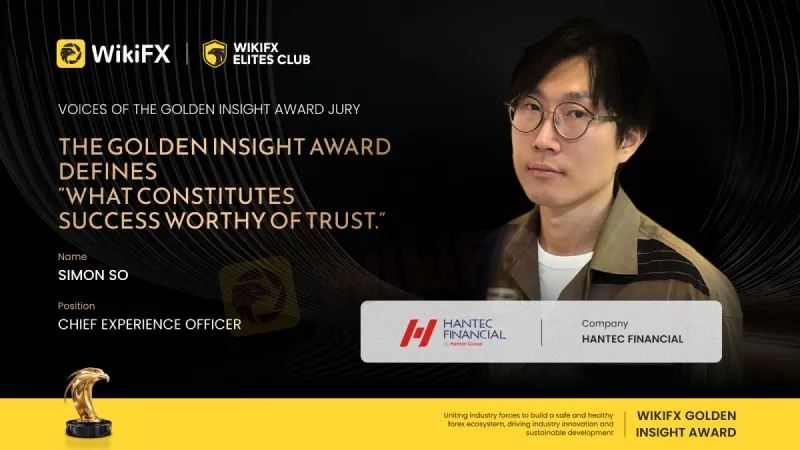
The “WikiFX Golden Insight Award” is dedicated to uniting industry forces to jointly build a safe and robust forex ecosystem, driving industry innovation and sustainable development. Now it launches a brand-new interview series — “Voices of the Golden Insight Award Jury”. Through in-depth interviews with authoritative jury members, this series will explore the future landscape of the forex industry and the shared mission of industry elites in enhancing innovation, compliance, and sustainable development.
This episodes guest is Simon So, CEO of Hantec Financial, a seasoned digital transformation leader with over 15 years of experience, specializing in driving innovation in customer experience, marketing strategy, and operational excellence within fast-growing environments. He has an outstanding track record in successfully expanding multi-regional business operations across Asia-Pacific, Africa, and the Middle East.
Part 1 | Trust Mechanisms and Sustainable Development
Q1: You have experience in business expansion across APAC, Africa, and the Middle East. What significant differences do you see in the forex markets of these regions regarding compliance, regulation, and trading transparency?
A: While the forex market is global in nature, regulation is highly regionalized, with each market bearing the imprint of its economic background and financial culture. Taking APAC as an example, some markets have a high overall maturity level, such as Japan and Australia, which place extreme importance on investor protection, while some Southeast Asian markets are still in a phase of rapid regulatory formation. The Middle East market is one with great potential but gradually maturing regulations; financial centers like the UAE and ADGM are actively introducing international standards and emphasize corporate entities and compliance licensing. The challenge in African markets lies in the gap between the pace of regulatory development and trading demand; investor education and institutional maturity still need to advance in tandem.
To serve multiple countries and regions simultaneously, Hantec Financial does not adjust compliance standards based on regional norms. Instead, we uniformly apply the industrys highest compliance standards to every region and client. This allows compliance processes to be unified, reducing administrative costs, and enables investors to enjoy the highest level of security and transparency across different markets.
We believe that unified systems and culture drive the brand forward, consistently providing investors with stable and reliable financial services.
Q2: The forex industry is continuously promoting sustainable development and corporate social responsibility. What role do you think digital transformation plays in implementing these concepts?
A: When the forex industry discusses “sustainability,” it is often misunderstood as ESG reporting or green marketing, but we believe that is merely superficial. True sustainability lies in whether the market can operate in a trustworthy manner over the long term.
The emergence of Bitcoin and blockchain reminded the entire financial industry: people no longer simply trust institutions; they trust mechanisms.
If the forex market wants to be re-embraced by a new generation of investors, it must make “trust verifiable.”
Technology now exists to make the process of quoting, execution, and risk control more traceable and verifiable, allowing every transaction to be scrutinized.
At Hantec Financial, we are committed to making technology the language of trust. It‘s not just about improving efficiency, but also about enhancing trust. Hantec marks its 35th anniversary this year, and it is precisely this pursuit of trust that has enabled Hantec’s long-term development.
Q3: In which aspects of the current forex market mechanism do you think “information asymmetry” is prone to occur? How does your company view and address this issue?
A: The forex market is inherently an OTC market without a centralized matching mechanism. Dispersed liquidity, multiple quote sources, and layered execution – this structure inherently makes it difficult to achieve absolute transparency and unified standards.
Our stance is to honestly face this reality and strive to present the true state of the market, rather than creating an idealized illusion.
Hantec Financial employs a multi-liquidity provider structure, allowing both market depth and real quotes to reflect current fluctuations, rather than an artificially smoothed “stable picture.”
Simultaneously, we invest significant resources in education, helping investors understand the characteristics of the OTC market and its quoting logic.
We believe transparency isnt about making the market clean, but about allowing investors to see clearly.
True transparency is about honestly helping people understand why the market is imperfect.
Q4: How should forex brokers integrate the concept of “sustainable development” into their actual operations?
A: The key to the forex market‘s sustainability does not lie in trading volume, but in whether investors can maintain long-term trust. Over Hantec Group’s 35 years since establishment, the reason for our steady development is that we have always regarded integrity as the companys most important asset.
Hantec Financial views “client protection” as the starting of our business, not the last line of defense. For example, we proactively adjust leverage and risk control parameters during high volatility periods, making risk management a shared language between the platform and the client.
However, for the market to truly develop sustainably, education is the most fundamental investment. “Investing involves risk” is not just a warning; it should be understood as knowledge.
When more people understand forex investment, and more people comprehend the risks involved, the forex industry can truly achieve “sustainable development.”
Part 2 | What Sets the Golden Insight Award Apart
Q6: As a new jury member for the “WikiFX Golden Insight Award”, what kind of traders do you most hope to see stand out?
A: The forex industry is not short of successful players, but those most worthy of recognition are those who maintain discipline and integrity amidst uncertainty. I hope to see brokers who can respect rules, respect risks, and earn investor trust in volatile markets. Short-term profitability is just an outcome; long-term trust is the real asset.
Q7: Do you think the “WikiFX Golden Insight Award” can promote transparency and credibility in the forex industry?
A: Industry transparency cannot be achieved by regulators alone; it requires a system and standards recognized by the entire industry. This is precisely the value of the Golden Insight Award: it turns “transparency, compliance, and responsibility” into measurable criteria. This is an exercise in institutionalization and a symbol of self-governance.
Most importantly, it prompts the entire industry to think about “how to be trusted”. When good behavior is institutionalized, trust can be produced.
Q8: What do you think is the biggest difference between the “WikiFX Golden Insight Award” and other industry awards?
A: Most awards focus on exposure, not standards; the special feature of the Golden Insight Award is that it defines “what constitutes success worthy of trust.” It does not use scale as the sole measure but focuses on the substantive actions of enterprises in compliance, risk control, and education. More importantly, the selection mechanism is transparent and traceable, making the award itself an extension of trust. The reason I am willing to serve as a jury member is precisely because I believe transparency should not only exist in products but also in awards.
Q9: What impact will the establishment of the “WikiFX Golden Insight Award” have on the healthy development of the forex industry?
A: The healthy growth of the forex industry relies not only on regulation but also on self-discipline within the ecosystem. The Golden Insight Award establishes a positive “behavioral incentive mechanism.” The outstanding performance of participants allows the companies they represent to be seen by the public and also compels companies to self-reflect, ultimately forming new industry standards and a consensus culture, encouraging companies to invest more in risk control and education. A healthy market is not one without risk, but one where risks become understandable and manageable.
Q10: As a jury member, what expectations and suggestions do you have for the participants?
A: What I hope to see are those who can use practical actions to change the industry. The forex industry emphasizes speed, but what truly endures is discipline and principles.
I have three specific suggestions:
First, transparency isnt necessarily about disclosing all data, but about making the decision-making basis understandable.
Second, educate clients. “Investing involves risk” is not just a slogan. Education is the most worthwhile responsibility for a company to invest in.
Third, make compliance a culture. True compliance is not about approval processes, but about habits.
Finally, I would like to say:
A few bad apples are enough to cause the collapse of trust across the entire industry.
The industry needs to collectively uphold professionalism and integrity, handling trading issues in ways that everyone understands and are fair, making the market larger, stronger, and healthier.
Part 3 | The Value of WikiFX: Building Transparent Trust for the Industry
Q11: What role do you think WikiFXs products and services play in enhancing industry transparency and standardization?
A: One of the biggest challenges in the forex industry is information asymmetry. Investors often cannot easily determine a brokers true compliance status, regulatory background, or execution quality. The value of WikiFX lies in turning this “invisible information” into “verifiable information.”
I particularly appreciate WikiFXs rigorous approach to verifying information – not just collecting data online, but personally visiting our offices around the world to verify addresses and observe the actual operating environment, something general investors cannot easily do.
Simultaneously, the WikiFX team also carefully examines the content of brokers regulatory licenses, delving into details with the companies to ensure investors are not harmed by mistakenly trusting fake licenses or unregulated platforms.
For the industry, such a rigorous attitude is very rare. Because it‘s not just about supervision; it’s also about education.
Q12: What value do you think WikiFXs products and services demonstrate in helping investors achieve safe trading and risk control?
A: The biggest risk investors face is not just market volatility, but also misplaced trust. WikiFX provides very practical value in this regard, which I believe is an important step towards maturity for the forex industry. Investors can see the physical presence of brokers and understand the true regulatory situation, making “safe trading” a tangible action.
Furthermore, for those brokers who perform excellently and operate honestly, WikiFX also provides display and recommendation services, allowing more investors to get to know and trust them. This creates a positive cycle – good companies are seen, honest behavior is amplified, and the market naturally becomes healthier.
WikiFX is taking concrete steps to build a foundation of transparent trust for the entire industry.
About the Golden Insight Award
As the worlds leading forex ecosystem service platform, WikiFX has been deeply rooted in the industry for over a decade and has become a technology-driven leader in forex investment security. To recognize the efforts of forex professionals in building a healthier industry ecosystem, we launched the “WikiFX Golden Insight Award.”
The Award unite regulatory bodies, brokers, IBs, KOLs, industry media, service providers, and other forex industry professionals to jointly foster a global healthy forex ecosystem and recognize industry elites for their outstanding contributions.
Join us in uniting the industry to create a secure and healthy forex ecosystem, advancing transparency, security, and sustainable development for all. Click the link to view live rankings & vote: https://goldeninsight.wikifxact.com/en/
Read more
ITB Review: Top Reasons Why Traders Say NO to This Trading Platform
Finding it hard to withdraw profits from the ITB forex trading platform? Complying with the ITB no deposit bonus norms, but finding a NIL forex trading account balance upon withdrawal? Contacting the broker’s support officials, but not receiving any help from them? You are not alone! There are many such complaints against the Saint Lucia-based forex broker. In this ITB broker review article, we have highlighted some of these complaints. Take a look!
Scam Alert: 8,500 People Duped with Fake 8% Monthly Return Promises from Forex and Stock Investments
In a major revelation, the Economic Intelligence Unit of the Police Economic Offices Wing (EOW) is overseeing a cheating case where around 8,500 people were scammed in the name of 7-8% monthly return promises from forex and stock investments. While inquiring about the investment scheme, the Enforcement Directorate (ED), Surat, confiscated illegal cash worth INR 1.33 crore, foreign currency worth INR 3 lakh, and digital proof related to fraudulent transactions.
Long Position vs Short Position in Forex Trading: Know the Differences
When investing through forex, you often come across terms such as long position and short position. You may wonder what these two mean and how they impact your trading experience. So, the key lies in understanding the very crux of this forex trading aspect, as one wrong step can put you behind in your trading journey. Keeping these things in mind, we have prepared a guide to long position vs short position forex trading. Keep reading!
RM1.3Mil Gone in Days: JB Kinder Boss Falls for Online “Investment”
A Johor Baru kindergarten owner lost her life savings of RM1.3 million to a non-existent online investment scheme after responding to a social media ad promising returns of up to 41%. Between Nov 6–21, she made multiple transfers to several accounts and was later pressured to “add funds” to release profits that never materialised. She lodged a police report on Nov 28; the case is being probed under Section 420 (cheating).
WikiFX Broker
Latest News
Absolute Markets 2025: Is It Scam or Safe? Suitable for Traders in Pakistan?
WikiFXOffshore Forex Brokers Ramp Up Expansion in Vietnam as Authorities Crack Down on Scams
WikiFX'Worse Than COVID': Weak US Manufacturing Surveys Signal Stagflation In November
WikiFXScam Alert: 8,500 People Duped with Fake 8% Monthly Return Promises from Forex and Stock Investments
WikiFXUK snack brand Graze to be sold to Jamie Laing\s Candy Kittens
WikiFXFTMO Completes Acquisition of Global CFDs Broker OANDA, Marking a Major Milestone
WikiFXThinkMarkets Review: Why High Ratings Are Masking a "Withdrawal Black Hole"
WikiFXDelta Fx Review: Are Technical Glitches and Scam-Like Practices Draining Trader Profits?
WikiFXDeriv Review and Global Regulation Explained
WikiFXFXGROW Exposed: Complete Review & Customer Complaints Analysis
WikiFXRate Calc

