Dbinvesting User Reputation: Is It a Safe Broker or a Scam?

Abstract:When checking for a broker, the most important question is always about safety. Is my capital secure? Can I take out my profits? For Dbinvesting, the evidence we have gathered points to a conclusion that should make any trader think twice. Based on a thorough review of user feedback, regulatory status, and how transparent they are, Dbinvesting presents a high potential risk to its clients. We don't make this claim lightly; it's based on facts we can verify and a clear pattern of user-reported problems that can't be ignored.
The Verdict Upfront
When checking for a broker, the most important question is always about safety. Is my capital secure? Can I take out my profits? For Dbinvesting, the evidence we have gathered points to a conclusion that should make any trader think twice. Based on a thorough review of user feedback, regulatory status, and how transparent they are, Dbinvesting presents a high potential risk to its clients. We don't make this claim lightly; it's based on facts we can verify and a clear pattern of user-reported problems that can't be ignored.
A Clear Warning
The most immediate and telling piece of evidence is the broker's trust score. As of our 2026 analysis, Dbinvesting holds a WikiFX score of just 2.14 out of 10. This is an extremely low rating in an industry where trust is everything. Such a low score isn't random; it's a data-driven reflection of serious underlying problems. WikiFX accompanies this score with direct and clear warnings: “Low score, please stay away!” and notes that “The WikiFX Score of this broker is reduced because of too many complaints!” This serves as the first major red flag, showing that many users have reported severe issues.
What This Analysis Covers
This article will not be a basic overview of the broker's features. Instead, we will take a deep dive into the specific factors that contribute to this low trust score and answer the core question - Whether Dbinvesting is safe. We will break down the numerous user complaints to identify recurring themes of misconduct. We will carefully analyze the broker's regulatory framework and what its “offshore” status truly means for your financial protection. Finally, we will examine evidence regarding the company's physical operations. To see the full breakdown of the score and the latest alerts, users can review the broker's profile directly. You can view the complete Dbinvesting report on WikiFX to see all the data for yourself.
A Pattern of Problems
A few complaints can happen with any service. However, when a clear and consistent pattern of specific problems emerges from multiple, unrelated users, it points to systematic issues within a broker's operations. Our investigation into Dbinvesting complaints reveals a disturbing and repetitive story centered on withdrawal denials and profit confiscations, particularly after a trader becomes successful. These are not minor complaints about platform glitches or spread costs; they are fundamental breaches of trust that disallow a broker to fulfill its primary obligation.
Profit Confiscation & “Bonus Abuse”
A prominent theme in user reports is the weaponization of vague terms and conditions, especially “bonus abuse,” to justify the removal of legitimately earned profits.
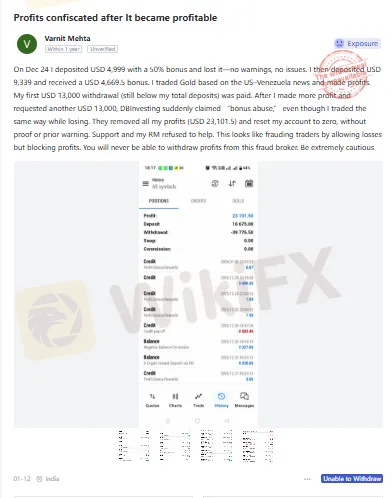
Consider the detailed case of trader Varnit Mehta. He deposited funds, traded, and initially lost capital without any issue or warning from the broker. After a subsequent deposit of over $9,300, he began trading profitably. His first withdrawal request for $13,000, which was still less than his total deposits, was processed successfully. This is a common tactic to build a false sense of security. However, once he generated significant profits and requested another $13,000 withdrawal, Dbinvesting suddenly accused him of “bonus abuse.” The broker then unilaterally removed all his profits, amounting to $23,101.5, without providing any proof of the alleged violation.
This experience is not unique. User FX3659739811 reported a similar story. After trading profitably, they were accused of bonus misuse via a single email. When they contested the claim and asked for evidence, none was provided. The broker then presented two coercive options: continue trading under scrutiny or forfeit all profits and the bonus to retrieve the initial deposit. Feeling trapped, the user reluctantly agreed just to get their principal back.
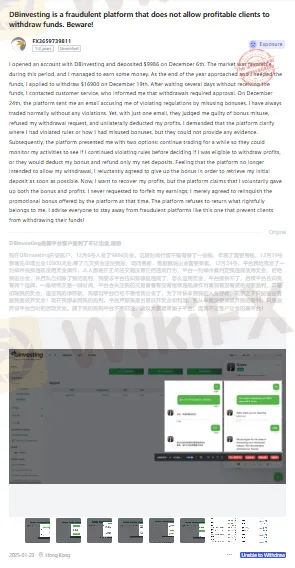
The common thread is clear: profits are tolerated, and small withdrawals may even be permitted, but as soon as a trader attempts to withdraw substantial earnings, a pretext is found to block the funds.
Withdrawal Obstruction
Beyond profit confiscation, a pattern of general withdrawal obstruction is widely reported. The justifications provided by the broker often appear to be shifting and arbitrary, designed to frustrate the client until they give up.
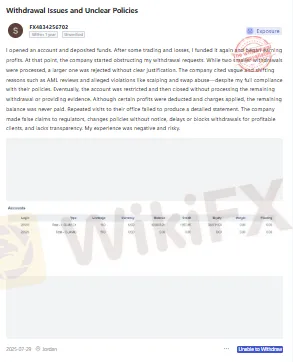
User FX4834256702 shared an experience that exemplifies this tactic. After funding their account and becoming profitable, their withdrawal requests were systematically obstructed. The reasons given by Dbinvesting were vague and changed over time, including “AML reviews,” “scalping,” and “swap abuse,” despite the user's insistence that they complied with all policies. Ultimately, the broker closed the account without returning the remaining balance.
This sentiment is echoed in a concise but powerful statement from user “tryyu,” who warns: “In case of profits, the company will not process the withdrawal, will fabricate reasons, impose unjustified penalties, and erase the profits.”
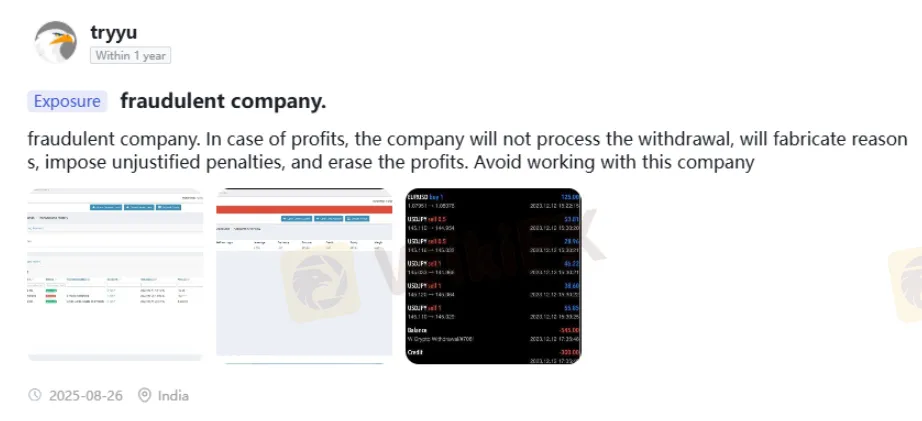
The message from these detailed accounts is consistent: profitability is a trigger for withdrawal problems.
Common Reported Tactics
Based on the collection of user complaints, we can summarize the alleged operational playbook used by Dbinvesting when dealing with profitable traders.
· Building False Trust: Allowing initial deposits and processing small, early withdrawals to create an illusion of legitimacy and encourage larger investments.
· Blocking Profit Withdrawals: Systematically delaying, rejecting or ignoring large withdrawal requests, especially those that include significant profits.
· Using Vague Justifications: Citing unsubstantiated clauses from the terms and conditions, such as “irregular trading,” “scalping,” or “bonus abuse,” to justify withholding funds without providing concrete evidence.
· Unilateral Profit Removal: Directly accessing client accounts and removing earned profits, often resetting the balance to the initial deposit amount or even zero.
· Unresponsive Support: Providing unhelpful, evasive or non-responsive customer service when clients attempt to resolve withdrawal issues or dispute profit confiscation.
Analyzing the Other Side
A balanced analysis requires acknowledging all available feedback. Dbinvesting does have a number of positive reviews online. However, a critical examination of these reviews, when contrasted with the negative complaints, reveals a telling discrepancy in their nature, detail, and substance. This contrast is, in itself, another significant red flag.
The Nature of Praise
The positive comments are overwhelmingly brief and generic. They often consist of one or two short sentences praising surface-level aspects of the service. Examples include: “good broker,” “Smooth transactions,” “fast response,” “Easy to use,” and “good offer of bonus.” While positive on the surface, they lack the specificity and context needed to be truly credible. They rarely mention specific trade scenarios, profit amounts or successful large-scale withdrawal experiences—the very issues at the core of the negative complaints.
A Tale of Two Reviews
To illustrate this stark difference, we have organized the characteristics of the feedback into a comparative table. This visual breakdown makes the disparity in quality and credibility immediately apparent.
| Feature | Negative Complaints | Positive Reviews |
| Detail Level | Highly detailed, with specific dates, dollar amounts ($23,101.5, $16,900), and narrative trade scenarios. | Very brief, generic, and lacking any specific, verifiable details. |
| Core Subject | Focus on fundamental, critical issues: withdrawal denial, profit confiscation, and account closure. | Focus on surface-level aspects: “easy platform,” “good bonus,” “fast response.” |
| Length & Effort | Often lengthy, narrative-style posts showing significant user effort to document their experience and warn others. | Typically one or two short, low-effort sentences. |
| Emotional Tone | Expresses clear frustration, a sense of injustice, and an urgent desire to warn the community and seek resolution. | Vague, general, and often emotionless positivity. |
What This Discrepancy Suggests
This pattern—highly detailed, specific and emotionally charged negative reviews versus a sea of short, generic and superficial positive ones—is a well-known warning sign in the online brokerage industry. It can strongly suggest an orchestrated campaign to either incentivize low-effort positive comments or to use them to bury the far more serious and detailed negative reports. Authentic positive experiences are usually just as detailed as negative ones, with users happy to share their success stories. The absence of such detailed positive feedback, especially concerning large profit withdrawals, is conspicuous. The sheer volume and severity of the negative complaints have directly impacted the broker's rating. You can read through all eight user complaints on WikiFX to gain a comprehensive understanding of the issues.
Foundational Flaws
The problems described in the user complaints section are not random occurrences; they are symptoms of deeper, foundational flaws in Dbinvesting's regulatory structure and operational transparency. A broker's regulatory status is the bedrock of trader protection. When that foundation is weak, the kinds of issues reported by users become not only possible but probable.
Illusion of Safety
Dbinvesting is regulated by the Seychelles Financial Services Authority (FSA) under license number SD053. On the surface, the word “regulated” can provide a sense of security. However, it is crucial to understand what “offshore regulation” means in practical terms for a trader.
Regulators, such as the Seychelles FSA, operate with far less stringent compliance requirements and oversight compared to top-tier authorities in jurisdictions such as the UK (FCA), Australia (ASIC), or Cyprus (CySEC). For the individual trader, this translates to several critical risks:
· Limited Recourse: In the event of a dispute, such as a refused withdrawal, a trader has very little effective legal recourse. Pursuing a claim against a company based in an offshore jurisdiction is often prohibitively complex and expensive.
· No Compensation Funds: Top-tier regulators typically mandate participation in investor compensation funds, which protect client capital up to a certain amount if a broker becomes insolvent. Offshore regulations rarely offer such protections, meaning if the broker fails, your funds are likely gone.
This weak regulatory environment creates a permissive atmosphere where a broker can engage in the practices described in the complaints—such as unilaterally confiscating profits—with minimal fear of serious regulatory consequences.
Verifying Physical Presence
A global broker's credibility is often backed by a tangible, physical presence in established financial centers. Dbinvesting claims a global operation, but on-the-ground verification tells a different story. WikiFX conducts field surveys to verify the registered office addresses of brokers, and the results for Dbinvesting are alarming.
· Seychelles: An office was found at the registered address. This is expected, as it is the location of its incorporation and regulation.
· Cyprus: The survey team concluded: “No Physical Presence Found.”
· Egypt: The survey team concluded: “No Physical Presence Found.”
The failure to find a physical office in Cyprus is particularly concerning. Cyprus is a major, reputable hub for the forex industry, and claiming a presence there lends a broker credibility. The finding that no such office exists suggests that the broker's projected image may not align with its actual operational substance. This lack of a verified presence in key advertised locations further erodes trust and points to a company that may not be as substantial or transparent as it appears.
Conclusion: The Clear Answer
After a thorough analysis of user reputation, regulatory oversight and operational transparency, we can return to the initial question: Is Dbinvesting safe or a scam? The evidence compiled presents a clear and concerning picture that demands extreme caution from any potential investor.
Weighing the Evidence
Let us recap the critical findings of our 2026 investigation. The case against the safety of Dbinvesting is built on multiple pillars of high-risk evidence:
· An extremely low WikiFX trust score of 2.14/10, accompanied by explicit warnings to stay away.
· A consistent and detailed pattern of user complaints alleging profit confiscation and withdrawal denial, often using “bonus abuse” as a pretext.
· Suspiciously generic and low-effort positive reviews that stand in stark contrast to the detailed, credible grievances, suggesting an attempt to manipulate online reputation.
· Weak offshore regulation in Seychelles that offers traders minimal protection, legal recourse, or access to compensation funds.
· A verified lack of physical presence in key advertised locations such as Cyprus, undermining the broker's claims of being a substantial global operation.
The Final Verdict
While the term “scam” can be a subjective label, the documented patterns of behavior, combined with the weak regulatory framework and operational red flags, place Dbinvesting firmly in the high-risk, non-recommended category for traders. The evidence does not suggest isolated incidents of poor customer service; it points to a systematic risk, especially for traders who achieve profitability. The danger of being unable to access your profits and potentially your initial capital appears to be significant and well-documented by a growing number of users.
We strongly advise traders to prioritize capital preservation above all else. Before depositing any funds with a broker, it is crucial to conduct thorough due diligence and review all available evidence. For the most up-to-date information and a full list of user exposures, visit the Dbinvesting page on WikiFX.
Update - Download the latest WikiFX app for improved broker comparison & ranking, along with extensive exposure reports. Scan the QR code below to get started.

Read more
Understanding Dbinvesting Deposit and Withdrawal: What Traders Should Know
When choosing a forex broker, few things matter more than how easy it is to make investments and withdraw them. Looking into the Dbinvesting Deposit and Dbinvesting Withdrawal processes is an important part of researching this broker. At first glance, this broker offers normal payment options. However, many users have reported serious problems that show a big difference between what the company promises and what actually happens to real traders. This article aims to give you the complete, honest truth. We will look at both the official procedures that Dbinvesting advertises and the real risks that every trader needs to know about. Here's some important background: as of early 2026, WikiFX (a global financial review website) gives Dbinvesting a very low score of 2.14 out of 10 and warns users to "Low score, please stay away!" This creates a dangerous situation where traders need to be extremely careful. This guide will first explain the payment methods the company claims to offer, then
Dbinvesting Regulation: A Complete Guide to Its License and High-Risk Status
When looking at a broker, the first question is always about safety. Is Dbinvesting a safe platform for your investments? The immediate answer is complicated and requires extreme caution. While Dbinvesting is officially a regulated company, its license comes from the Seychelles Financial Services Authority (FSA), which is classified as an offshore regulator. This difference is important and forms the basis of the high-risk status connected to this broker. This initial concern is made worse by objective, third-party data. As of our 2026 review, Dbinvesting holds an extremely low WikiFX safety score of just 2.14 out of 10. This score is not random; it is a data-based reflection of the broker's weak regulation, lack of transparency, and most importantly, its track record with clients. The platform has been flagged for a large number of serious user complaints, which show a disturbing pattern of issues, especially concerning withdrawing funds and the random cancellation of profits. The pu
Evest Broker Review: Regulated, but Complaints Persist
Evest is regulated, yet exposure reports cite withdrawal issues and aggressive managers. Verify the license on the WikiFX App before you deposit.
4T Broker Review: Regulation, Risks & Scam Alerts
Is 4T a safe forex broker? Learn how FCA and offshore licenses work, the risks traders face, and how the WikiFX App helps you avoid 4T scams before investing.
WikiFX Broker
Latest News
RM115 Million Lost in a Month: Are Malaysians Underestimating Investment Scams?
WikiFXInvest RM300, Make RM10,000? Police Say It’s a Scam
WikiFXMiddle East Tensions Rattle Risk Sentiment: Airspace Closures Signal Supply Fears
WikiFXWar in the Middle East: Oil Spikes and Stocks Tumble as Conflict Enters "Uncharted Territory"
WikiFXCySEC Withdraws CIF License of OBR Investments Ltd (OBRInvest)
WikiFXInvestment Scams That Could Be Targeting Malaysians Right Now
WikiFXGeopolitical Conflict Drives Gold Rally as Insurers Cut Gulf Coverage
WikiFXFX Markets: King Dollar Reigns Amid Chaos; BoJ Eyes "Neutral" Rates
WikiFXOil Markets Rally as Escalating Middle East Conflict Threatens Supply Lines
WikiFXXBTFX Review: Beware of Offshore Regulated Forex Traps
WikiFXRate Calc
