Understanding Xlibre's Regulation: What You Need to Know About Its License and Risk Level

Abstract:When choosing a broker, the most important question is: "Is my broker properly regulated and is my capital safe?" For Xlibre, the answer is straightforward but worrying. Based on detailed research from independent global regulatory checking platforms, Xlibre is not regulated by any major financial authority. This article looks at the main issues around Xlibre Regulation status, or more correctly, the lack of it. We will examine the truth behind the claimed Xlibre License and explain why its business setup has high-risk warning signs such as a "Suspicious Regulatory License" and very low trust scores from auditors. The goal of this research is to give a clear, fact-based analysis of Xlibre's company registration, its claims, and the real risks these create for traders' capital. While this article provides a detailed analysis, regulations can change. Traders should always check the most current information before working with any broker. You can find the detailed verification report for
The Main Question
When choosing a broker, the most important question is: “Is my broker properly regulated and is my capital safe?” For Xlibre, the answer is straightforward but worrying. Based on detailed research from independent global regulatory checking platforms, Xlibre is not regulated by any major financial authority. This article looks at the main issues around Xlibre Regulation status, or more correctly, the lack of it. We will examine the truth behind the claimed Xlibre License and explain why its business setup has high-risk warning signs such as a “Suspicious Regulatory License” and very low trust scores from auditors. The goal of this research is to give a clear, fact-based analysis of Xlibre's company registration, its claims, and the real risks these create for traders' capital. While this article provides a detailed analysis, regulations can change. Traders should always check the most current information before working with any broker. You can find the detailed verification report for Xlibre on WikiFX.
Warning Signs About Regulation
Understanding a broker's regulatory status is not just paperwork; it protects traders. Xlibre's situation shows several warning signs that need careful review. We will explain what its unregulated status means, look at its offshore registration, and investigate conflicting information that has appeared in user complaints.
Not Regulated: What This Means
Xlibre operates without a valid financial services license from any respected, top-level regulatory authority. This is not a small issue—it is a major problem in how they operate. For a trader, working with an unregulated company has serious and direct consequences:
· There is no legal promise that client capital is kept in separate accounts, away from the company's operating funds. This means your money could be at risk if the company has financial problems.
· You cannot access investor protection programs. If the broker goes out of business, there is no fund like the UK's FSCS or Cyprus's ICF to pay you back for your losses.
· There is no official, neutral organization for solving disputes. If you have a problem, such as trouble withdrawing capital, your only option is the broker's internal process, which has no outside accountability.
· The broker can change its rules, manipulate prices, or even stop operating completely without any regulatory oversight or legal responsibility to its clients.
The Mauritius Registration Strategy
According to available information, Xlibre is registered as a company in Mauritius, with a listed address at Office 306, 3rd Floor, Ebene Junction, Rue De La Democratie, Ebene 72201. It is important to understand the difference between a simple business registration and a financial services license. Registering a company in an offshore location, such as Mauritius, is a fairly easy administrative process. It proves the company legally exists, but it does not mean it is authorized or monitored to offer complex financial services like forex and CFD trading. Offshore locations are often chosen specifically for their minimal oversight, lower money requirements, and relaxed reporting standards—features that benefit the company, not the trader. This registration should not be confused with real regulation.
Looking at Conflicting FSCA Information
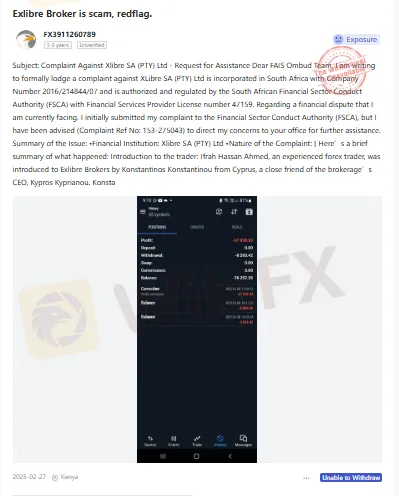
A major warning sign comes from user complaints filed in early 2025. One detailed complaint claims that “XLibre SA (PTY) Ltd” is authorized by the South African Financial Sector Conduct Authority (FSCA) with license number 47159. This creates an important point of confusion. Is this South African company the same as the global exalibre.com website that operates out of Mauritius? Is this FSCA license active, and does it even cover the retail forex trading services being offered to global clients? Often, high-risk brokers use a legitimate-sounding but unrelated license from one location to create a false sense of security for clients of a separate, unregulated company. Such differences are a sign of brokers trying to appear legitimate while avoiding real oversight. This conflicting information makes independent verification absolutely necessary. Cross-checking these claims on a comprehensive tool is vital. For instance, a check on WikiFX immediately shows the broker's primary operational status as unregulated, raising significant doubt about the relevance of the FSCA claim for international clients using the main platform.
Breaking Down the “Xlibre License”
The term Xlibre License is misleading. What the broker has is a business registration in an offshore location, which is fundamentally different from a license that provides real trader protection. This section will clarify this difference and show what traders are missing by working with an unregulated company.
Registration vs Regulation
Having a company name such as “XLibre” and a registered office in Mauritius simply proves the corporate entity exists. It is an administrative fact, not a mark of financial compliance or oversight. A true financial license for offering forex trading to retail clients would be issued by a strict regulatory body. These include the Financial Conduct Authority (FCA) in the United Kingdom, the Australian Securities and Investments Commission (ASIC) and the Cyprus Securities and Exchange Commission (CySEC). Xlibre does not hold a license from any of these top-tier authorities. Therefore, any marketing that suggests it is a “licensed” broker is deeply misleading. Its license is for business operation, not for ensuring the fair and safe conduct of financial trading.
What a Real License Guarantees
The gap between a regulated broker and an unregulated one like Xlibre is huge. The protections you give up are not minor; they are the core safety nets of the modern trading world. The following table provides a clear comparison of what a top-tier regulated broker offers versus what is absent at Xlibre.
| Feature | Top-Tier Regulated Broker | Xlibre (Unregulated) |
| Fund Security | Client funds must be held in segregated bank accounts. | No legal guarantee of segregation; funds are at risk. |
| Negative Balance Protection | Often mandated by law, protecting you from debt. | Claimed, but not enforceable by an external regulator. |
| Investor Compensation Fund | Yes, access to schemes like FSCS (UK) or ICF (Cyprus). | No access to any compensation fund. |
| Dispute Resolution | Access to an independent financial ombudsman service. | Internal process only; no impartial third-party recourse. |
| Operational Audits | Regular, mandatory audits by the regulator ensure fair practices. | No independent oversight or mandatory audits. |
| Leverage Limits | Capped at reasonable levels (e.g., 1:30 in EU/UK) to protect traders. | Extremely high leverage (1:2000) offered, increasing risk. |
Understanding the Warning Signs
Independent verification platforms have assigned specific warning tags to Xlibre, including “Suspicious Regulatory License” and “Suspicious Scope of Business.” These are not random labels; they are expert interpretations of risk. “Suspicious Regulatory License” directly points to the misleading nature of its registration versus actual regulation. “Suspicious Scope of Business” is equally concerning. It suggests that the broker is providing services—specifically high-leverage forex and CFD trading—that it is not legally authorized to offer under any credible regulatory framework. This means it is operating outside the established rules designed to protect consumers, placing its clients in a position of significant financial danger.
Operating Risks and Experiences
Beyond the abstract concept of regulation, the operating practices and user-reported experiences of a broker paint a clear picture of the real-world risks. For Xlibre, these elements align perfectly with the dangers expected from an unregulated entity.
The Appeal of Extreme Leverage
Xlibre offers leverage up to an amazing 1:2000. For new traders, this can seem like a powerful tool to maximize potential profits. However, industry experts and regulators view such high leverage as a major red flag. Top-tier regulators in locations such as the UK, EU, and Australia have deliberately limited leverage for retail clients (often at 1:30 for major forex pairs) for one simple reason: to protect them from catastrophic losses. Extreme leverage magnifies losses just as much as it magnifies gains, and it can wipe out a trading account in seconds. Offering 1:2000 leverage is a tactic used by offshore brokers to attract risk-seeking clients, without regard for their financial safety.
Documented User Complaints
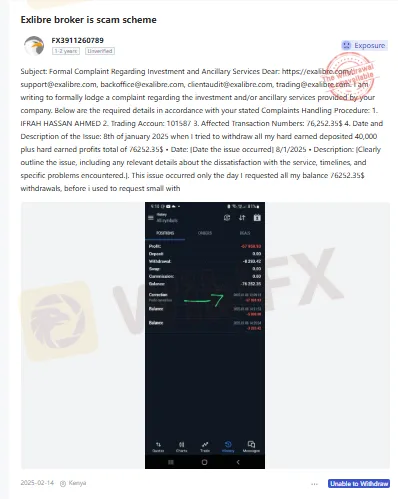
Theory becomes reality when we examine user experiences. In early 2025, a series of alarming complaints against Xlibre surfaced. These are not minor grievances; they are serious allegations of financial misconduct. One user filed a formal complaint labeling the broker a “scam” and a “redflag.” An even more disturbing report details a specific withdrawal issue involving a trading account with a balance of $76,252.35. The user claims that after depositing capital and earning profits, their withdrawal request on February 14, 2025, was not honored. These first-hand accounts provide powerful social proof of the risks. They are the predictable and tragic outcomes when traders entrust their capital to a broker that operates without accountability.
Withdrawal and Payment Concerns
Xlibre's official documentation states a withdrawal processing time of “2-7 business days” for methods such as VISA, Mastercard, and SWIFT transfers. On its own, this timeframe is not unusually long for international transactions. However, when viewed in the context of its unregulated status and the serious user complaints about failed withdrawals, it becomes another significant risk factor. Without a regulator to enforce payment processing rules, a stated timeframe is merely a guideline that the broker can choose to ignore without consequence, leaving the trader with little to no recourse to recover funds.
Final Judgment and Self-Protection
After a thorough analysis of the evidence, a clear picture of Xlibre emerges. This final section will provide a conclusive verdict and equip you with a practical, actionable strategy to protect yourself from similar high-risk brokers.
Conclusion: A High-Risk Broker
The evidence is overwhelming. Xlibre is an unregulated broker operating from an offshore location. It presents conflicting and misleading information regarding its regulatory status, offers dangerously high leverage, and, most importantly, has been the subject of serious user complaints regarding six-figure withdrawal failures in 2025. The concept of Xlibre Regulation is a fiction; the broker operates in a regulatory vacuum. Based on this comprehensive analysis, we conclude that Xlibre is a high-risk entity that should be avoided by all traders who value the safety of their capital.
Your Research Checklist
In the world of online trading, your most powerful tool is independent verification. Before depositing with any broker, you must conduct your own research. Follow this simple, effective checklist to protect yourself:
1. Always Check Regulation First. Before you even look at spreads, bonuses or account types, your first step must be to check the broker's regulatory status. This is non-negotiable.
2. Use a Trusted Verification Tool. Do not take the broker's word for it. Use independent platforms, such as WikiFX, which gathers data from global regulators, compiles user reviews, and conducts its own on-site investigations. This search function provides a comprehensive report on any broker's legitimacy.
3. Cross-Check License Numbers. If a broker claims to have a license (like the FSCA number mentioned in Xlibre's case), go directly to that regulator's official public register. Verify the license number, check if it's active, and confirm which specific website domains are approved under that license.
4. Read User Reviews and Complaints. Look for patterns in user feedback. While a few negative reviews are normal for any business, consistent complaints about withdrawal problems are a massive red flag and often the first sign of a failing or fraudulent operation.
In trading, protecting your capital is the first and most important job. Always prioritize brokers with a long, proven track record and robust, top-tier regulation.
For a complete and up-to-the-minute report on Xlibre's status, including all user-submitted complaints and detailed corporate information, please refer to its profile on the WikiFX Global Broker Regulation Inquiry App.
Read more
MYFX Markets: Is it Legit or a Scam? This Review Will Tell You the Answer!
Is your trading experience with MYFX markets full of fund withdrawal denials despite repeated communications with its customer support team? Has the broker deleted all your profits? Did the broker accuse you of false trading strategy implementation while deleting your profits? There have been many such instances reported by traders against these activities online. In this MYFX Markets review article, we have shared some complaints. Take a look!
Exfor Exposure: Investigating Alleged Withdrawal Denials, Illegitimate Account Closure & More
Exfor, a Malaysia-based forex broker, has allegedly been the centre of attention for all the wrong reasons. These include long-pending withdrawal denials, no communication or assistance from the broker’s customer support team, manipulated pricing upon a withdrawal request by the trader, and account blowups due to bonus-related issues. It’s the traders who allegedly bear the brunt of all these suspicious trading activities. A lot of them have criticized it on broker review platforms. We have highlighted some of their complaints in this Exfor review article. Take a look!
Axiory Exposed: Low WikiFX Score & Trader Complaints!
Axiory WikiFX score 1.5: Active Belize FSC license (no FX authorization), multiple complaints. Reports show withdrawal/support issues. Traders beware.
RCG Markets Exposed: License Verification & Trader Complaints
RCG Markets holds a valid FSCA license. Reports show withdrawal rejections & stop‑loss issues. Traders urged to verify details and exercise caution.
WikiFX Broker
Latest News
WikiFX Invitation Rewards Program
WikiFXMentari Mulia Review : Is This BAPPEBTI-Regulated Indonesian Forex Broker Right for You?
WikiFXEnergy Crisis Deepens: Hormuz Blockade Risks Physical Supply Shock
WikiFXECB Watch: Energy Shock Won't Derail Policy Path, Says Nomura
WikiFXOil War Shock: Diesel Futures Surge 34% as White House Pledges Military Escort for Tankers
WikiFXMiddle East conflict poses fresh test to central banks as oil shock fuels inflation
WikiFXAUD & NZD Slip as Mixed China PMI Data Clouds Recovery Signal
WikiFXNigeria: Tinubu Overhauls Fiscal Team Amid Fuel Price Hike and Inflationary Pressures
WikiFXGlobal Divergence: Eurozone Inflation Fears vs. China's "Value" Play
WikiFXGeopolitical Shock: Reports of Iranian Drone Strike on U.S. Embassy in Riyadh
WikiFXRate Calc
