Key To Markets Review: Unregulated Broker Risk Alert
Abstract:Is Key To Markets safe? Revoked regulation, user complaints, and withdrawal issues raise red flags. Read this WikiFX review before you deposit.
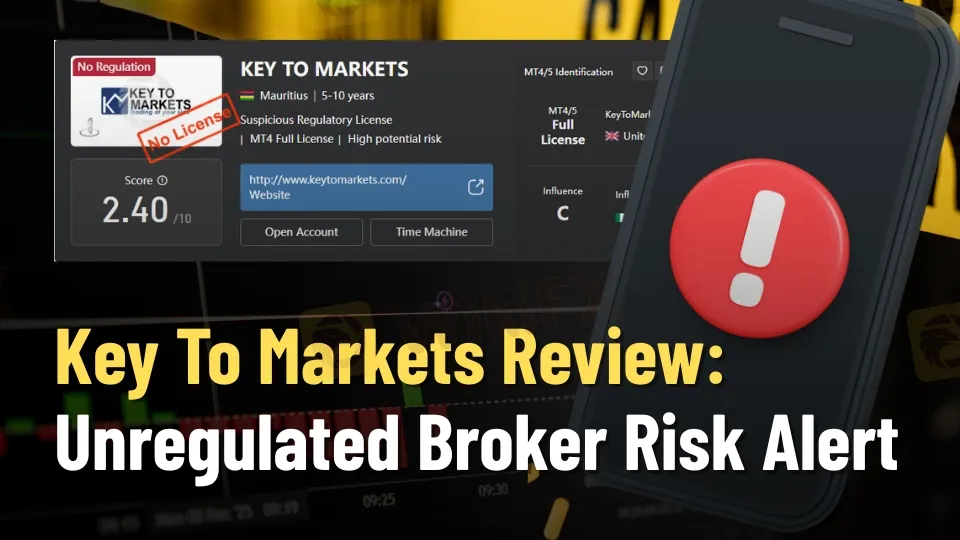
Key To Markets: High-Risk Forex Broker With Revoked License
Key To Markets presents itself as an ECN broker offering over 400 CFDs on forex, stocks, indices, commodities, and cryptocurrencies via MT4 and MT5 with spreads from 0.0 pips and leverage up to 1:500. However, its regulatory status is marked as “Revoked,” meaning it no longer holds an active license, which places traders at higher risk compared with fully regulated forex brokers. This article uses data and user feedback from the WikiFX broker page and WikiFX App to highlight payout issues, withdrawal problems, and other red flags potential clients must understand before funding an account.
Brief Broker Overview: What Is Key To Markets?
According to its WikiFX profile, Key To Markets was registered in Mauritius in 2010 and operates as an ECN broker, marketing access to over 400 CFD instruments, a minimum deposit of 50 USD, and no inactivity fees. It supports MT4 and MT5 on desktop, web, and mobile, offers raw spreads starting from 0.0 pips, and promotes ECN execution with no stated trading commissions on its main account types. While these features can look attractive to forex and CFD traders, they must be weighed against the absence of a valid license and growing trader complaints highlighted on WikiFX.
Regulation and Safety: Revoked License and Unregulated Risk
WikiFX lists Key To Markets regulation as “Revoked,” even though it was previously associated with a license number under the UK Financial Conduct Authority (FCA). A revoked status means the broker no longer benefits from full FCA oversight, compensation schemes, or robust dispute resolution, which dramatically reduces investor protection in the event of fraud, misconduct, or insolvency. In practice, this places Key To Markets in the unregulated broker or high-risk category for many traders, especially when combined with leverage up to 1:500 that magnifies both profits and losses.
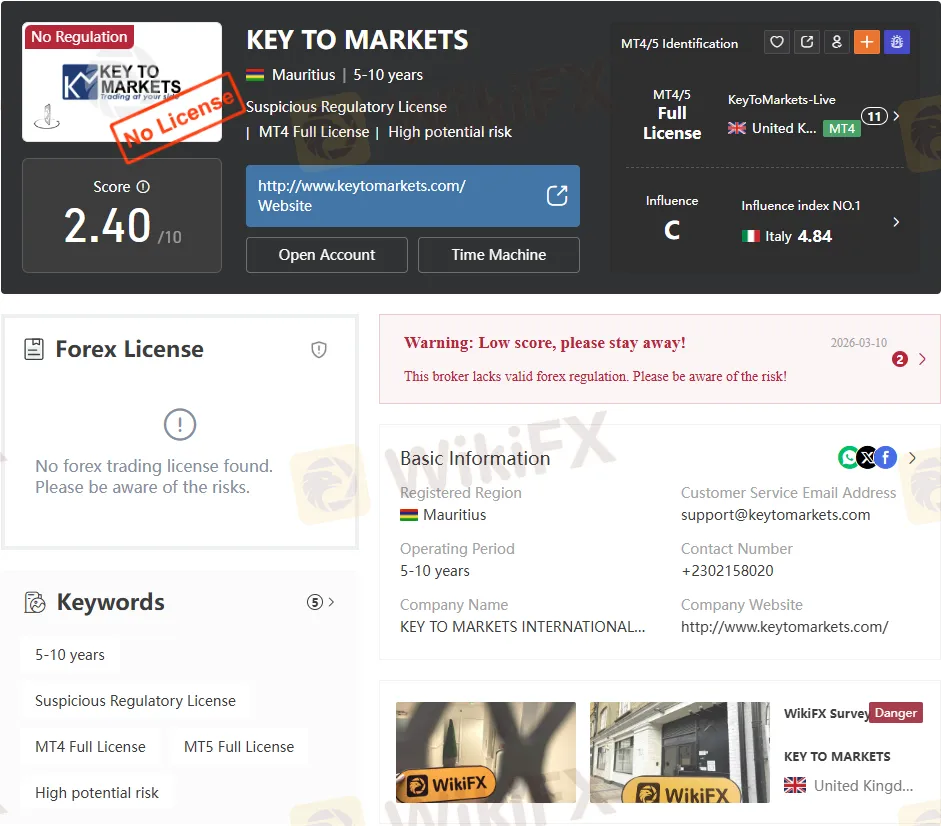
For traders searching for a safe forex broker, a revoked license is a serious warning sign, because it can be linked to compliance problems, regulatory breaches, or strategic shifts offshore that weaken client safeguards. The WikiFX App highlights this regulatory downgrade clearly, which is why checking Broker Regulation and license status on WikiFX before investing is essential to avoid potential forex scams or online trading scam exposure.
User Complaints: Deposit and Withdrawal Issues You Should Not Ignore
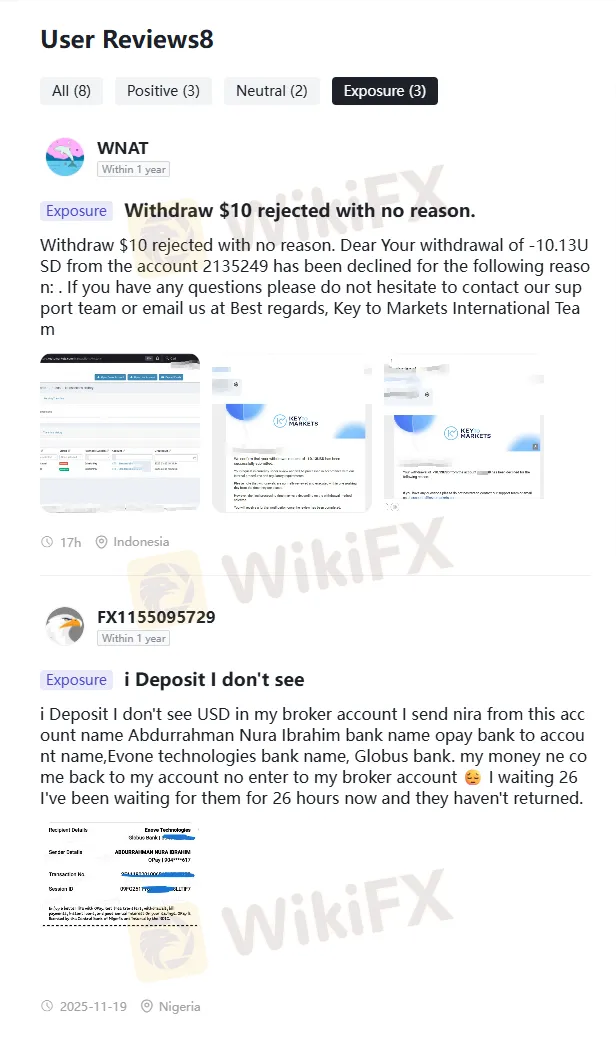
The user reviews section on the WikiFX page for Key To Markets reveals serious operational concerns, especially involving deposit and withdrawal problems. One Nigerian trader reports depositing funds in naira via a local payment route (through Opay bank to an account named Evone Technologies at Globus Bank) and states that the money neither appeared in the broker account nor returned to the sender after 26 hours of waiting. This kind of deposit-related complaint suggests potential payout issues and raises the possibility of funds being stuck or mishandled, which is a major red flag for any forex broker.
Another case from Indonesia describes a rejected withdrawal of approximately 10 USD with no clear reason provided, quoting a message that the withdrawal “has been declined for the following reason:” followed by a blank explanation. Even though the amount is small, withdrawal denials without transparent justification undermine trust and reinforce concerns that traders may face broader withdrawal issues or online investment scam–like behavior if larger sums are involved. When a broker with a revoked license also draws trader complaints around deposits and withdrawals, the risk profile moves closer to a possible forex trading scam scenario that should not be underestimated.
Trading Conditions vs. Risk: Attractive Spreads, But At What Cost?
On paper, Key To Markets offers competitive trading conditions: raw ECN spreads from 0.0 pips, leverage up to 1:500, and over 400 tradable instruments across forex, commodities, stocks, indices, and cryptos. It promotes two main account types (Standard and Pro) with a minimum deposit of 50 USD, minimum lot size of 0.01, no stated maximum position size, and no commission according to the WikiFX summary table. The broker also lists multiple payment options for deposits and withdrawals, including SWIFT, SEPA, bank cards, Skrill, STICPAY, UnionPay, crypto, and PayRetailers, with indicative processing times ranging from instant to several working days.
However, good-looking spreads, platforms, and payment options do not compensate for key structural dangers: revoked regulation, limited transparency on dispute resolution, and real trader complaints around deposit and withdrawal handling. A broker can advertise fast withdrawals and flexible funding, yet still delay, reject, or freeze transactions in practice, which is why actual user complaints, not just marketing claims, are critical when assessing potential forex broker scams. The WikiFX App is particularly useful here because it consolidates both technical broker data and live user feedback, providing a more realistic picture of payout reliability and withdrawal risks.
High‑Intent Risk Signals: When to Treat Key To Markets as a Scam Alert
Several high-intent risk indicators appear when you review Key To Markets via WikiFX: a revoked license, complaints about deposits not arriving, and unexplained withdrawal rejections. For traders, these signs often precede more serious issues such as account freezes, account suspension during profitable periods, or escalated withdrawal denials once balances grow, patterns frequently seen in forex fraud and online trading scam cases. While not every complaint automatically proves a full-blown forex investment scam, the combination of regulation problems and negative user feedback is enough to justify a strong scam alert stance and extremely cautious exposure, if any.
Traders searching for a funded account, trading challenge, or straightforward forex broker should consider that using an unregulated broker with revoked status can result in unrecoverable losses, especially when deposits are routed through third-party payment processors or local banks with weak recourse mechanisms. Instead of chasing raw spreads or high leverage at any cost, using the WikiFX App to verify broker regulation, read trader complaints, and check for previous allegations or forex broker scams is a far more prudent way to protect your capital.
Practical Safety Tips for Traders Considering Key To Markets
If you are still thinking about opening or funding an account with Key To Markets despite these warnings, you should reduce your risk as much as possible. Start with the smallest deposit, avoid large single transfers, and document every transaction (screenshots, emails, payment confirmations) so you have a clear trail if withdrawal problems occur. Test withdrawals early and often, withdrawing small amounts shortly after your first deposit, and repeat tests whenever you increase capital or profitability to detect payout issues before your balance becomes significant.
Always verify the current Broker Regulation status on WikiFX, because a broker‘s license situation can change over time, and a revoked or offshore-only setup greatly increases your exposure to online investment scam patterns. Make it a habit to check trader complaints and reviews on the WikiFX App before choosing any forex broker, especially if you trade from higher-risk regions or rely on local payment intermediaries where recourse can be limited. If you already experience withdrawal denials, unexplained delays, or login failure around the time you try to cash out, treat that as a critical warning and seek assistance, including reporting the case via WikiFX’s complaint and review channels.


Read more
VORBIX MARKETS Review: No License, Withdrawal Risk
Is VORBIX MARKETS safe? Read this WikiFX review on no license status, withdrawal issues, and trader complaints before you deposit. Download now.
CySEC Put Cyprus Brokers on Notice in Last Week’s Conflict-of-Interest Sweep
CySEC has told Cyprus brokers to prepare for on-site inspections and desk reviews focused on conflicts of interest and retail product sales.
Amana Review: Regulation, Complaints, Withdrawal Risk
Read this amana review covering broker regulation, user complaints, and withdrawal risk signals on WikiFX before you deposit. Check the facts now.
Capital FX Review: No License and Withdrawal Complaints
Capital Fx shows no valid regulation on WikiFX, and reviews cite withdrawal problems and steep fees. Read the warning signs on the WikiFX App.
WikiFX Broker
Latest News
Canadian Regulators Say More Than 7,500 Fraudulent Investment and Crypto Websites Were Taken Down
 WikiFX
Oil prices jump above $100 for first time in four years
WikiFXRetiree’s Tabung Haji Savings Gone: Elderly Retiree Loses RM277,000 After One Whatsapp Message
WikiFXUS NFP Preview: Markets Brace for Volatility as Employment Data Tests Fed's Patience
WikiFXCrude Oil Rallies to $85 on Escalating Middle East Geopolitical Risks
WikiFXForex Brief: Dollar Dips Ahead of NFP; RBA Bets Lift AUD
WikiFXHeroFx Review: Withdrawal Problems, Scam Alert & Risks
WikiFXJRJR Review: Safety, Regulation & Forex Trading Details
WikiFXMiddle East Conflict Esculates: Cloud Infrastructure Targeted as US & Israel Strike Tehran
WikiFX9X markets Review 2026: Is this Forex Broker Legit or a Scam?
WikiFXRate Calc
