US Open: Wall Street bulls take the stage!
Abstract:U.S. stock indexes opened on a positive note as the latest PCE data indicated a decrease in inflation, easing concerns about potential interest rate hikes.

• Wall Street opens higher as PCE data reveals lowest inflation in over 2 years
• S&P 500 is up 1.0%, and Nasdaq Composite gains 1.1%
• Headline PCE shows a modest 0.1% increase in May, while year-over-year price increase slows to 3.8%
U.S. stock indexes opened on a positive note as the latest PCE data indicated a decrease in inflation, easing concerns about potential interest rate hikes. The Dow Jones Industrial Average climbed 0.5%, the S&P 500 rose 0.8%, and the Nasdaq Composite saw a gain of 1.1%.
The PCE deflator, the Federal Reserve's favored inflation gauge, slowed to 3.8% in May, accompanied by stagnant consumer spending, indicating a potential loss of momentum in the economy. The core PCE reading also softened to 4.6%, while services inflation, excluding housing and energy services, experienced a welcome deceleration. These figures led to increased futures gains and the reversal of losses in benchmark Treasuries, as market speculation suggested reduced pressure on the Fed for multiple interest rate hikes by the end of 2023.
On the other hand, in the euro-area, core inflation accelerated in June, posing a setback for the European Central Bank (ECB) and potentially strengthening its determination to raise interest rates next month. The measure of underlying consumer-price gains rose to 5.4%, while headline inflation reached 5.5%, both slightly higher compared to the previous month.
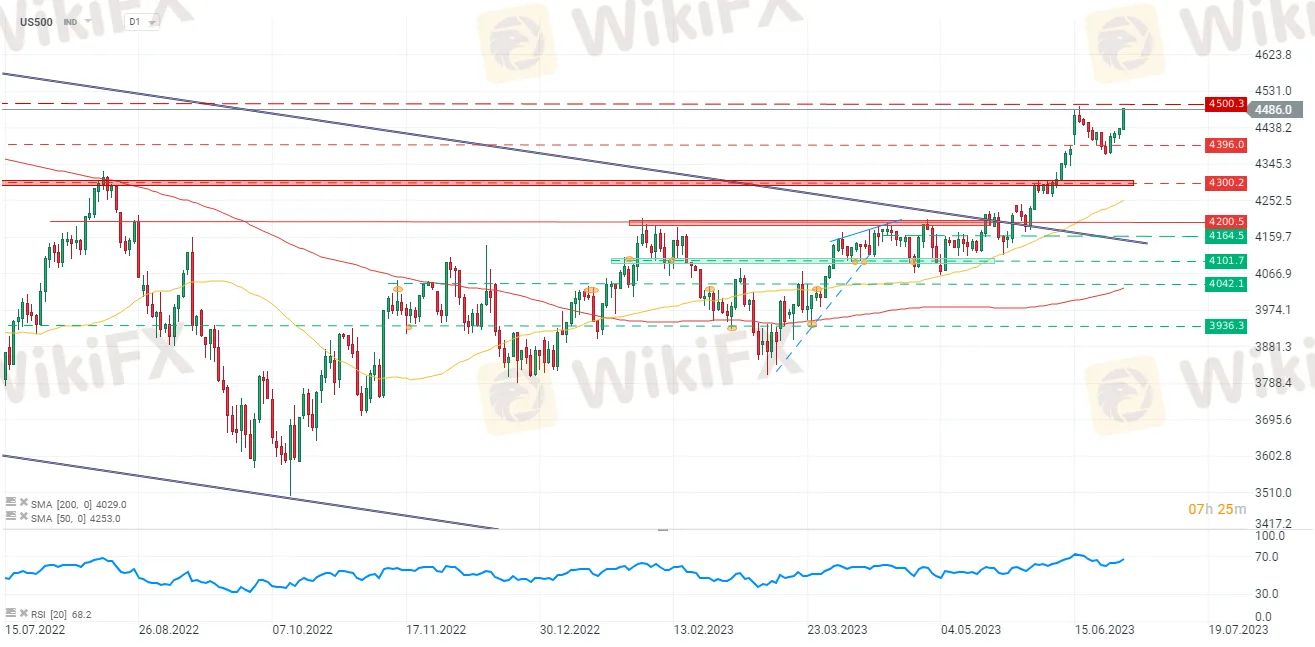
US500 index, currently trading at 4490 points, has shown a significant 1.2% increase on june 30. It recently experienced a bounce from the support level at 4400, indicating a potential shift in momentum. As the index approaches the 4500 level, it is important to monitor its ability to break through this resistance. A successful break of 4500 could potentially pave the way for further gains towards the next level at 4550.


Read more

Pakistan Forex Reserves Reach $22.5 Billion: Why a Stable USD/PKR Snapshot is Not Yet a Trend
Pakistan forex reserves stood at $22.506 billion on 13 August 2026, while the SBP dashboard showed a USD/PKR mark to market rate of 277.5713 on 20 August. This article separates the SBP forex reserves facts from predictions about the Pakistan rupee and the forex market Pakistan.

Multi-Asset Liquidity Solution in 2026: Expand Instruments Without Fragmenting Execution
A multi-asset liquidity solution can help a broker support FX, CFDs, commodities, and indices through a more unified operating model. But adding asset classes can also create fragmented symbols, pricing, routing, margin rules, records, and client messages if controls are not designed first. This 2026 guide explains how a multi asset liquidity provider, forex CFD liquidity setup, commodity liquidity provider, and indices liquidity provider fit into a broker-owned execution service. It outlines the due-diligence questions, shared-control model, cost drivers, and 90-day implementation plan that help teams expand without making the execution chain harder to explain. The aim is not to promise deeper liquidity or better trading outcomes. It is to create evidence that a broker can supervise market access, trace order events, reconcile costs, and communicate consistently to the relevant clients when conditions are difficult.

XAU/USD Hits $4,500: Washington Bought Bonds—and Gold Exploded
Gold surged above $4,500 after the US Treasury expanded its purchases of longer-dated government bonds, pushing yields and the dollar lower. But this was not debt forgiveness or Federal Reserve money printing—it was a liquidity operation that exposed a much bigger fear: America may be finding it increasingly difficult to live with market-driven interest rates.
India Forex Reserves Rebound to $707 Billion: Why That Does Not Guarantee a Stronger Rupee
India forex reserves rose by $14.136 billion to $707.002 billion in the week ended 7 August 2026. This explainer separates RBI forex-reserve facts from rupee predictions, explains the role of foreign currency assets and gold, and gives forex-market readers a practical checklist before treating one headline as a trading signal.
WikiFX Broker
Latest News
India Forex Reserves Rebound to $707 Billion: Why That Does Not Guarantee a Stronger Rupee
 WikiFX
DA finance chief steps aside over R4bn SARB forex probe
WikiFXAustralia dollar on longest weekly winning streak since 2020
WikiFXMaybank Completes Malaysia's First Tokenised Financing Deal
WikiFXSingapore orders Facebook, Instagram, TikTok to ban scam ads
WikiFXReview 2026: FBS Complaints, Regulation, and Withdrawal Risk Signals
WikiFXPhillip Futures Review 2026: An A+++ Result Does Not Replace a 09:30 Withdrawal Check
WikiFXWarren Bowie & Smith Review 2026: Severe Withdrawal Complaints and Unregulated Risks
WikiFXWhy Multi-Strategy Diversification Does Not Eliminate Risk
WikiFXUS Dollar Sinks As Yields Drop
WikiFXRate Calc

