GBP/USD Forecast: Navigating the Market's Ups and Downs
Abstract:Analyzing Key Signals in the GBP/USD Currency Pair

Analyzing Key Signals in the GBP/USD Currency Pair
Technical Analysis: The GBP/USD's Downward Journey
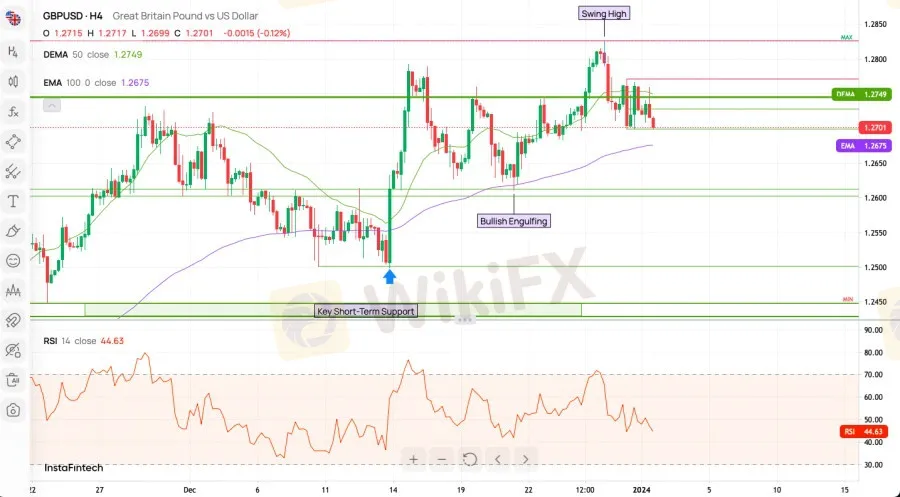
As of January 2, 2024, the GBP/USD pair has been testing critical support levels. The pair touched the intraday low at 1.2700, with bearish pressure suggesting possible further declines to 1.2675 (100 EMA) and 1.2615. The momentum indicates that bears currently have the upper hand in the market.
Indicator Analysis
- DEMA (50 Close): 1.2749.
- EMA (100 Close): 1.2675.
Relative Strength Index (RSI):
- The RSI reads at 44.63, suggesting a balanced market with potential for both upward and downward movements.
Market Dynamics
The recent 'Bullish Engulfing' pattern is crucial. If the GBP/USD stays above key support levels and the DEMA, it might signal a recovery. However, a break below the 100 EMA could tilt the market towards further bearish trends.
Weekly Pivot Points:
- Resistance Levels: WR3 - 1.28261, WR2 - 1.27709, WR1 - 1.27522.
- Pivot Level: 1.27157.
- Support Levels: WS1 - 1.26970, WS2 - 1.26605, WS3 - 1.26053.
Trading Outlook
On the weekly chart, a Bullish Engulfing pattern emerged post-breakout above 1.2340, indicating bullish dominance. The market trading above the 50 WMA and 100 WMA sets the next bull target at the 2023 high of 1.3141. On the contrary, a sustained drop below 1.1802 raises the likelihood of a significant bearish trend, potentially down to 1.1494.
H1 Intraday Indicator Signals
- Majority (17 out of 21) technical indicators signal 'Sell'; 4 remain Neutral.
- All 18 moving averages signal 'Sell'.
Sentiment Scoreboard
- General sentiment is bullish (57% bulls vs. 43% bears). This bullish trend continues from last week (60% bulls) and the past three days (58% bulls).
Conclusion: Insights for Traders
For Bulls:: A sustained position above key support levels could indicate an ongoing recovery. Keep an eye on the resistance levels for signs of a bullish continuation.
For Bears: Watch for breaks below support levels, especially the 100 EMA, as this could signal further declines.


Read more
Perry Warjiyo Resigns: Why the Rupiah Moved Above Rp18,000 per US Dollar
Perry Warjiyo resigned as Bank Indonesia governor, Destry Damayanti became acting governor, and the rupiah traded above Rp18,000. Here is what forex traders should monitor next.
MT4 White Label Cost in 2026: What Brokers Must Budget Beyond the Platform Fee
The visible fee in an MT4 white label proposal is rarely the real cost of operating it. For an existing broker, the decision is not simply whether an MT4 white label platform is “cheap” or “expensive.” The real question is whether the commercial model remains viable after integration, support, data, client migration, compliance, and exit costs are included. That is why an MT4 white label cost review should be built as a 24- to 36-month operating case. It should compare three credible choices: 1. Keep the present MT4 setup and improve its weakest controls. 2. Replace the MT4 white label provider but retain the client proposition. 3. Migrate selected clients or products to another platform while running MT4 in parallel. This guide explains how to build that case without relying on headline prices or generic vendor claims.

The Rise of Deepfake Investment Scams: ASIC Shares Key Warning Signs
Artificial Intelligence (AI) has grown remarkably recently. However, it has also amplified the scope for financial fraud. One such is the rapid use of deepfake technology involving AI-generated videos, images and audio clips imitating real people. Fraudsters are leveraging these technologies to impersonate financial advisers, celebrities, business leaders and government officials to lure victims into fake investment schemes. Understanding the emerging implications, the Australian Securities and Investments Commission (ASIC) has cautioned investors of investment avenues promoted through convincing AI-generated content. Seemingly authentic, deepfakes are designed to manipulate trust and make people transfer funds before authenticating the investment’s legitimacy.

Best White Label Trading Platform 2026
The decision to switch white label providers or migrate to a modern white label trading platform is no longer a luxury for growth-minded brokers—it's a strategic necessity for survival in 2026. The convergence of technological stagnation, regulatory evolution, and shifting client expectations has created a perfect storm.
WikiFX Broker
Latest News
BX Trade Review: Is This Unregulated Broker Worth the Risk?
 WikiFX
STMARKET Review: Withdrawal Complaints Cloud a Low-Rated Broker, What to Know Before You Deposit
WikiFXWhy the Dollar Moves Almost Every Forex Pair
WikiFXCONSOB Orders Blocking of 24 Unauthorized Investment Websites
WikiFXBitDelta Receives UAE Category 5 Licence for Introducing Activities
WikiFXRinggit Gains on Majors but Slips vs US Dollar Ahead of Fed
WikiFXtrading.com Review: FCA-Regulated, But Withdrawal Complaints Persist
WikiFXDeriv Review: What Traders Should Know Before Depositing
WikiFXDollar Steadies as Rupee Finds Market Support
WikiFXPRIME VEST SAFE Review: Is Your Deposit Safe?
WikiFXRate Calc

