Is Forex Zone Trading Regulated and Licensed?
Abstract:Forex Zone Trading is an unregulated broker with no license and an FCA warning, making it a high-risk choice for traders.
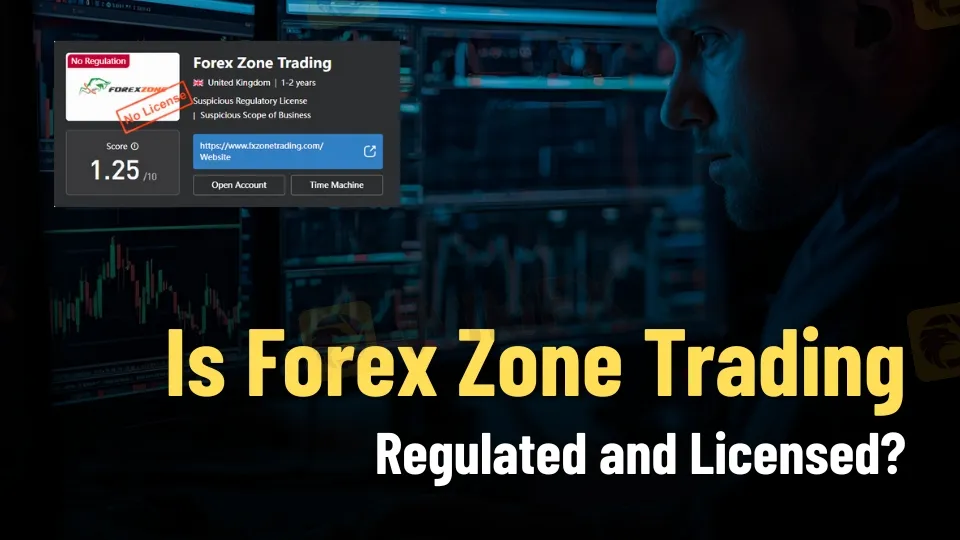
Forex Zone Trading Overview
Forex Zone Trading presents itself as a promising broker, yet it operates without regulation or a valid license. This places it outside the supervision of financial watchdogs such as the FCA, CySEC, or ASIC. For traders, this is a major warning sign: without oversight, there is no assurance of fund protection, fair practices, or reliable dispute resolution.
The company promotes itself as a UK-based forex broker. Its listed address is 100 Pall Mall Street, St. James, London SW1Y 5NQ—a location often linked with reputable financial institutions. But closer review shows no verifiable office for this broker at that site.
Forex Zone Trading claims to have been active for one to two years, yet its online presence is minimal and inconsistent. Contact details include an email (info@fxzonetrading.com) and a phone number (+52 2203098157), both of which raise doubts. The phone number, notably, carries a Mexican country code instead of a UK one, which is unusual for a firm claiming London headquarters.
Other details:
- Broker name: Forex Zone Trading
- Website: fxzonetrading.com
- Trust score: 1.25/10 (very low)
- Regulatory status: Unregulated, no license
The mix of a prestigious London address with no office, mismatched contact data, and a poor trust score suggests Forex Zone Trading may be trying to appear more credible than it is.
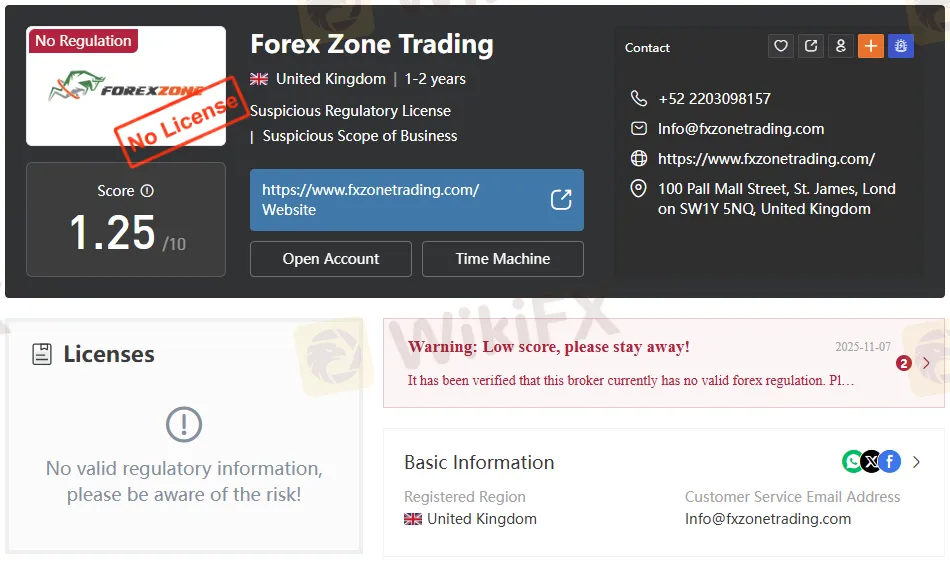
Is Forex Zone Trading Regulated?
The most important factor in assessing any broker is regulation. Forex Zone Trading is not supervised by any recognized authority. It holds no license and has been flagged for questionable claims.
Why regulation matters:
- Investor protection: Licensed brokers must separate client funds to prevent misuse.
- Transparency: Regulators require clear disclosure of fees, risks, and trading terms.
- Accountability: Regulated firms undergo audits and compliance checks.
- Dispute resolution: Clients can appeal to regulators if conflicts arise.
Without regulation, Forex Zone Trading avoids these safeguards. Depositors have no legal recourse if the broker blocks withdrawals or vanishes.
This lack of oversight is not a minor issue—it is a fundamental red flag that should deter serious investors.
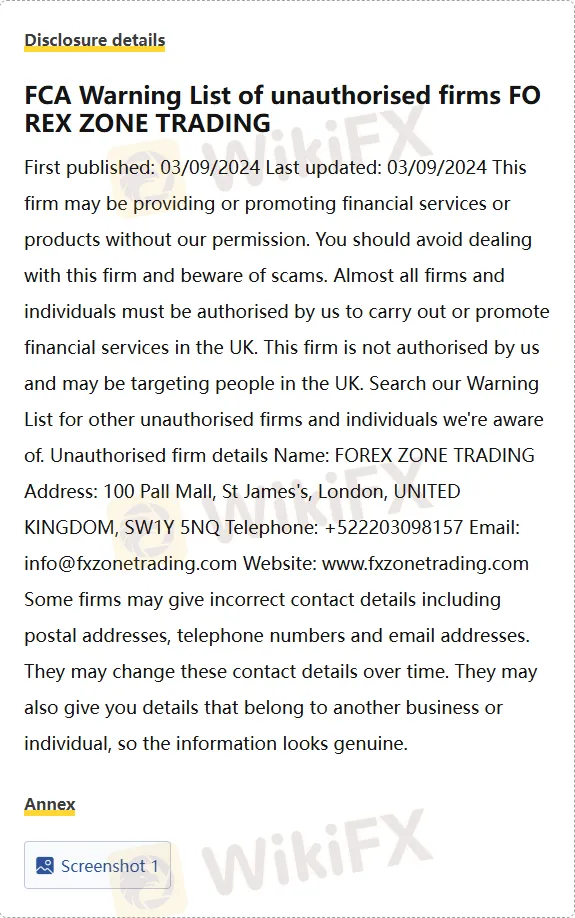
FCA Warning Against Forex Zone Trading
On September 3, 2024, the UKs Financial Conduct Authority (FCA) issued a public warning against Forex Zone Trading. The regulator confirmed the firm is unauthorized and may be targeting UK clients.
Key points from the FCA notice:
- Forex Zone Trading is not allowed to offer or promote financial services in the UK.
- The firm may be using false or misleading contact details, including addresses and phone numbers.
- Traders are advised to avoid this broker and remain alert to scams.
The FCA maintains a Warning List of unauthorized firms, and Forex Zone Trading is now included. This is significant: once a broker appears on this list, regulators have identified clear risks to investors.
For traders, the FCA warning should be taken as proof that Forex Zone Trading is unsafe. Such notices are rarely issued unless regulators have strong evidence of misconduct.
Account Types and Deposits
Forex Zone Trading advertises four account tiers—VIP, Pro, Premium, and Basic—but the information is inconsistent and incomplete.
Examples from its listings:
- VIP Account: Minimum deposit $100,000
- Pro Account: Minimum deposit $10,000
- Premium Account: Minimum deposit $1,000
- Basic Account: Minimum deposit $50
At first glance, these tiers suggest flexibility. Yet the documentation is riddled with gaps:
- Maximum leverage: Not disclosed
- Spreads and commissions: Not disclosed
- Withdrawal methods: Not disclosed
- Trading environment and product offerings: Not disclosed
The contradictions are striking. In one section, the “Basic” account requires $100,000, while elsewhere it is listed as $50. Such inconsistencies suggest either poor oversight or deliberate obfuscation.
For traders, this lack of clarity is dangerous. Legitimate brokers provide consistent details about account conditions. Forex Zone Tradings vague and conflicting information makes it impossible to know what clients are signing up for.
Forex Zone Trading Website
The brokers domain, fxzonetrading.com, is hosted on servers in the United States. This is unusual for a company claiming London headquarters.
Key observations:
- Domain IP: 104.21.28.121
- Most visited region: United States
- ICP registration: None
- Company details: Not disclosed
The absence of corporate ownership information is another warning sign. Legitimate brokers typically provide parent company details, registration numbers, and corporate structure. Forex Zone Trading offers none of this.
The website itself is sparse, with limited information about trading conditions, products, or company background. Combined with the FCA warning, this lack of transparency strongly suggests the broker is not acting in good faith.
Risks of Using Unlicensed Brokers
Working with an unregulated broker like Forex Zone Trading exposes traders to serious risks:
- No investor protection: Deposited funds may be lost without recourse.
- No dispute resolution: Clients cannot appeal to regulators if issues arise.
- High deposit requirements: Large sums demanded without justification.
- Suspicious contact details: Potentially false addresses and phone numbers.
- Low trust score: 1.25/10 signals extreme risk.
These risks are not theoretical. Many traders dealing with unlicensed brokers report withdrawal problems, sudden account closures, and complete loss of deposits.
Forex Zone Trading shows all the hallmarks of such high-risk firms: lack of regulation, misleading claims, and inconsistent account details. Traders should treat these red flags as clear warnings to stay away.
Final Verdict on Forex Zone Trading
After reviewing all available information, the conclusion is straightforward: Forex Zone Trading is unregulated, unlicensed, and officially flagged by the FCA.
Its contradictory account details, suspicious contact information, and lack of transparency make it a high-risk option for traders.
Recommendation:
Avoid Forex Zone Trading entirely. Instead, select brokers licensed by reputable regulators such as the FCA (UK), CySEC (Cyprus), ASIC (Australia), or NFA (United States). Regulation ensures accountability, transparency, and protection for clients.
For anyone considering Forex Zone Trading, the safest decision is to walk away. The risks far outweigh any potential rewards.


Read more
CMC MARKETS Analysis Report
CMC MARKETS presents a mixed picture for forex traders, earning a moderate overall rating of 6.4 out of 10 based on 228 reviews and a "Use with Caution" designation. The broker demonstrates notable strengths that have resonated with the majority of its client base, particularly its user-friendly interface that simplifies the trading experience, responsive customer support that addresses initial inquiries effectively, and a solid reputation for safety that provides some reassurance to traders. These positive attributes are reflected in the sentiment distribution, where 150 reviews were positive compared to just 47 negative ones, suggesting that many traders have had satisfactory experiences with the platform. However, the 20.6% negative rate cannot be ignored, as it highlights recurring concerns that potential clients should carefully consider.

Top Trends in India’s Forex, Gold and Stock Markets Today
While it was a flat day for India’s benchmark stock indices (Sensex & Nifty), there was a sort of recovery for the rupee in the foreign exchange market on May 21, 2026. Giving investors more reasons to enjoy was another bull run for gold, which is touching the 16K threshold for 10 grams. Taking three markets combined, the overall sentiment remains mixed for investors. Here is how the day panned out for investors across these markets.
Mazi Finance Analysis Report
Mazi Finance presents a concerning mixed picture with an overall rating of 5.2 out of 10 and a "Use with Caution" designation that should give traders pause before committing funds. Based on 41 total reviews, the broker shows a troubling 43.9% negative rate, with sentiment nearly evenly split between positive experiences (21 reviews) and negative ones (18 reviews), alongside just 2 neutral assessments. Check this extensive analysis report.
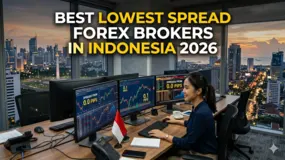
Best Lowest Spread Forex Brokers in Indonesia 2026
Indonesia's retail forex market has matured into one of Southeast Asia's most active. With more than 800,000 Indonesians now trading currencies online and demand for tighter pricing rising every year, the spread — the gap between a broker's bid and ask quote — has become the single most decisive cost factor for active traders. A difference of even half a pip on EUR/USD can add up to thousands of US dollars annually for a trader running 50+ standard lots a month. This guide breaks down the brokers offering the lowest spreads to Indonesian traders in 2026, explains exactly how spread mathematics impacts your bottom line through real trader scenarios, and walks through the regulatory framework you should understand before depositing.
WikiFX Broker
Latest News
Peace Talks Subdue Dollar and Oil
 WikiFX
US Dollar Holds Flat as Crude Oil Prices Slip
WikiFXDollar Peaks As Asian Currencies Slide
WikiFXWhy Malaysian Traders Are Rapidly Shifting Towards Multi-Asset Trading Strategies and MT5
WikiFXIs AAA TRADING Safe? A Complete 2026 Broker Review
WikiFXOcta Review: Withdrawal Delays, Regulation Warnings, and Broker Risk Exposed
WikiFXDollar Holds as Crude Oil Plunges
WikiFXOcta Review: Withdrawal Delays, Regulation Warnings, and Broker Risk Exposed
WikiFXNvidia\s record results fail to impress investors
WikiFXReview 2026: LOYAL PRIMUS Regulation, Complaints, and Platform Access
WikiFXRate Calc

