Trive Review: Is This Forex Broker Penalizing Winners?
Abstract:Our investigation into Trive exposes a severe risk pattern where profitable traders report retroactive fund deductions totaling tens of thousands of dollars under vague 'abuse' clauses. Despite holding valid regulatory licenses, recent complaints allege the broker systematically penalizes success while permitting losses.

By WikiFX Special Investigator
The most dangerous trap in the Forex market isn't a losing streak. It's winning, only to have the broker confiscate your profits.
Our investigation into Trive broker reveals a disturbing trend. While the platform boasts a high WikiFX score of 7.84 and holds licenses in major jurisdictions, a surge of recent complaints paints a different reality. Traders aren't just facing delays; they are facing direct deductions of capital. If you are trading with Trive, or considering it, you need to see this evidence first.
The “Profit Penalty”: A $30,000 Shock
Most brokers welcome volume. Trive, according to recent user reports, appears to penalize profitability.
In a case reported in December 2024, a trader from Hong Kong experienced a devastating blow. After negotiating a swap-free (interest-free) account with a Trive sales representative—explicitly approved by the company—the trader generated significant profits.
The outcome? The platforms risk department allegedly performed a “post-mortem” audit. They retroactively deducted $30,089.90 from the account, citing overnight fees that were supposed to be waived. The trader calls this “unreasonable” and a clear act of funds withholding.
This is not an isolated incident. Another investor, Mr. Wu, reported in late 2024 that after turning a losing account into a winning one, the platform deducted $18,698.72. His plea is chilling:
> “They allow you to lose, but not to win. When I applied for a profitable withdrawal, they deducted the funds directly.”
Trive Regulation & Safety Audit
Does a license guarantee safety? Not always. Our Trive regulation audit shows a complex mix of top-tier licenses and unverified claims. While they are regulated in Australia and Malta, their status in the UK and Indonesia raises validation errors.
Regulatory Status Table
| Regulator | License Type | REAL STATUS |
|---|---|---|
| Malta MFSA | Full License | Regulated |
| Australia ASIC | Full License | Regulated |
| South Africa FSCA | Financial Service Provider | Regulated |
| Virgin Islands FSC | Retail Forex License | Offshore Regulated |
| UK FCA | Investment Advisory License | Unverified |
| Indonesia BAPPEBTI | Retail Forex License | Unverified |
Critical Insight: While the Australian (ASIC) license is solid, the Unverified status for their UK and Indonesian entities is a major red flag. Furthermore, the British Virgin Islands (FSC) license is offshore, which often offers less protection for international retail traders compared to tier-1 jurisdictions.
The “B-Book” Accusation: How the Trap Works
Users suspect Trive operates a predatory “B-Book” model—where the broker takes the other side of your trade. If you lose, they keep the money. If you win, they pay out of their own pocket.
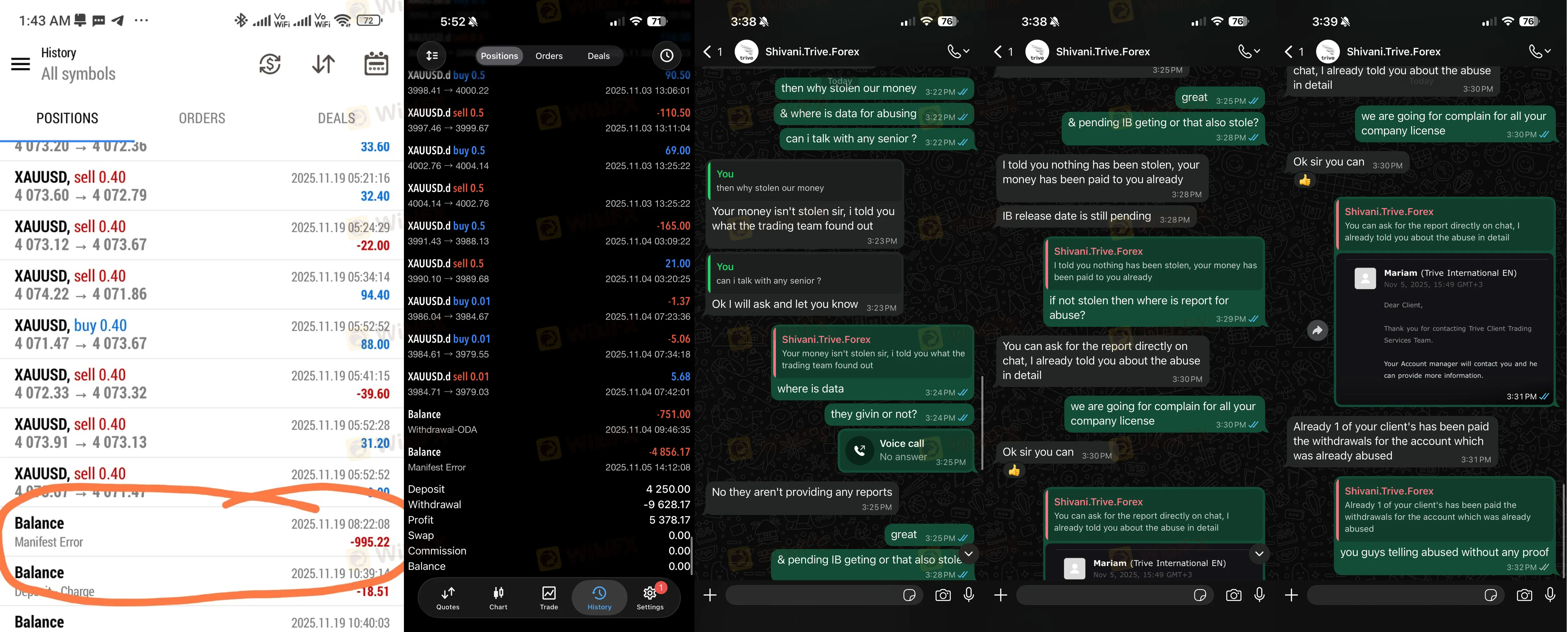
Evidence from Trive broker complaints suggests the platform may be refusing to pay these winnings:
- Selective Withdrawals: In Case 12041740 (December 2024), a trader used the exact same strategy across multiple accounts. The losing account was allowed to withdraw remaining funds immediately. The profitable accounts had $11,318 and $6,902 deducted.
- The “Abuse” Excuse: Multiple users (Case 1 and Case 3 from late 2025) report that when they ask for proof of their alleged “trading abuse,” the broker refuses to provide details. One user lost nearly $5,000 under this pretext.
Key Red Flags
Before you login to Trive, consider these distinct risks identified in our analysis:
- Retroactive Deductions: Profits removed after trades are closed, ranging from $900 to $30,000.
- Unverified Licenses: Regulatory gaps in the UK and Indonesia regions.
- Withdrawal Blocks: 14 complaints in just 3 months, with users reporting support teams stalling indefinitely.
- Bonus Traps: Reports of fake bonuses used to force position closures.
Verdict
Despite a high influence rank and established history, the current operational behavior of Trive is alarming. The pattern of allowing losses while confiscating profits suggests a severe conflict of interest.
WikiFX Guidance: We advise extreme caution. If you are profitable on this platform, document every trade and communication immediately. The Forex market is risky enough without your broker becoming your adversary.

WikiFX Broker
Latest News
Understanding Dbinvesting Deposit and Withdrawal: What Traders Should Know
 WikiFX
TradeEU Global Review 2026: Is this Forex Broker Legit or a Scam?
WikiFXEmerging Markets: South African Fiscal Strains in Focus Amid Calls for SOE Reform
WikiFXChina Economic Watch: PMI Divergence and "Two Sessions" Signal Structural Shift
WikiFXIs Tradier a trustworthy broker? A Tradier review and licensing overview based on WikiFX data.
WikiFXOil Spikes 9% and Shipping Rates Soar as Middle East Logistics Fracture
WikiFXAssetsFX Review 2026: Is this Broker Safe?
WikiFXFed Beige Book: Stagflation Risks Rise as Growth Stalls While Prices Stick
WikiFXAsia Market Volatility: KOSPI Stages Historic 12% Rebound as Capital Flows Pivot
WikiFXEvest Broker Review: Regulated, but Complaints Persist
WikiFXRate Calc
