KEY TO MARKETS: A Deep Dive into an Unregulated Forex Broker and Its Alarming Issues
Abstract:Is KEY TO MARKETS a scam? This in-depth KEY TO MARKETS review exposes the broker’s unregulated status, critical withdrawal issues, and deposit problems, urging caution for potential traders. Learn why KEY TO MARKETS regulation is a major red flag.
The Perils of Unregulated Forex Trading
The world of online forex trading offers lucrative opportunities, but it is also fraught with risks, particularly when dealing with unregulated brokers. One such entity that has drawn significant scrutiny is KEY TO MARKETS. This comprehensive KEY TO MARKETS review delves into the operational practices, regulatory standing, and reported user complaints associated with this Forex broker, aiming to provide potential investors with a clear understanding of the risks involved. Our analysis, primarily based on data from WikiFX, reveals a concerning picture that warrants extreme caution.
The Alarming Lack of KEY TO MARKETS Regulation
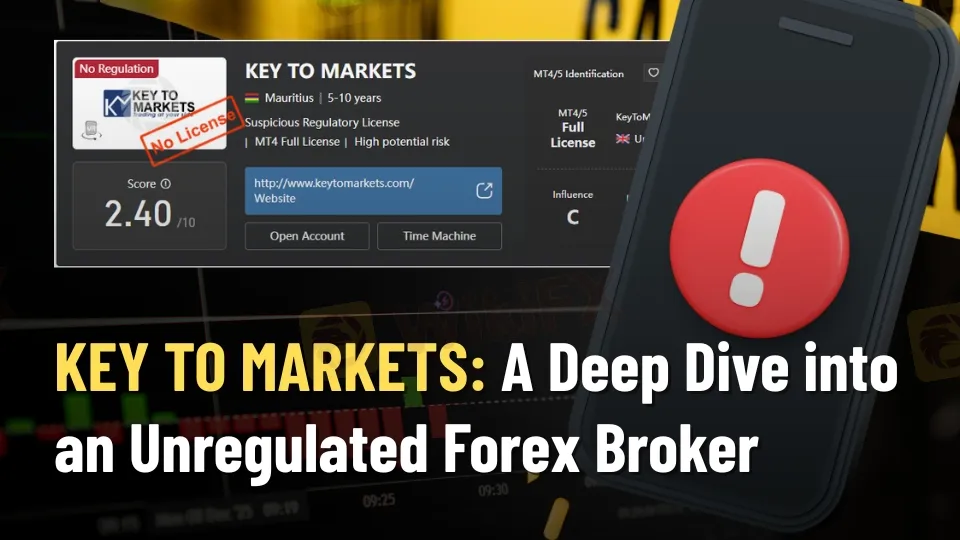
Perhaps the most critical finding regarding KEY TO MARKETS is its glaring lack of credible regulation. According to WikiFX, KEY TO MARKETS operates with
a “No Regulation” status and a remarkably low score of 2.40/10. This immediately raises a significant scam alert for anyone considering engaging with this platform. The absence of a valid forex trading license means that KEY TO MARKETS is not overseen by any recognized financial authority, leaving traders vulnerable to unchecked practices and without recourse in case of disputes.
While the broker claims to have an MT4/5 Full License, this refers to the trading platform software and not a regulatory license for financial operations. The WikiFX report explicitly states, “No forex trading license found. Please be aware of the risks.” This fundamental flaw in KEY TO MARKETS regulation is a primary indicator of high potential risk.
Red Flags and User Complaints: Withdrawal Issues and More
The lack of regulation directly correlates with a disturbing pattern of trader complaints and withdrawal issues reported by users. WikiFX highlights several exposure cases that paint a grim picture of the broker‘s operational integrity. These complaints often revolve around critical financial transactions, directly impacting traders’ ability to access their funds.
Notable Cases (2025 - Present):
- Withdrawal Denials: A user identified as WNAT from Indonesia reported a withdrawal denial of $10, stating, “Your withdrawal of -10.13USD from the account 2135249 has been declined for the following reason: . If you have any questions please do not hesitate to contact our support team or email us at Best regards, Key to Markets International Team.” This case, reported as recent as “Two days ago” (from the WikiFX update date of 2026-03-11), exemplifies the payout issues faced by clients.
- Deposit Problems: Another user, FX1155095729 from Nigeria, reported significant deposit problems on 2025-11-19. The user stated, “I Deposit I don‘t see USD in my broker account I send nira from this account name Abdurrahman Nura Ibrahim bank name opay bank to account name,Evone technologies bank name, Globus bank. my money ne come back to my account no enter to my broker account 😔 I waiting 26 I’ve been waiting for them for 26 hours now and they havent returned.” This indicates severe discrepancies in handling client funds, a hallmark of potentially fraudulent operations.
- Trading Manipulation Allegations: While not from 2025-present, an older complaint from FX7359315392 from Bangladesh (2021-09-13) describes the broker widening spreads to trigger stop losses, leading to significant losses. Although older, it points to a historical pattern of questionable trading practices that could still be prevalent. This type of allegation is common among forex broker scams.

These instances underscore the severe risks associated with KEY TO MARKETS. The recurring themes of withdrawal issues, deposit problems, and general user complaints are strong indicators that this Forex broker may not be a trustworthy platform for investments.
The Deceptive Lure of KEY TO MARKETS: What to Watch Out For
Despite the alarming regulatory status and numerous complaints, KEY TO MARKETS attempts to present itself as a legitimate trading platform. It offers trading of over 400 CFDs via MT4 and MT5, covering forex, stocks, indices, commodities, and cryptocurrencies, with leverage up to 1:500 and ECN spreads as low as 0.0. They also mention copy trading, which can be appealing to beginners.
However, these features are overshadowed by the fundamental lack of KEY TO MARKETS regulation. A brokers ability to offer advanced trading instruments and platforms means little if the underlying financial operations are not transparent and regulated. The “Suspicious Regulatory License” tag on WikiFX further solidifies the concern.
Why KEY TO MARKETS Login and Trading Poses a Risk
For individuals considering a KEY TO MARKETS login, it is crucial to understand the inherent dangers. Without proper regulatory oversight, there is no guarantee that your funds are segregated, protected, or even accessible. The reported login failure or account suspension issues, while not explicitly detailed as recent cases, are common tactics employed by online trading scams to prevent users from accessing their accounts and funds.
Investing with an unregulated broker like KEY TO MARKETS means you are essentially placing your capital at the mercy of an entity that operates outside the bounds of established financial laws. This significantly increases the risk of forex investment scam and makes it nearly impossible to recover lost funds.
Conclusion: Avoid KEY TO MARKETS – Prioritize Regulation and Safety
In conclusion, the evidence strongly suggests that KEY TO MARKETS is a high-risk Forex broker that should be avoided. The absence of legitimate KEY TO MARKETS regulation, coupled with numerous withdrawal problems and deposit issues reported by users, paints a clear picture of a potentially unreliable and dangerous trading environment. The WikiFX score of 2.40/10 and the explicit warning to “stay away” serve as critical warnings.
For anyone seeking to engage in Forex trading, the paramount consideration must be the regulatory status of the broker. Always choose a broker that is regulated by reputable financial authorities to ensure the safety of your investments and to have a clear path for recourse should any issues arise. Do not let the allure of high leverage or diverse instruments overshadow the fundamental requirement of robust regulation. Protect yourself from forex scams by conducting thorough due diligence and prioritizing regulated platforms.


Read more
Spreadex Review: Wider Spread & Unexplained Account Closure Allegations for This 2-Decade-Old Broker
Did you incur trading losses on the Spreadex platform due to wider spreads? Have you experienced delays in trade processing by the United Kingdom-based forex broker? Has your Spreadex trading account been closed without any explanation? You are not alone! Many traders have expressed concerns on online broker review platforms. In this Spreadex review 2026, we have covered user allegations and provided a regulatory framework the broker operates under.
cTrader White Label Platform: A Practical Guide for Broker Evaluation and Multi-Asset Expansion in 2
A broker can launch a white-label platform quickly and still fail the first serious operating test. The failure often begins quietly: an assets expansion has been approved, the client app is branded, and a new account journey looks complete. Then a client asks why a trade-related status, funding hand-off, or account restriction looks different across channels. Support cannot see the same reference trail as operations. The product owns the screen, but no one owns the explanation. The issue is not a missing feature. It is an untested operating model. That is why a cTrader white label platform should be evaluated as a route to a multi-asset service - not as a shortcut to a more attractive terminal. The central question is whether the broker can add instruments, client channels, integrations, and service capacity without making its controls harder to operate or explain.
Is TradingPRO Safe? FCA Warning, Indonesia Blocklist Evidence, and 7 Checks Before You Deposit
This Trading Pro broker review checks the FCA warning, Indonesia blocklist evidence, licence claims, and what South Asian users should verify before depositing.
MT4 White Label Cost in 2026: What Brokers Must Budget Beyond the Platform Fee
The visible fee in an MT4 white label proposal is rarely the real cost of operating it. For an existing broker, the decision is not simply whether an MT4 white label platform is “cheap” or “expensive.” The real question is whether the commercial model remains viable after integration, support, data, client migration, compliance, and exit costs are included. That is why an MT4 white label cost review should be built as a 24- to 36-month operating case. It should compare three credible choices: 1. Keep the present MT4 setup and improve its weakest controls. 2. Replace the MT4 white label provider but retain the client proposition. 3. Migrate selected clients or products to another platform while running MT4 in parallel. This guide explains how to build that case without relying on headline prices or generic vendor claims.
WikiFX Broker
Latest News
ForexMart Review: Profit Canceled, Principal Withheld, and a Broker Warning Traders Cannot Ignore
 WikiFX
BX Trade Review: Is This Unregulated Broker Worth the Risk?
WikiFXSTMARKET Review: Withdrawal Complaints Cloud a Low-Rated Broker, What to Know Before You Deposit
WikiFXWhy the Dollar Moves Almost Every Forex Pair
WikiFXCONSOB Orders Blocking of 24 Unauthorized Investment Websites
WikiFXBitDelta Receives UAE Category 5 Licence for Introducing Activities
WikiFXRinggit Gains on Majors but Slips vs US Dollar Ahead of Fed
WikiFXtrading.com Review: FCA-Regulated, But Withdrawal Complaints Persist
WikiFXDeriv Review: What Traders Should Know Before Depositing
WikiFXDollar Steadies as Rupee Finds Market Support
WikiFXRate Calc

