Finex Review: Regulation, WikiFX Score, & Trading Insights
Abstract:Is Finex a reliable broker? Explore Finex’s regulatory status, its WikiFX score, and user experiences. Get essential insights before you login or trade Forex with Finex. Read our comprehensive review now!
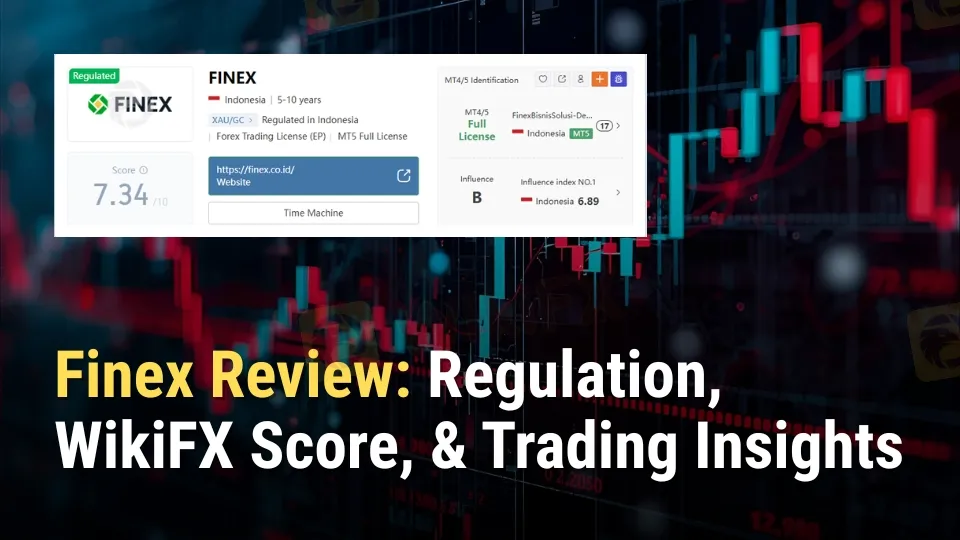
Finex at a Glance: A Regulated Indonesian Broker
Finex positions itself as a prominent and regulated forex broker within Indonesia, boasting an operational history of 5-10 years. The platform offers a comprehensive suite of trading instruments, encompassing Forex, Metals & Energy, Indices, and Shares. A key differentiator for Finex is its adherence to local regulatory frameworks, being overseen by both the Commodity Futures Trading Regulatory Agency (BAPPEBTI) and the Jakarta Futures Exchange (JFX). This commitment to local regulation provides a foundational layer of trust and security for Indonesian traders.
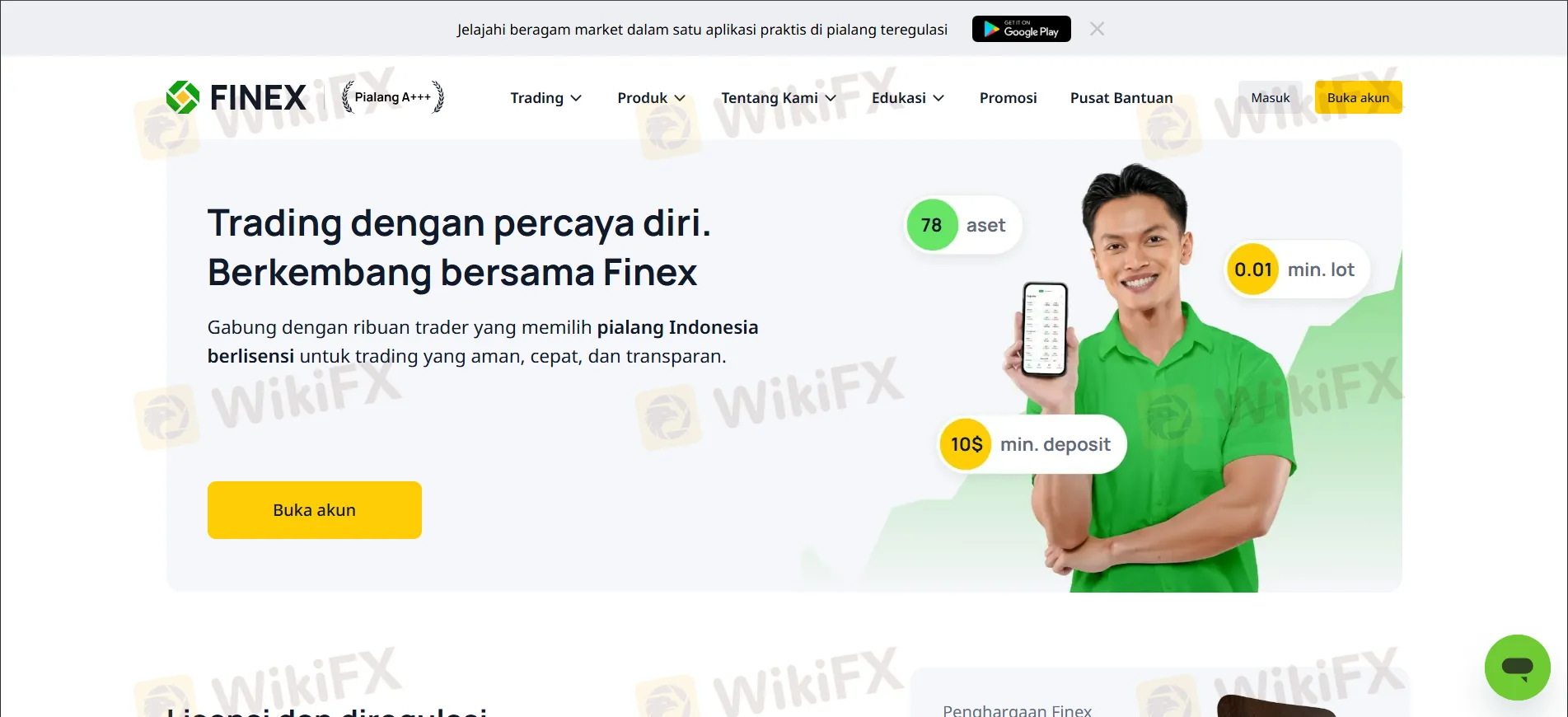
Regulatory Framework: Finexs Indonesian Licensing
Finex operates under the strict supervision of Indonesian financial authorities, holding a Retail Forex License from BAPPEBTI (No. 47/BAPPEBTI/SI/04/2013) and a Derivatives Trading License from JFX. These licenses are crucial, as they signify that Finex complies with the specific laws and regulations governing futures and derivatives trading in Indonesia. For traders, this means a higher degree of investor protection, transparent operational standards, and established mechanisms for dispute resolution, a stark contrast to the unregulated environments often encountered with offshore brokers. The presence of verifiable local regulation is a critical factor for any discerning trader evaluating a brokerage firm.
WikiFX Assessment: A Strong Score and User Sentiment
Independent financial platform WikiFX provides a favorable assessment of Finex, assigning it a robust score of 7.34 out of 10. This score reflects Finex‘s status as a regulated and generally reliable broker. A detailed breakdown of WikiFX’s evaluation further illuminates the brokers strengths:
| Index | Score |
| Regulation Index | 6.40 |
| Business Index | 7.55 |
| Software Index | 9.04 |
| Risk Control Index | 9.71 |
The high scores in Software and Risk Control Indices, alongside a commendable Regulation Index, underscore Finexs commitment to robust trading technology and effective risk management practices. Furthermore, the platform enjoys a largely positive user sentiment on WikiFX, with 53 out of 63 comments being positive, indicating a generally satisfied client base. This collective feedback suggests that many traders find Finex to be a trustworthy and efficient platform.
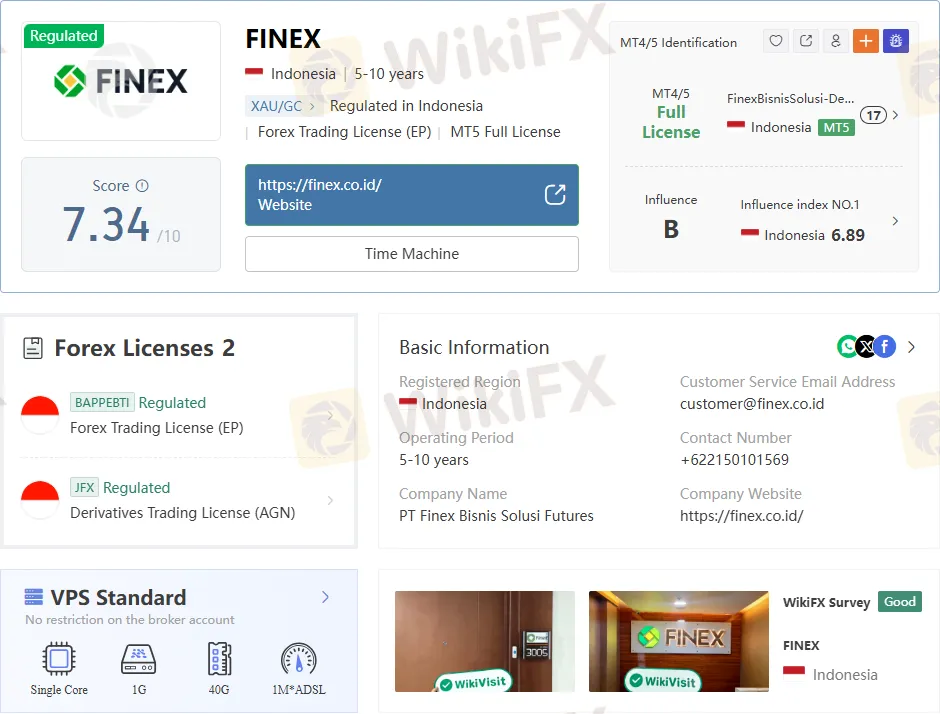
Addressing Concerns: Exposure Cases and Finex‘s Operational Transparency
While Finex generally garners positive reviews, WikiFX has documented three exposure cases that warrant attention. These cases highlight areas where Finex’s operational transparency and customer service could be improved:
- Unauthorized Transactions: One user, “Adi Sang Pengelana,” reported an instance where Finex allegedly conducted transactions without their authorization, leading to a margin call. Such incidents, if true, raise serious questions about account security and the integrity of trading operations.
- Failed Deposit: Another user, “FX3085868476,” experienced a failed deposit, despite receiving confirmation from their bank. This points to potential issues within the deposit processing system, which can be frustrating and concerning for clients.
- Withdrawal Issues: A third user, “napnap488,” reported problems with withdrawals, requesting a return of 200,000 funds. Withdrawal difficulties are a common red flag in the brokerage industry and require prompt and transparent resolution.
These cases, though few in number compared to the overall positive feedback, serve as important reminders that even regulated brokers can face operational challenges. Finex, as a regulated entity, has a responsibility to investigate and transparently address such complaints to maintain client trust and uphold its regulatory obligations.
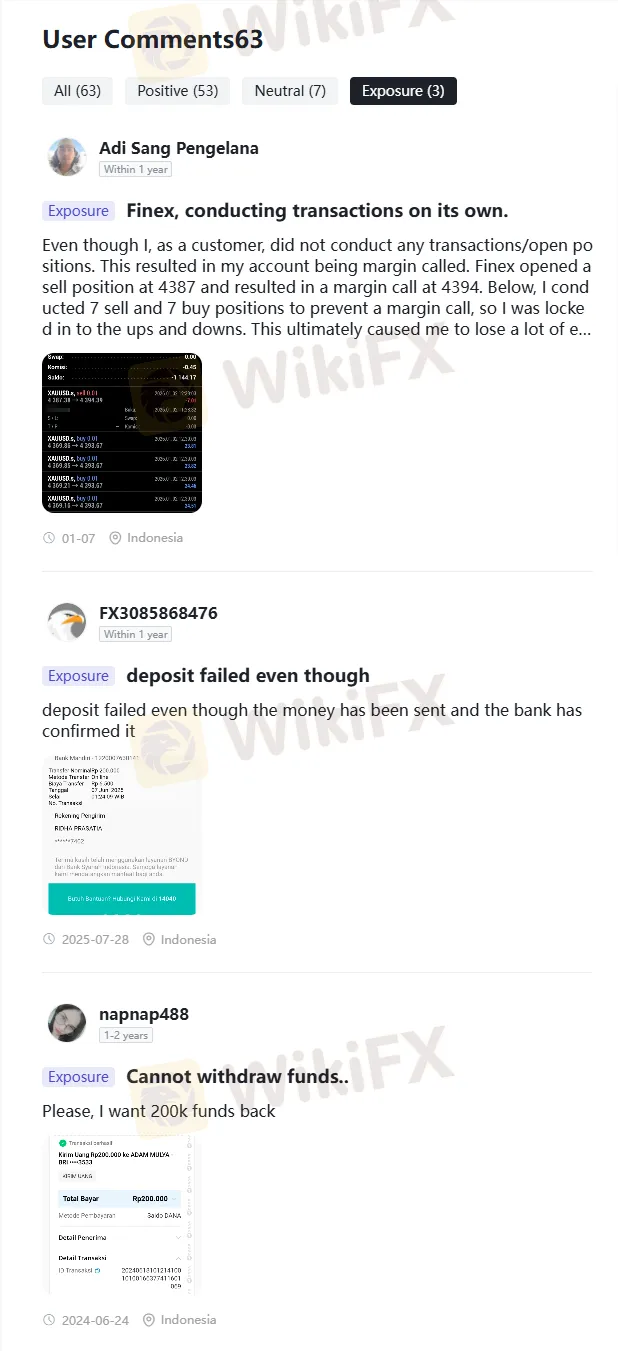
Trading with Finex: Platforms, Accounts, and Features
Finex offers a modern and accessible trading environment, primarily through the globally recognized MetaTrader 5 (MT5) platform, for which it holds a full license. This robust platform is available across various devices, including PCs and mobile (Android and iOS), ensuring traders can manage their portfolios on the go. Finex simplifies its account structure by offering a single live account type, designed to be accessible with a low minimum deposit of just $10.
Traders can benefit from competitive leverage of up to 1:500 for Forex and metals, 1:200 for indices and energies, and 1:100 for stocks. The broker also provides tight spreads starting from 0.5 pips and a commission of $1 per lot. For those new to trading or looking to refine their strategies, Finex offers a free demo account, allowing for risk-free practice. The diverse range of tradable instruments, combined with a user-friendly platform and accessible account options, makes Finex a viable choice for various trading styles.
Conclusion: A Regulated Option with Areas for Improvement
Finex stands out as a legitimately regulated Indonesian broker, distinguished by its oversight from BAPPEBTI and JFX. Its commendable WikiFX score of 7.34/10, coupled with a predominantly positive user sentiment, reinforces its standing as a credible trading partner. The brokers commitment to providing a robust trading environment, evidenced by its MT5 platform and competitive trading conditions, further enhances its appeal.
However, the documented exposure cases, particularly concerning unauthorized transactions, deposit failures, and withdrawal issues, highlight critical areas where Finex must strive for continuous improvement in customer service and operational transparency. While these incidents are not widespread, they underscore the importance of diligent oversight and prompt resolution of client concerns.
Prospective traders considering Finex are encouraged to leverage its regulated status and positive attributes while remaining cognizant of the reported challenges. It is imperative to conduct thorough personal research and engage with the platform cautiously, ensuring that all trading decisions align with individual risk tolerance and financial objectives. Finex presents a strong, locally regulated option, but like all financial service providers, it requires informed engagement.

Read more
Pepperstone Review 2026: Massive Deposit & Withdrawal Complaints Against This Regulated Broker
Have you experienced issues with Pepperstone deposit & withdrawal processing? From your experience, do you feel that the Australia-based forex broker causes losses to its clients? Did the brokerage entity freeze your account and give you a margin call? All these trading allegations have been rampant on broker review platforms such as WikiFX. This Pepperstone review article takes a close look at the user complaints, especially in 2026. Additionally, we have given an overview of the regulatory framework under which the brokerage entity operates.

Wundersys vs tradgrip: Two Offshore Newcomers Go Head to Head — and Neither Brings Home a Trophy
Some broker comparisons end with a confident "go with this one." This is not one of them — and that honesty is exactly what makes it worth reading. Wundersys and tradgrip are two young, offshore-registered brokers that keep popping up in front of beginner traders, often through aggressive online marketing. Both promise the usual buffet: tight spreads, generous leverage, multiple account tiers. And both, according to WikiFX, sit near the very bottom of the safety scale. So instead of crowning a champion, this comparison is really about something more useful: learning to read the warning signs, understanding the small differences that still matter, and knowing why "the better of two risky options" is still a conversation about risk.
The 6 Lowest-Commission Forex Brokers South Asian Traders Are Flocking To in 2026
If you trade forex from India, Pakistan, Bangladesh, Sri Lanka, or Nepal, you already know the quiet truth that eats into every trader's results: it is not just the market that decides whether you profit — it is the cost of getting in and out of each trade. Shave a couple of dollars off your commission on every lot, multiply it across hundreds of trades a year, and you are looking at the difference between a strategy that works and one that bleeds out slowly. South Asian traders are some of the most cost-conscious in the world, and rightly so. So we pulled the data on the brokers most often recommended for the region, cross-checked every name on WikiFX, and ranked them by the one number that matters most here: what they actually charge you to trade. Before the list, one quick lesson that will make this whole ranking click.

XPO Fund Wants $10,000 Before You Trade a Single Real Dollar — Read This Stunning Revelation
If you have spent even a week inside trading communities lately, you already know the pitch by heart. Pass a quick "challenge," get handed a funded account worth tens of thousands of dollars, and keep up to 80% of everything you make. No risking your own savings, no slow grind of building capital from scratch — just skill, a small fee, and a fast track to the big leagues. It is the exact dream every new trader is secretly chasing, and an entire industry has sprung up to sell it. XPO Fund is one of the louder voices selling that story right now. Its website is slick, its plans sound generous, and its marketing leans hard on words like "industry's lowest fee" and "fast payouts." But before you reach for your card, there is one number sitting quietly on this firm's profile — a number it would rather you scroll past — that every experienced trader would beg you to look at first. And no, it is not the profit split. Let's pull XPO Fund apart piece by piece: what it actually is, who is real
WikiFX Broker
Latest News
Dollar Hits Two-Month High Amid Surging Yields
 WikiFX
Getting Started in Forex: Understanding Currency Pairs, Central Banks, and Legal Risks
WikiFXKeeping Your Forex Profits Safe With Trailing Stop Losses
WikiFXHEADWAY Review: Broker Complaints Point to Withdrawals, Zeroed Balances, and Login Blocks
WikiFXIndian Stocks Take a Beating, Sensex Falls by Over 600 Points Today: Check Out Why
WikiFXReview 2026: Japan FSA Regulation, Platform Access, and Complaint Signals
WikiFXThe Market's Ledger: Why Price Returns to Fill Liquidity Voids
WikiFXThe May inflation numbers are due out Wednesday morning. Here's what to expect
WikiFXIndia Left Reeling as Net FDI Crashes from $28 Billion to Just $1 Billion in Two Years
WikiFXAssetsFX Review 2026: Unregulated Status, Withdrawal Complaints, and Extreme Risk Signals
WikiFXRate Calc

