FXCentrum Regulation: Is It Safe or Risky in 2026?
Abstract:Is FXCentrum regulation safe? Discover its offshore license, risks, complaints, and whether you should trust this broker in 2026. Read before trading.
Is FXCentrum Regulation Legit or Offshore? What Traders Must Know
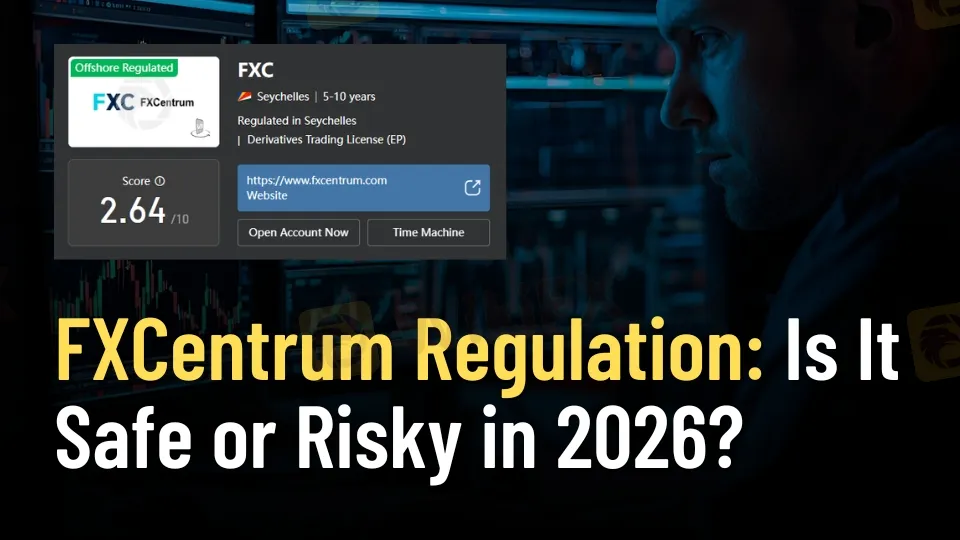
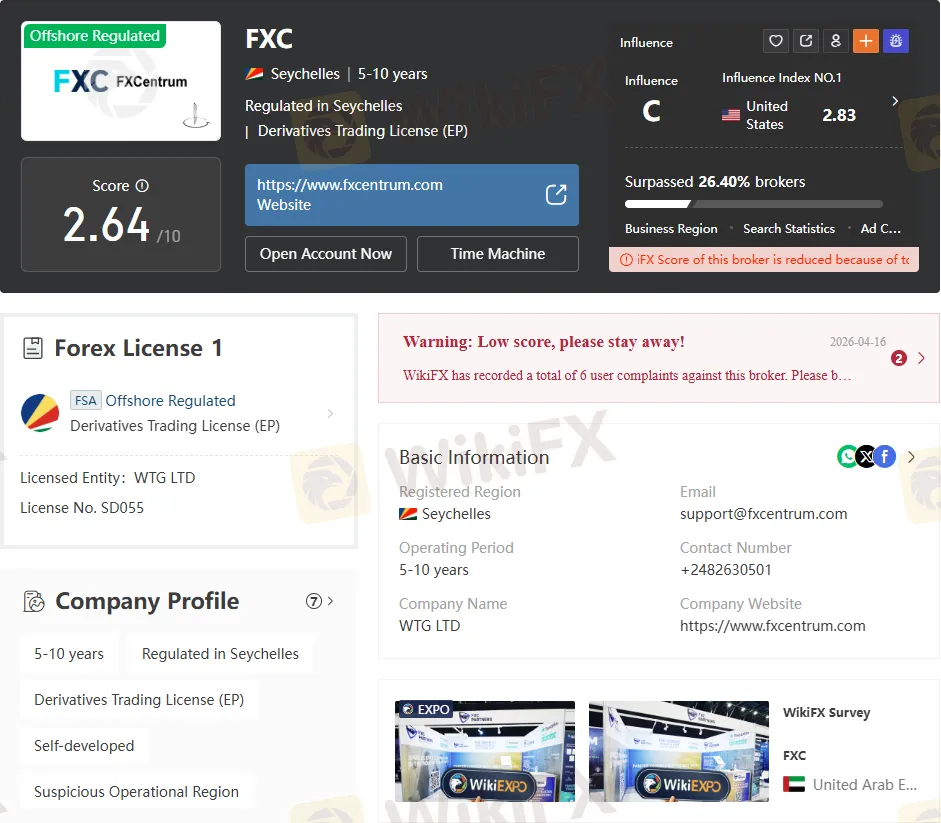
When evaluating FXCentrum regulation, the first critical factor is whether the broker operates under a recognized financial authority. Based on data from WikiFX, FXCentrum is regulated by the Financial Services Authority (FSA) of Seychelles under a Retail Forex License (License No. SD055).
However, it is essential to understand that the Seychelles FSA is classified as an offshore regulator. Offshore jurisdictions typically have less stringent compliance requirements, weaker enforcement mechanisms, and limited investor protection frameworks compared to top-tier regulators such as the FCA (UK) or ASIC (Australia).
This means that while FXCentrum is technically regulated, the quality and strength of that regulation are considered lower-tier. Traders searching for “FXCentrum Regulation” should recognize that not all licenses provide equal protection.
What Regulatory Authority Oversees FXCentrum and Is It Trustworthy?
FXCentrum operates under the supervision of the Seychelles Financial Services Authority (FSA). According to WikiFX, this regulator provides licensing for forex brokers but is widely categorized as offshore.
To evaluate trustworthiness, regulation must be assessed based on several factors:
- Capital requirements are generally lower
- Fund segregation rules may not be strictly enforced
- Dispute resolution mechanisms are limited
- Global credibility is weaker compared to tier-1 regulators
In contrast, regulators like the FCA or CySEC require strict reporting, investor compensation schemes, and regular audits.
Therefore, while FXCentrums regulation is legally valid, it is not considered highly reliable in terms of investor protection standards.
Does FXCentrum Regulation Provide Real Trader Protection or Just Basic Licensing?
A key concern for traders is whether FXCentrum regulation offers real protection or merely fulfills minimum legal requirements.
Based on WikiFX insights, offshore regulation such as that from the Seychelles FSA generally provides:
- Basic licensing compliance
- Limited operational oversight
- No strong investor compensation scheme
- Weaker enforcement in dispute cases
This creates potential risks such as:
- Difficulty recovering funds during disputes
- Limited regulatory support
- Reduced transparency requirements
Compared to top-tier regulators, which provide strong enforcement, compensation schemes, and strict audits, FXCentrums regulatory framework offers only baseline protection.
Are There Any Regulatory Warnings or Complaints Against FXCentrum?
Another critical factor in assessing FXCentrum regulation is the presence of user complaints and risk warnings.
According to the WikiFX page, FXCentrum has multiple user complaints recorded, and the platform flags it with potential risk indicators. These warnings contribute to its overall lower trust score.
Reported issues include:
- Withdrawal-related concerns
- Account disputes
- Service reliability complaints
While complaints do not automatically prove wrongdoing, a pattern of negative feedback combined with offshore regulation significantly increases perceived risk.
WikiFX explicitly advises traders to exercise caution, reinforcing the need for careful evaluation.
Should You Trust FXCentrum Based on Its Regulation Status in 2026?
For traders targeting the keyword “FXCentrum Regulation,” the final consideration is trust.
Based on verifiable data:
- FXCentrum holds a valid offshore license (FSA Seychelles)
- The regulation is lower-tier globally
- Risk warnings and complaints exist
- Investor protection mechanisms are limited
This suggests that FXCentrum may only be suitable for traders who:
- Understand offshore regulatory risks
- Are willing to trade with limited safeguards
- Conduct thorough independent due diligence
For traders prioritizing safety, brokers regulated by tier-1 authorities remain the preferred option.
Final Verdict: Is FXCentrum Regulation Safe or Risky?
Based strictly on WikiFX data, FXCentrum is regulated but under an offshore authority, which offers limited investor protection. The presence of multiple complaints and risk warnings further weakens its trust profile.
FXCentrum regulation is legitimate but weak, making it a higher-risk broker choice compared to platforms regulated by top-tier financial authorities.
Traders are strongly advised to proceed with caution, verify all information independently, and consider safer alternatives when regulatory protection is a priority.

Read more
TRANS X MARKETS Review 2026: I Lost as Much as $40K. One of Many Verified User Allegations
This allegation representing fund loss worth $40,000 came from a verified Indian user on a trusted platform such as WikiFX. However, this is not the only allegation from users across India and other regions. Many verified users have complained about the loss of access to withdraw profits from the TRANS X MARKETS platform. At the same time, we came across complaints about the withdrawal issue from the free software provided by the brokerage firm. In this TRANS X MARKETS review, we have examined these allegations while also giving you the company’s regulatory background.
5 Warning Signs Your Forex Account is Heading Toward a Margin Call
New to forex trading? Surprised by the margin call from your forex broker? In one moment, you seem to have manageable trades. The next moment, you receive a warning from your broker about inadequate equity to support your open positions. So, if the market movement continues to be on the opposite side of your positions, some or all of your trades may see an unfortunate automatic closure through a stop-out process. However, margin calls do not usually happen without warning. Recognizing the early signs can help traders take corrective measures and avoid a potentially significant loss in their trading accounts. But what are those signs that indicate that a margin call is all but near? Let’s discuss the same here.
exfor Review 2026: I’m Unable to Receive My Profits. We Investigated This Common User Allegation.
User complaints regarding profit withdrawals have become an increasingly discussed issue among some Exfor traders, including those in South Asia. Trading profits never come easy; they come by spending hours understanding the fundamental and technical factors and their impact on different markets such as forex. However, what matters is whether you are able to receive them. For exfor clients, according to their complaints, this problem is worse! While they claim profits on the dashboard, the same do not reach their trading accounts, resulting in many negative exfor reviews. In this article, we have examined user allegations concerning several issues, including this common profit withdrawal problem.
Seacrest Markets Review 2026: Are Claims of Account Terminations and Fund Scams True? Let’s Find Out
While searching for user reviews for Seacrest Markets, a South Africa-based brokerage entity, we came across some repeated complaint patterns about the alleged account disablement and the funds that were trapped in it. At the same time, users have complained that the broker unnecessarily extended the fund withdrawal review process to deny them their hard-earned funds. While they may be user allegations and not established facts yet, the emergence of many complaints against the brokerage firm calls for an in-depth investigation in this Seacrest Markets review.
WikiFX Broker
Latest News
How Pig Butchering Scams Drain Beginner Trading Accounts
 WikiFX
Weltrade Review 2026: Is This Forex Broker Safe?
WikiFXOver US$2.9 Million Saved: Singapore's Crypto Scam Crackdown Sends a Warning to Malaysian Investors
WikiFXHow Reversal Candlesticks Trap Beginners at the Top and Bottom
WikiFXexfor Review 2026: I’m Unable to Receive My Profits. We Investigated This Common User Allegation.
WikiFXDollar Navigates Inflation Risks as Oil Prices Spike
WikiFXHTFX Review 2026: Blocked Withdrawals and Severe Risk Signals
WikiFXRM5.18 Million Lost: Investment Scams Are Targeting Kelantan
WikiFXOcta Review 2026: Severe Withdrawal Complaints and Account Blocking Risks
WikiFXFake Boss, Real Losses: Business Lost Nearly RM1 Million in WhatsApp Impersonation Scam
WikiFXRate Calc

