Pay a 17% Tax First, Then You Can Withdraw" — How Nixse Allegedly Held One Trader's €25,000 Hostage
Abstract:Imagine logging into your trading account and seeing a balance of €25,860. You started with €12,450, you traded carefully, and now you want to pull out a modest €5,000 — money that, on paper, is sitting right there waiting for you. Then the message arrives: before you can withdraw a single euro, you must first pay a "stock market flat tax" of 17% on all your earnings. That is more than €4,400, demanded upfront, with no invoice, no official document, no legal basis whatsoever. You refuse. Your account is promptly frozen. That is not a hypothetical. According to a complaint filed on WikiFX, it is exactly what one French trader says happened to them with Nixse — and it is a textbook example of one of the oldest, ugliest tricks in the online trading world. Let's unpack what Nixse is, what users are reporting, and why the warning signs around this broker are flashing bright red.
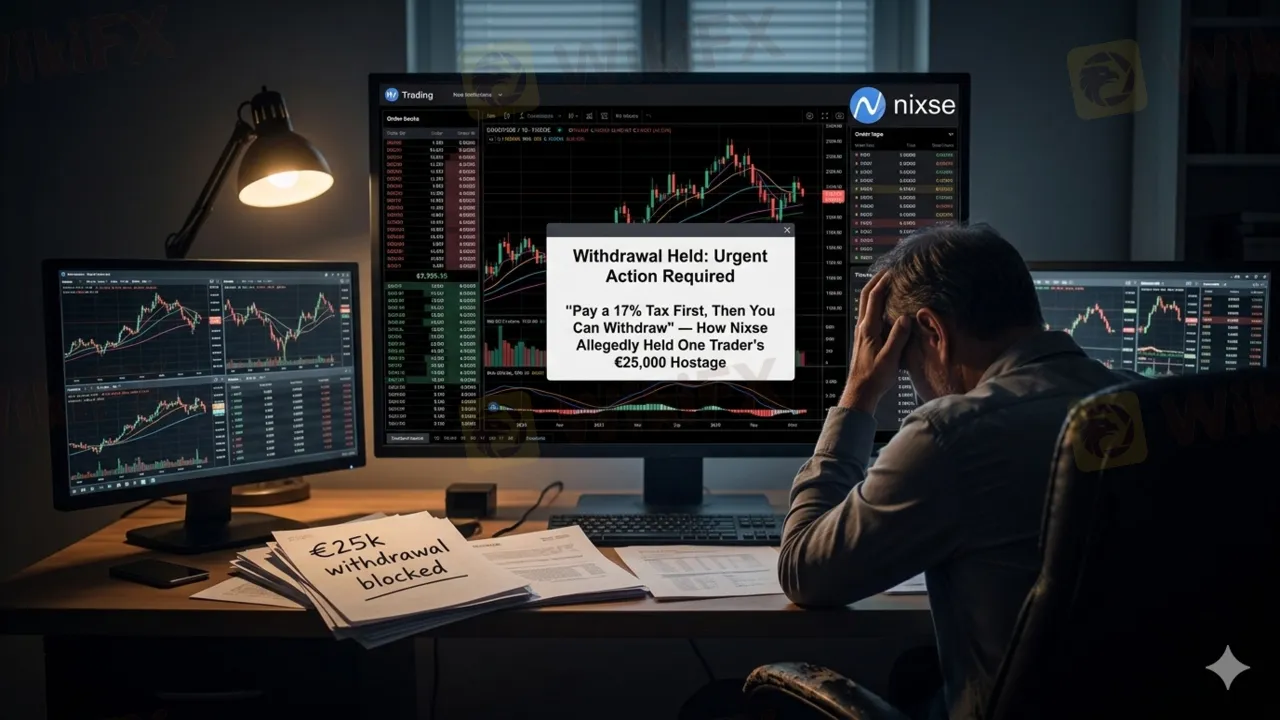
Imagine logging into your trading account and seeing a balance of €25,860. You started with €12,450, you traded carefully, and now you want to pull out a modest €5,000 — money that, on paper, is sitting right there waiting for you. Then the message arrives: before you can withdraw a single euro, you must first pay a “stock market flat tax” of 17% on all your earnings. That is more than €4,400, demanded upfront, with no invoice, no official document, no legal basis whatsoever. You refuse. Your account is promptly frozen.
That is not a hypothetical. According to a complaint filed on WikiFX, it is exactly what one French trader says happened to them with Nixse — and it is a textbook example of one of the oldest, ugliest tricks in the online trading world. Let's unpack what Nixse is, what users are reporting, and why the warning signs around this broker are flashing bright red.
First, Who Is Nixse?
Nixse markets itself as a sleek, modern, multi-asset online trading platform. According to data compiled on WikiFX, it presents itself under the name Nixse Ltd, claims a registration link to the United Kingdom, and lists its operational headquarters in Saint Vincent and the Grenadines — a small Caribbean nation that is one of the most notorious offshore zones in the entire brokerage industry.
The platform advertises a broad menu: over 1,500 instruments spanning currency pairs, commodities, stock indices, global shares, and digital currencies, all traded through its own proprietary software called the NX Trader Platform. It dangles leverage of up to 1:400, accepts deposits via Mastercard, Visa, and Bitcoin, and structures its clients into five escalating account tiers — Silver, Gold, Platinum, VIP, and Black. While Nixse advertises an entry point as low as $250, those named tiers are listed running from $10,000 all the way up to a staggering $1,000,000 for the Black account.
On the surface, it is designed to look established and premium. But the surface is exactly where many beginners stop looking — and that is the problem.
The Complaint That Should Make Every Trader Pause
Let's return to that French trader's exposure report on WikiFX, because the details matter.
The trader says they joined Nixse in June, and at first everything seemed fine. By November, with an account balance of €25,860 (from an initial €12,450 investment), they requested a withdrawal of just €5,000. That is when Nixse allegedly demanded a 17% “stock market flat tax” — over €4,400 — be paid before the withdrawal could be processed. Crucially, the trader reported there was no proof, no written payment request, and no supporting document of any kind for this so-called tax. They even noted that Nixse's own website stated withdrawals would be free of charge.
Being a careful person, the trader checked with France's financial authority and confirmed that no such broker-collected “flat tax” exists; the only relevant tax is a capital-gains tax that an individual declares and pays through their own income tax return — never funneled to the broker. When the trader refused to pay, they say their account was simply blocked.
A second report from the same trader describes the same wall: requesting a withdrawal while holding over €25,000, and being refused at every turn.
What This Pattern Is Called — and Why Beginners Must Recognize It
For a new trader, this might look like a confusing bureaucratic dispute. It is not. It is a recognized fraud pattern, and learning to spot it could save you thousands.
It is commonly called an advance-fee scam, or in trading circles, the “withdrawal tax” trap. Here is how it works. A platform lets you deposit and “trade,” and your on-screen balance climbs nicely — often suspiciously nicely. The numbers you see are just figures in a database the platform fully controls; they may have nothing to do with real market positions. The trap springs the moment you try to take money out. Suddenly there is a fee, a tax, a “verification deposit,” a “liquidity charge,” or an “insurance payment” that you must pay first — and always from your own pocket, never deducted from the balance you supposedly have.
The genius of the trap, from the scammer's perspective, is that it preys on hope. You can see €25,000 right there on the screen. Paying €4,400 to “unlock” it feels almost rational. But here is the iron rule every beginner must tattoo on their brain: a legitimate broker NEVER requires you to send additional money in order to withdraw your own funds. Taxes are handled by tax authorities, not collected by your broker as a gate to your withdrawals. The instant any platform demands an upfront payment before releasing your money, you are almost certainly looking at a scam, and sending that payment only feeds the machine.
The Regulators Have Already Spoken
This is not merely one angry customer's story. The warning is institutional.
On April 15, 2024, France's financial markets regulator — the Autorité des Marchés Financiers (AMF) — added nixse to its official blacklist of unauthorized companies offering forex services without authorization.
For beginners, a quick explainer. The AMF is France's equivalent of a top-tier financial watchdog, the authority responsible for licensing and policing financial firms that operate in France. When a regulator like the AMF places a company on its blacklist, it is issuing a public, official warning that the firm is not authorized to offer the financial services it is providing. It is the regulatory version of a flashing neon sign that reads “stay away.” Being blacklisted by a serious authority like the AMF is one of the gravest red flags a broker can carry.
The Other Red Flags Stacking Up
Beyond the headline complaint and the AMF blacklisting, Nixse's WikiFX profile is studded with warning signs:
- A rock-bottom score. Nixse carries a WikiFX score of just 1.54 out of 10, with its regulation index, license index, and risk-control index all sitting at a flat 0.00.
- No valid regulation, period. Despite waving a UK company link, the platform holds no genuine forex trading license from any recognized authority.
- An offshore operational base. Running operations out of Saint Vincent and the Grenadines is a deliberate choice that places the firm largely beyond the reach of meaningful financial oversight.
- A suspicious cluster of glowing reviews. Alongside the serious withdrawal complaints sits a tight bunch of nearly identical five-star reviews, almost all posted within the same few days of mid-2023, gushing about “fast withdrawals” in oddly similar language. A sudden burst of formulaic praise is a classic signature of fabricated reviews designed to bury genuine complaints and inflate a platform's image.
- A closed, proprietary platform. By routing everyone through its own NX Trader software instead of the industry-standard MetaTrader 4 or 5, Nixse makes independent verification of pricing and execution far harder.
To be balanced: Nixse does offer a wide instrument range and a polished interface, and not every single user reports a problem. But weigh that honestly against an official regulator blacklisting, a zero regulation score, an offshore base, and a documented account of a five-figure balance held hostage behind a fake “tax.” The scale is not close.
How to Protect Yourself From the “Withdrawal Tax” Trap
Burn these rules into your routine, because this scam pattern recycles endlessly under new names:
- No legitimate broker charges a fee to release your own money. Any upfront “tax,” “fee,” or “deposit” demanded before a withdrawal is a scam signal. Full stop.
- Verify regulation before you deposit, not after. Check whether the firm holds a real license from a recognized authority — and whether any regulator has blacklisted it.
- Distrust balances you cannot withdraw. A big number on screen means nothing until you have successfully moved money out. Test a small withdrawal early.
- Treat clusters of identical glowing reviews as a warning, not reassurance. Real feedback is messy and varied; manufactured praise is uniform and sudden.
- Be wary of offshore-only operators. A Saint Vincent address with no real top-tier license offers you almost no protection if things go wrong.
The Bottom Line on Nixse
The story emerging around Nixse is not subtle. You have a broker with no valid regulation, based in a notorious offshore haven, carrying a near-bottom WikiFX score of 1.54, officially blacklisted by France's AMF, flagged by multiple independent analysts — and at the center of it all, a documented complaint describing the exact “pay a tax to unlock your withdrawal” trap that has separated countless traders from their savings. For a newcomer, this is not a gray area. It is a case study in what to avoid.
The single habit that protects you here is checking a broker before your money is anywhere near it. Do not take a platform's slick website at face value, and do not take any single review — including this one — as the final word. Open the WikiFX app or website, search the broker by name, and in seconds you can see its real regulatory status, any official regulator warnings or blacklistings, genuine user exposure reports, and an overall risk score, all in one place. That quick check is the difference between spotting the trap from a safe distance and learning about it the hard way, €4,400 at a time.
If a platform asks you to pay before you can withdraw, the answer is always no. Verify first, deposit never-blindly, and trade safe.
Note: This article reflects user complaints and regulatory disclosures compiled on WikiFX and other public sources. If you believe you have been affected by a broker-related issue, document everything and consider reporting it through official regulatory and law-enforcement channels.
Download the WikiFX for in-depth broker investigation reports

More Interesting Articles for You
vs XTB — The Battle Of Two Very Different Broker Philosophies Exposure Report 2026: Mounting KYC & Fund Withdrawal Complaints

Read more
Is TradingPRO Safe? FCA Warning, Indonesia Blocklist Evidence, and 7 Checks Before You Deposit
This Trading Pro broker review checks the FCA warning, Indonesia blocklist evidence, licence claims, and what South Asian users should verify before depositing.
MT4 White Label Cost in 2026: What Brokers Must Budget Beyond the Platform Fee
The visible fee in an MT4 white label proposal is rarely the real cost of operating it. For an existing broker, the decision is not simply whether an MT4 white label platform is “cheap” or “expensive.” The real question is whether the commercial model remains viable after integration, support, data, client migration, compliance, and exit costs are included. That is why an MT4 white label cost review should be built as a 24- to 36-month operating case. It should compare three credible choices: 1. Keep the present MT4 setup and improve its weakest controls. 2. Replace the MT4 white label provider but retain the client proposition. 3. Migrate selected clients or products to another platform while running MT4 in parallel. This guide explains how to build that case without relying on headline prices or generic vendor claims.
The Rise of Deepfake Investment Scams: ASIC Shares Key Warning Signs
Artificial Intelligence (AI) has grown remarkably recently. However, it has also amplified the scope for financial fraud. One such is the rapid use of deepfake technology involving AI-generated videos, images and audio clips imitating real people. Fraudsters are leveraging these technologies to impersonate financial advisers, celebrities, business leaders and government officials to lure victims into fake investment schemes. Understanding the emerging implications, the Australian Securities and Investments Commission (ASIC) has cautioned investors of investment avenues promoted through convincing AI-generated content. Seemingly authentic, deepfakes are designed to manipulate trust and make people transfer funds before authenticating the investment’s legitimacy.
Best White Label Trading Platform 2026
The decision to switch white label providers or migrate to a modern white label trading platform is no longer a luxury for growth-minded brokers—it's a strategic necessity for survival in 2026. The convergence of technological stagnation, regulatory evolution, and shifting client expectations has created a perfect storm.
WikiFX Broker
Latest News
FBS Review: Is Your Deposit Safe?
 WikiFX
Pocket Broker Review: Can You Actually Withdraw Your Money?
WikiFXTHINK MARKETS Broker Might Not Want You To See This
WikiFXYAIBroker Review: Website Is Down and Users Report Withdrawal Problems
WikiFXBONUS Review: Is Your Deposit Safe?
WikiFXAlpari Review 2026: Official Warnings and High Complaint Patterns
WikiFXHow to Spot Your First Trial Short on H1 After a Break
WikiFXIG Review: Broker Complaints Collide With Mixed Regulation Signals
WikiFXHow to Lock In Profits and Create a Zero-Risk Trade
WikiFXSTARTRADER Adds SK Hynix CFD Days After $26.5B US Listing
WikiFXRate Calc

