Stop Chasing Green Arrows: Why High Win Rate Strategies Are Bankrupting You

Abstract:Listen to me closely because what I’m about to tell you might hurt your feelings, but it will save your trading account.
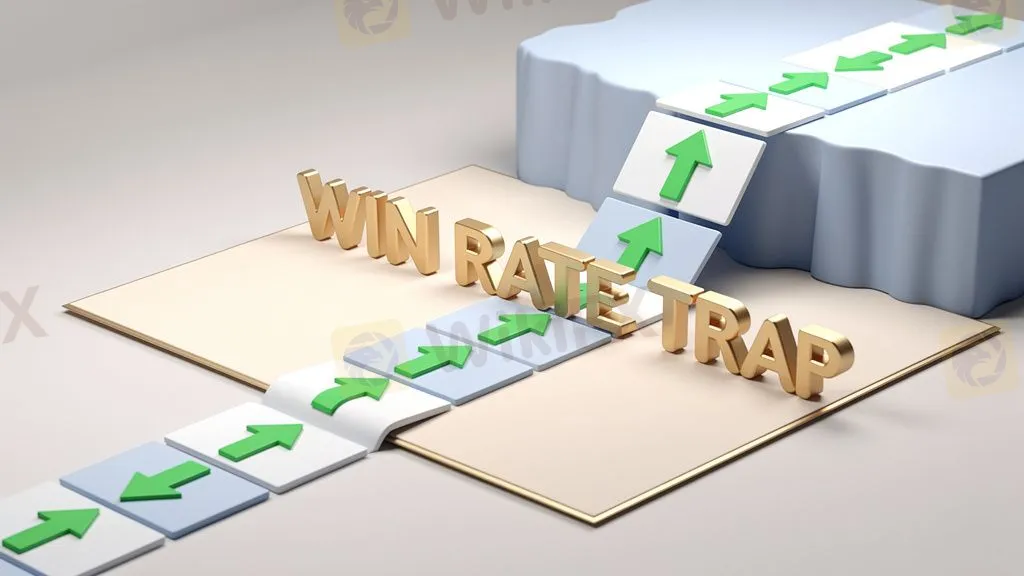
Listen to me closely because what Im about to tell you might hurt your feelings, but it will save your trading account.
I get messages every single day from new traders. They send me screenshots of their history. It‘s a sea of green. “Coach K, look at this! I won 9 out of my last 10 trades. I’m crushing it.”
Then I ask to see their account balance.
Silence.
Usually, the balance is down 20% or more. How is that possible? How can you be right 90% of the time and still be broke?
Its the biggest lie in trading: The High Win Rate.
Novices obsess over being “right.” Professionals obsess over making money. These are not the same thing. Lets break down why your high-probability strategy is actually a ticking time bomb.
The Mathematical Trap: Eating Like a Bird, Pooping Like an Elephant
I hate using that analogy, but it stays in your head. And thats what most high win-rate strategies are.
strategies that offer an 85% or 90% win rate usually rely on taking tiny profits very quickly. You scalp 5 pips here, 10 points there. You are grabbing pennies in front of a steamroller.
Here is the math of a “perfect” novice strategy:
- Trade 1-9: You make $10 each. Total Profit: $90.
- Trade 10: The market turns against you. Because you are used to winning, you refuse to close the trade. You hold. You hope. The market spikes. You lose $150.
Net Result: You were right 90% of the time, but you lost $60.
In trading, this is called a Negative Risk-to-Reward Ratio. You are risking $150 to make $10. It feels good psychologically because you get that dopamine hit of “Winning” constantly, but one bad day wipes out three months of hard work.
Is High Win Rate Actually a Trap?
Yes, because it destroys your psychology.
When you trade a strategy that wins 90% of the time, you become emotionally fragile. You expect to win every time. So when that inevitable loss comes, you don't know how to handle it.
You freeze. You move your stop-loss (or worse, you enter without one). You think, “It has to come back, it always comes back.”
The market does not care about your feelings. That one trade keeps going against you until you get a margin call.
I would rather have a student with a 40% win rate. Why? Because a trader with a 40% win rate is used to losing. They cut losses fast because they know the next big win is coming. They risk $1 to make $3. They can be wrong more than half the time and still buy a Ferrari at the end of the year.
The Broker Variable: Are Your Wins Even Real?
There is another hidden danger with high-frequency, high-win-rate scalping strategies: The execution environment.
If your strategy relies on sniping tiny movements for quick profits, you are at the mercy of your broker. A shady broker hates scalpers. If you start winning too much on tight margins, they might widen the spreads or introduce “slippage” (where your order executes at a worse price than you clicked).
Suddenly, your strategy works on paper, but fails in the live market.
It is absolutely critical to know who you are betting against. Before you deposit real money to run a scalping strategy, check the broker's regulatory status and complaints on WikiFX.
Ive seen it a hundred times—traders blaming their strategy when the reality is they are trading on an unregulated bucket shop that is manipulating the feed. WikiFX can show you if other users have reported severe slippage or withdrawal issues. Don't let a bad broker steal the edge you worked hard to build.
How to Fix Your Trading Today
So, if you are sitting there with a high win rate but a shrinking account, here is your homework.
- Stop counting wins. Nobody pays your rent with “win percentage.” You pay rent with dollars.
- Audit your Risk-to-Reward (R:R). Look at your last 20 trades. Is your average loss bigger than your average win? If yes, stop trading immediately.
- Learn to lose. This sounds crazy, but you need to get comfortable taking a small loss. A small loss is the cost of doing business. It protects your capital for the next opportunity.
Switch your mindset. Stop trying to be a sniper who never misses. Be a casino. Casinos lose individual hands of blackjack all day long, but the math ensures they always end up rich at the end of the night.
Build a strategy where you can be wrong and still survive. That is how you stay in this game.
Disclaimer: This article is for educational purposes only and does not constitute financial advice. Trading involves significant risk, and you may lose your invested capital. Always do your own research.
Read more

Should You Delete Every Indicator from Your Charts? Let’s Talk Real Trading
Trading is about confluence—getting different clues to tell the same story.
The Copycat Trap: Why You Lose Money Using a "Winning" Strategy
The market is a mirror. If you are disorganized, emotional, and impatient, the charts will reflect that right back at your bank balance. Get your mind right, and the strategy will follow.
Stop Buying the Top: Why You Always Enter at the Worst Time
Trading isn't about predicting the future; it's about waiting for the right odds.
5 Mental Traps That Are Burning Your Trading Account Today
Trading is 10% skill and 90% psychology. You can learn technical analysis in a month, but mastering your own head takes a lifetime.
WikiFX Broker
Latest News
JRJR Review: Why a "Valid" License Can't Hide the Withdrawal Nightmare
WikiFXZarVista Review 2025: A Complete Look at Its High-Risk Profile
WikiFXVoices of the Golden Insight Award Jury | Greg Matwejev, Chief Market Strategist of BCR
WikiFXEC Markets Opens New Marketing Hub in Central Limassol
WikiFXLondon Capital Group – Regulation & Genuine User Reviews
WikiFXWhy Do You Always Lose When Trading?
WikiFXCoinbase Expands Into Stocks and Tokenized Assets
WikiFXTitan Capital Markets: The "Token" Trap Hiding Behind a Forex Mask
WikiFXShould You Delete Every Indicator from Your Charts? Let’s Talk Real Trading
WikiFXIs ZarVista Legit? A Critical Review of Its Licenses and Red Flags
WikiFXRate Calc

