Are You Trading Against the Central Banks? Know Your Competition

Abstract:You open your MetaTrader app. You see the EUR/USD chart moving. You spot a support level, calculate your risk, and hit "Buy."
You open your MetaTrader app. You see the EUR/USD chart moving. You spot a support level, calculate your risk, and hit “Buy.”
Two seconds later, the price drops 15 pips, hits your stop loss, and then immediately shoots back up. You stare at the screen, frustrated. You feel like the market knew exactly where your stop was.
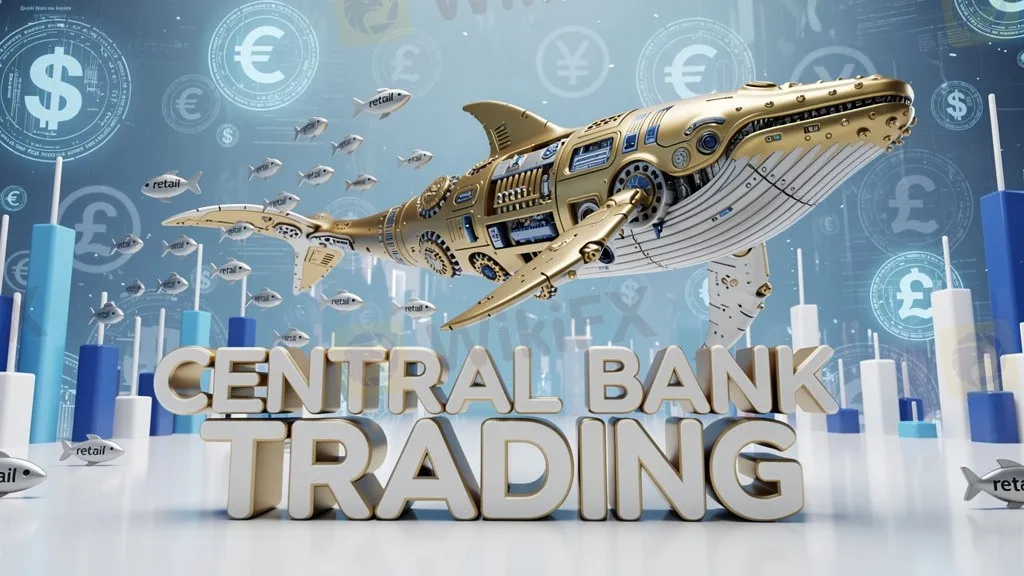
Here is the cold, hard truth: You are a minnow swimming in an ocean full of sharks, whales, and submarines.
Most new traders treat Forex like a video game against the computer. It isn't. It is a zero-sum environment. For you to buy a Lot, someone else must sell it. To survive, you need to know exactly who sits on the other side of that screen.
Who actually moves the Forex prices?
The Forex market processes over $6 trillion a day. You with your $500 account are not moving the needle. The market moves based on volume, and that volume comes from a hierarchy of players.
1. The “Big Dogs” (The Interbank Market)
At the very top of the food chain, you have the Tier 1 banks. We are talking about the likes of Citi, Deutsche Bank, JPMorgan, and UBS.
These banks trade directly with each other globally via electronic broking services (EBS) or Reuters dealing. They don't pay the spread you pay; they create the spread. When you see a price quote, its essentially the average of what these giants are willing to do business at. They trade billions in seconds. They are the market.
2. The Central Banks
If the Tier 1 banks are sharks, Central Banks are the weather. The Federal Reserve (US), the ECB (Europe), and the BOJ (Japan) don't trade for profit. They trade to manage their country's economy.
When a Central Bank decides to intervene—like Japan buying Yen to stop it from crashing—they dump massive volume into the market. This creates trends that can last for months. If you are holding a trade against a Central Bank policy, you will lose. Period.
Are huge corporations manipulating the charts?
Not exactly, but they are a massive piece of the puzzle that technical analysts often ignore.
Think about a company like Apple or Toyota. If Toyota sells a million cars in the US, they get paid in US Dollars. But they need Japanese Yen to pay their workers in Tokyo. They have to convert billions of dollars into Yen.
This is called “Commercial Hedging.” These companies do not care if the RSI is overbought. They do not care about your Fibonacci levels. They just need to exchange currency to do business. Their transactions provide the steady volume that keeps the market liquid. They aren't trying to beat you; they are just doing business, but their sheer size can push price through your support levels without blinking.
The Speculators vs. The Retail Trader
Then there are the Hedge Funds and High-Frequency Trading (HFT) firms. These are the speculators. They use complex algorithms to hunt for liquidity. They are volatile, aggressive, and fast.
And finally, there is you. The Retail Trader.
Retail traders makes up a tiny fraction of the total volume, yet we provide a lot of liquidity for the bigger players. We are often called “dumb money” by institutional traders because we tend to trade emotionally. We chase candles, we over-leverage, and we panic.
Because retail traders are small, we don't trade directly with the Interbank market. We go through brokers. And this is where the danger lies. Since you are the smallest player, you are the easiest target for bad actors.
Your First Line of Defense
The market is dangerous enough with Central Banks and Hedge Funds trying to take your pips. You don't need your own broker working against you too.
Many retail brokers act as “Market Makers” (the B-Book model). This means when you buy, they sell. If you lose money, they keep it. This creates a massive conflict of interest. Some shady brokers will widen spreads artificially or create “slippage” to ensure you lose.
Before you deposit a single cent, you need to vet your broker. I always tell my students to treat this like a background check. Use an independent inquiry app like WikiFX. They catalog broker licenses, regulation status, and user complaints. If a broker claims to be regulated in London but WikiFX shows their license is actually from a tiny island with no laws, run away.
Protecting your capital starts with choosing a broker that isn't a scam. If the regulatory score on WikiFX is low, keep your wallet closed.
How to Trade Alongside the Whales
So, how do you win if you are the smallest fish? You become a “Remora”—those little fish that attach themselves to sharks to eat the scraps.
1. Stop Fighting Trends: If the Central Banks are hiking rates, don't try to short the currency just because it looks “too high.” The big money follows the interest rates.
2. Watch the Sessions: The biggest moves happen when the major banks are open. The overlap between London and New York sessions (8:00 AM - 12:00 PM EST) is where the volume is. This isn't just noise; it's the Interbank market at work.
3. Respect the News: When Non-Farm Payrolls (NFP) or CPI data drops, the big banks re-price the market instantly. If you are holding a trade during these times with a tight stop loss, you are just donating money to the liquidity pool.
You cannot beat the market participants. You are too small. Your only job is to identify which way the herd of elephants is running and run in the same direction—preferably a few steps ahead.
Disclaimer: This article is for educational purposes only and does not constitute financial advice. Forex trading involves significant risk to your invested capital. Leverage can work against you as well as for you.
WikiFX Broker
Latest News
Labuan Forex Scam Costs Investors RM104 Million | Authorities Pressed to Act
WikiFXThinkMarkets Review 2025: Safety, Features, and Reliability
WikiFXLMS Forex Broker Review (2026): Is LMS Legit or a Scam?
WikiFXRockwellHalal User Reputation: Looking at Real User Feedback and Common Complaints to Check Trust
WikiFXFXNovus Review: Traders Report Fund Scams & Illegitimate Tax Payment Demands on Withdrawals
WikiFXProfit Wipeout: Why AccuIndex Traders Are losing Their Hard-Earned Money
WikiFXInside the Elite Committee: Talk with LadyChiun
WikiFXUS Imposes 25% Tariff on AI Chips, Elevating Tech Trade Tensions
WikiFXIs DRW Legit or a Scam? 5 Key Questions Answered (2026)
WikiFXAre You Trading Against the Central Banks? Know Your Competition
WikiFXRate Calc
