Why More Commodity Revenue Doesn't Instantly Strengthen a Currency

Abstract:Explains why a rise in commodity export income does not automatically improve a government's budget or strengthen its currency, covering leakages, timing, and policy choices with a simple worked example.

What commodity revenue really means for a budget and a currency
Commodity revenue is the money a government collects from natural resource exports such as oil, copper, cocoa, or gold. The fiscal balance is the gap between what a government earns and what it spends; a surplus means it earns more than it spends. The exchange rate is the price of one currency in terms of another, often quoted against the US dollar. At first glance, a jump in commodity revenue should fill the treasury and push the local currency up. But revenue improves potential, not an automatic outcome.
One reason is that gross export earnings are not the same as government receipts. Exporters pay taxes and royalties, but private companies also keep profits and recover costs. Another reason is that foreign exchange supply only strengthens a currency if the net inflow is larger than demand for foreign currency at the same time. Both effects work with delays, so the headline commodity number can rise while the budget and currency barely move.
Where the money leaks before it can help
A commodity exporter rarely receives the full export price in usable government cash. Foreign mining or oil companies often take their share as costs, dividends, or profit repatriation before the government sees royalties. Many resource firms must also repay hard-currency loans, which are loans denominated in US dollars or euros, taken to build mines or pipelines. Higher export revenue usually triggers more imports because households, companies, and the government raise spending. Each drain reduces the net foreign-exchange inflow that actually reaches the central bank or the treasury.
The central bank is the institution that manages a country's money supply and often holds official foreign currency reserves. Even when some net inflow arrives, the central bank may choose to add it to reserves instead of letting the currency appreciate sharply. This is common when policymakers want to avoid a boom-bust cycle or protect other exporters. The treasury, which manages government revenue and spending, may also face new spending commitments that rise along with commodity income. For example, fuel subsidies, public wages, or debt repayments can absorb much of the windfall before it improves the fiscal balance.
A simple worked example of the lag
To make the lag concrete, consider a purely hypothetical case. A resource-exporting economy we can call Copperland books an extra USD 200 million in gross copper export receipts for one quarter. The foreign mining company repatriates USD 80 million as profit and cost recovery. The government owes USD 60 million in external debt service. Higher incomes add USD 40 million in imported consumer and capital goods. The net foreign-exchange inflow left for the central bank is:
Net FX inflow = 200 - 80 - 60 - 40 = USD 20 million
Now look at the budget side. Suppose the government collects USD 30 million in royalties and taxes from that same windfall. But it also announces a fuel subsidy of USD 45 million partly tied to the commodity cycle. Fiscal impact = 30 - 45 = a negative USD 15 million. So the currency gains only a modest inflow, and the budget position can actually worsen. This is a hypothetical teaching calculation, not a forecast for any country.
Notice that the forex market does not see USD 200 million; it sees a net change after outflows and policy decisions. If the central bank also decides to hold most of the USD 20 million in reserves, the spot exchange rate may not move much at all. That is why a commodity windfall can arrive without immediately strengthening the currency or repairing the budget.
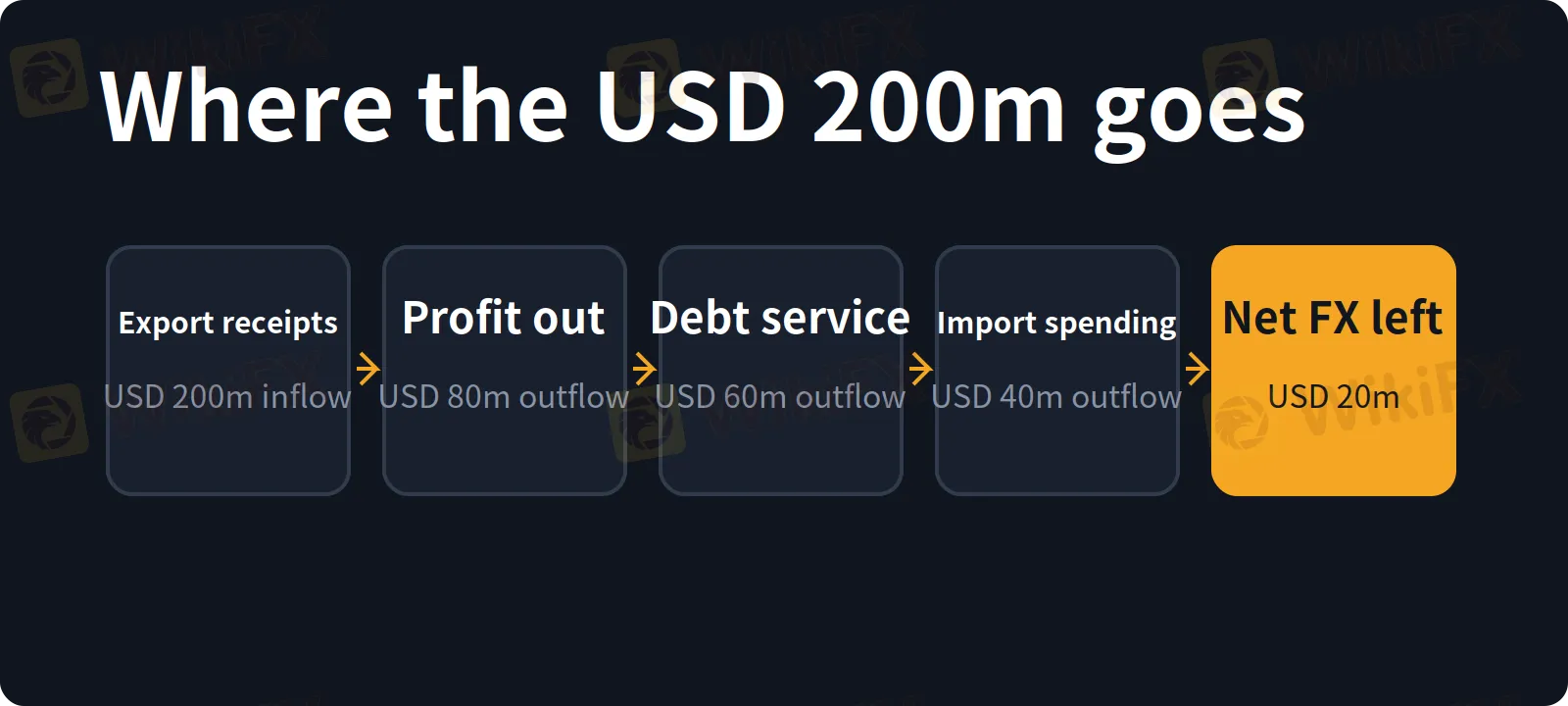
The USD 200m commodity windfall shrinks to USD 20m after common outflows.
What beginners often get wrong about commodity income
- Assuming every dollar of commodity income lands in the government's account. Royalties, taxes, and profit shares are usually only a fraction of gross revenue.
- Confusing gross export earnings with the net amount that affects the currency. Exchange rate pressure depends on the net flow after outflows.
- Ignoring timing. Royalty payments, tax collection, and budget spending often lag the price boom by one or more quarters.
- Treating commodity revenues as a currency direction signal. A currency can weaken even when export income rises if outflows are larger or if markets expect weak policy.
- Overlooking fiscal commitments. Governments often lock in higher spending during a boom, so a later price drop can leave the budget worse than before.
Commodity revenue is a building block for fiscal and currency strength, not a switch. It can widen a government's external capacity over time, reduce borrowing pressure, or build reserves, but it does not by itself fix a budget deficit or guarantee a stronger currency. Leakages, debt, import demand, and policy choices determine the final outcome. When a beginner sees a commodity boom, the useful question is not how much money came in but how much is left after the drains and how it is being used. A commodity windfall creates room, not an automatic fix.
WikiFX Broker
Latest News
Winvest Review: Is Your Deposit Safe?
WikiFXKCB Review: Is Your Deposit Safe?
WikiFXCrypto Revenue Falls in Q2 as Another Platform Moves Into CFDs
WikiFXOcta Review 2026: Severe Withdrawal Complaints and High Risk Signals
WikiFXWhy More Commodity Revenue Doesn't Instantly Strengthen a Currency
WikiFXExness Review for Indian Traders 2026: The RBI Question Comes Before Leverage and Spreads
WikiFXEMAR MARKETS Review 2026: Severe Withdrawal Complaints and Risk Signals
WikiFXTrader's Way Review: Trades Vanished Overnight , And There's No Regulator to Call
WikiFXLockwood Review: AMF-Blacklisted Broker with Users Reporting Blocked Withdrawals
WikiFXBYBIT Review: What Traders Should Know Before Depositing
WikiFXRate Calc

