FOMO in Forex: Why a Missed Move Feels Like a Real Loss

Abstract:Understand FOMO, the fear of missing out, and how it pushes forex beginners into hasty decisions. This guide explains the psychological mechanism and offers simple self-observation exercises.
You sit down to check the charts and notice a pair you have not been watching. In twenty minutes, it has moved hard in one direction. Your first thought is not 'what happened' but 'why am I not in that?' This feeling has a name: FOMO, or fear of missing out. It can be one of the most expensive emotions in retail trading, not because every FOMO entry ends in a loss, but because it asks you to make decisions without a plan.
What FOMO Really Is
FOMO is the sense that everyone around you is capturing gains while you are being left behind. In trading, it rarely appears as a calm conclusion. It appears as urgency. You refresh the price feed, scroll through screenshots of profits, and feel as though a door is closing.
- Refreshing the price feed again and again, even when nothing else is happening in your routine.
- Entering a trade after a big move because you assume the move will continue now that you are watching.
- Changing your plan halfway, such as adding to a position, just to feel part of the crowd.
- Skipping the usual checks, like whether the market has already moved too far, because waiting feels unbearable.
None of these actions are automatically wrong. The problem is that FOMO takes over the job your analysis should do. The question stops being 'does this trade make sense?' and becomes 'can I stand to watch this without joining?'
Why a Missed Move Feels Like a Loss
The force behind FOMO is close to loss aversion, a behavioural pattern in which the pain of losing something feels stronger than the pleasure of gaining something equal. A missed move is not a loss in your account, but your brain can process it as one. That is why sitting on the sidelines can feel so difficult.
- Scarcity: The move looks like a limited opportunity, even though the market opens again tomorrow.
- Social proof: Seeing others show profits makes an uncertain situation feel like a sure thing.
- Anticipation: Your brain releases reward signals when it imagines a win before it has happened, making the urge to act feel urgent.
FOMO also feeds on a feedback loop. The less you trust your own process, the more you rely on the crowd. The more you rely on the crowd, the louder the fear that you are missing something. This is why beginners often carry the heaviest load: not because they are careless, but because a structured framework is still under construction.
A Hypothetical Example: A Fast Jump in EUR/USD
Imagine the EUR/USD rate is trading around 1.1593. In this purely hypothetical scenario, it climbs to 1.1630 within twenty minutes. The move is visible and tempting. Along the way, you enter at 1.1610, telling yourself that even a small profit beats watching from the sidelines.
Then, in this same hypothetical window, the market pulls back to 1.1580. Now your entry is above the pullback low, and the emotional loop takes over: first frustration, then bargaining, then the urge to add to the trade. The entry was not necessarily doomed. The difficulty is that it was built on fear of missing a move rather than on a method you tested beforehand.
Let me be explicit: this is a teaching example, not a signal. Prices can always move again, and none of these levels has any predictive power. The point is to see how FOMO interrupts good judgment. If some of your most stressful trades are rushed entries like this, you are not alone.
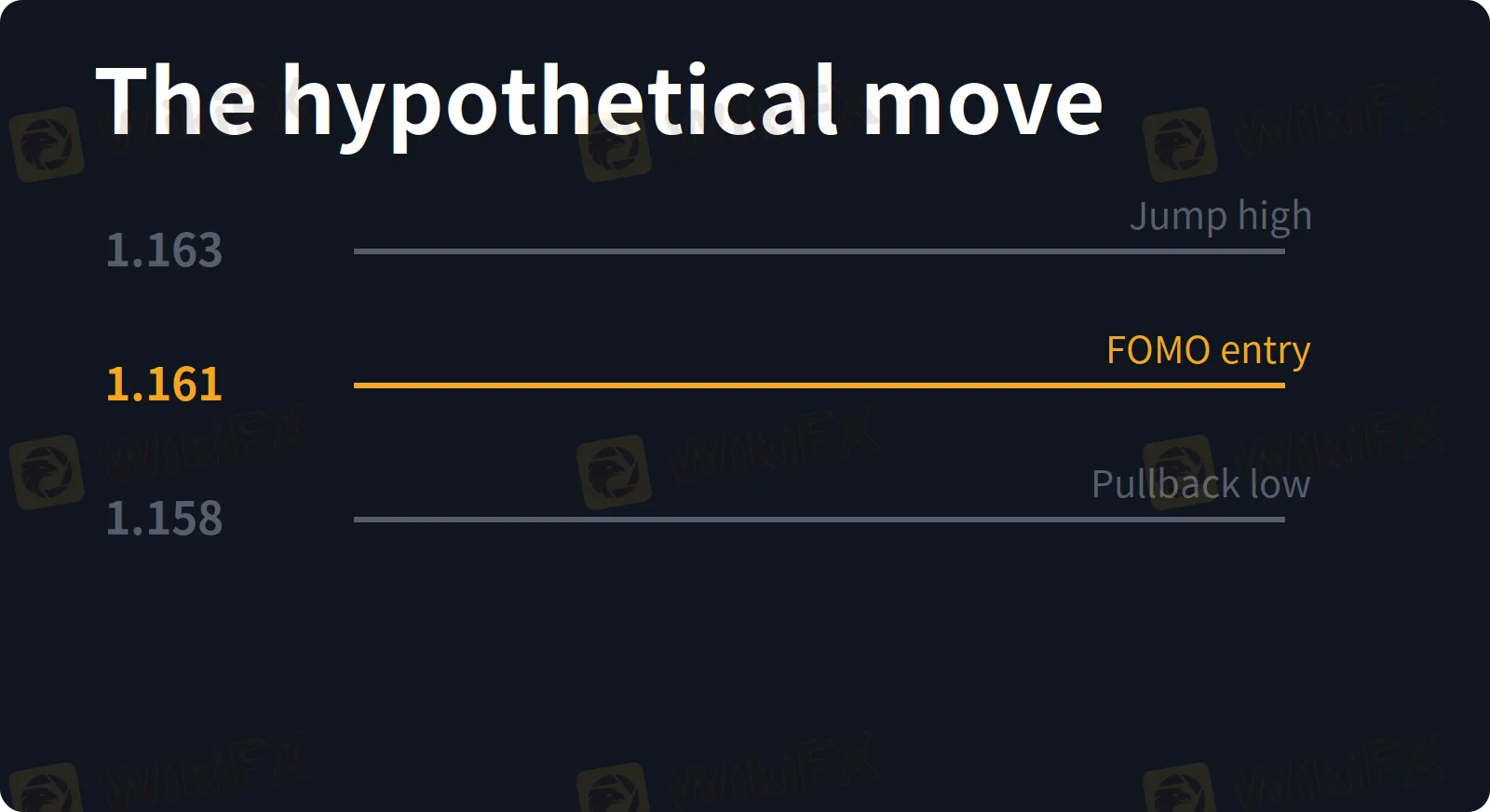
Teaching example only; no market advice.
The FOMO Cycle and a More Useful Habit
The cycle often looks like this: a trigger appears, excitement rises, you make a quick decision, the market moves against you, regret appears, and the next trigger feels even louder. Breaking the loop is not about promising to never feel FOMO. It is about widening the space between the feeling and the action.
- Name the feeling: “I am about to enter because I feel left out, not because my analysis says so.”
- Write down one thing you would say to a friend who described the exact same situation to you.
- If you keep a journal, record your emotional state before the trade, not just the price and the risk.
Self-observation will not make FOMO vanish. It will make it familiar, and familiarity is a kind of buffer. The more clearly you see the pattern, the less likely you are to hand it the keyboard. That is a skill worth keeping, no matter how the market moves.
WikiFX Broker
Latest News
What Your Trading Journal Really Reveals About Your Behaviour
WikiFXSygnum Global FCA Warning: Check sygnumglobal.co Before You Send Money
WikiFXFOMO in Forex: Why a Missed Move Feels Like a Real Loss
WikiFXSaracenMarkets Review 2026: Regulation, High Leverage, and Mixed User Signals
WikiFXHF Market Review: A CySEC Clone Warning and an Unreachable Website
WikiFXRupee Holds Near 95.70 as RBI Support Meets Oil Risk
WikiFXFIX API Forex in 2026: The Broker Integration Questions That Matter After the Connection is Live
WikiFXEMIRAX MARKETS Review: Withdrawal Blocks, Suspended Login Access, and a High-Risk Broker Warning
WikiFXCapital Street FX Review: Is Your Deposit Safe?
WikiFXFXGT Review 2026: Withdrawal Rejection, Profit Deduction & Slippage Complaints Surface Online
WikiFXRate Calc

